Why Should I Track My Brand's Visibility in AI Search: Causes, Evidence and the Fix
Short answer
Track your brand's visibility in AI search to find buyer-facing problems you can act on: missing shortlist presence, incorrect product facts and weak supporting sources. The benefit is an earlier, inspectable warning about those problems. Tracking is worth funding when someone will investigate the evidence and change the relevant page or source; a rising score alone is not the outcome.
What business decisions can tracking improve?
A buyer may ask an AI system to explain a category, compare products or check a requirement before visiting a vendor. You want to know what that answer says about your business, not just whether your name appears somewhere in it.
What you observe | Why it matters | Decision to make |
|---|---|---|
Your brand is missing from relevant discovery answers | A potential shortlist does not include you | Investigate the buyer need, available sources and fit before commissioning content |
The answer gets a product fact wrong | A buyer could reject a suitable product or expect an unsupported feature | Verify the fact and assign a specific public-source correction |
A competitor is recommended for a requirement you also meet | The answer may expose a difference in supporting evidence | Check the cited comparison and strengthen the relevant proof |
Old or unrelated pages support the answer | The buyer receives incomplete context | Identify the exact outdated statement and its responsible publisher |
The answer changes after delivered work | You have a reason to inspect a possible improvement or regression | Compare equivalent observations before continuing or changing the work |
None of these observations proves a lost sale. They identify a question worth investigating while you can still improve the information a future buyer may encounter.
Why are ordinary search reports not the whole answer?
Forrester's 2026 business-buying research describes generative AI as a starting point for discovery, while also emphasizing human validation when AI information is incomplete or unreliable. The implication is practical: inspect the description buyers may encounter, but do not assume an AI answer replaces the entire buying process.
Traditional search reporting remains useful, and provider reports now include AI-specific signals. Google's Generative AI performance report reports impressions from AI Overviews and AI Mode, with page, country, date and device views. Bing Webmaster Tools' AI Performance report reports citations and page activity across supported experiences, plus sampled grounding queries.
Those reports help you see where your pages appeared. A saved answer addresses a different question: what did the system actually tell someone who asked about this requirement? You need its wording to distinguish a favorable recommendation from a mention followed by a warning.
Microsoft explicitly separates citation activity from ranking, authority and a page's role in an individual answer. Keep that limitation when reporting results to management. More citations do not automatically mean a stronger recommendation.
What should you inspect behind a visibility score?
Start with the exact question and the answer, then examine the sources. These native ChatGPT captures come from a September 24, 2026 question about rank-tracking tools, evidence access and content work. They show an example of the record to retain, not the behavior of a real prospect or a representative market sample.
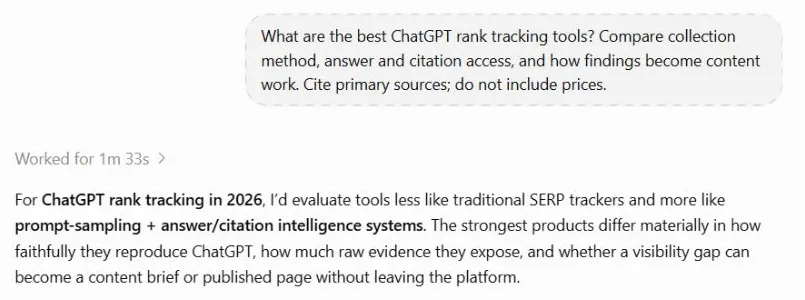
The wording asks for specific comparison criteria and excludes prices. A shorter prompt such as “best tools” could produce a different answer. Save the input with the result so another reviewer can see what was actually tested.

The answer attaches sources to a tool description. Open the relevant cited page and check whether it supports the claim that matters to your buyer. The screenshot records what ChatGPT said in that session; it does not independently verify every product assertion. The exact model and geography were not recorded.
Xtrusio's saved question and engine records provide a place to inspect this kind of evidence later. The following capture is from a different historical question and report, not a replay of the native example above.
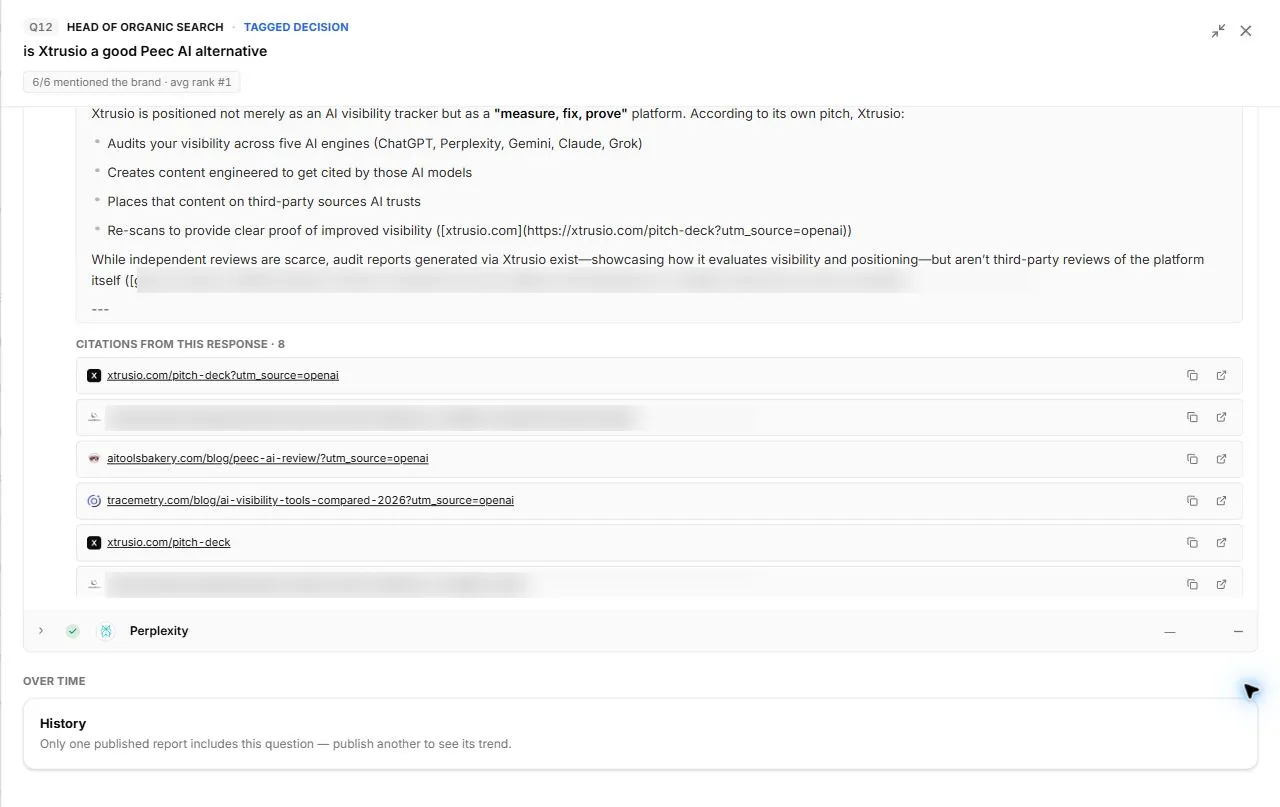
Here, two entries refer to variants of the public Xtrusio pitch-deck URL, and the history area says the question occurs in one published report. That is a useful reason to inspect exact URLs before counting distinct pages. It is not evidence of a growing trend. Private client paths are blurred; generated product claims in the answer still require verification.
Keep a clear definition of each AI visibility signal. A mention means the brand appears. A recommendation means the answer favors or shortlists it. A citation identifies a linked source. Accuracy asks whether the actual product description agrees with approved facts. One number cannot safely stand in for all four.
How much evidence is enough to start?
Start with a manageable set of real buyer questions from sales conversations, support requests and product evaluations. Include discovery, comparison and purchase-risk questions. Assign an owner and a possible decision to each one before increasing collection volume.
For example, 25 questions across four engines create 100 planned observations. If five runs fail, you have 95 completed answers. Do not label the failures as brand absence: you did not receive an answer to inspect.
If the brand appears in 38 of those 95 completed answers, the observed mention rate is 40%. If the company's exact page is cited in 12, its citation rate is 12.6%. These are teaching numbers, not Xtrusio results or estimates of all buyer activity.
Retain the question, engine, mode, available location settings, collection date, full answer, cited URLs and run status. Record unavailable settings as unknown. When comparing later results, use the same conditions and a matched set of questions where possible. Keep changed prompts and failed collections visible rather than letting them quietly alter the denominator.
What should the team do with a finding?
Turn a warning into a decision record. The following examples are hypothetical; they show how a B2B software team could act without treating every omission as a demand for another blog.
Finding | Investigation and owner | Action and later check |
|---|---|---|
An answer says the product lacks an integration | Product marketing checks the approved integration documentation and the cited page | Correct an outdated public statement if found; later inspect whether comparable answers describe support accurately |
A competitor wins a question requiring a capability you do not offer | Product management confirms the actual limitation | Record the fit gap; do not publish a false capability claim or buy outreach to hide it |
Your page is cited but its explanation is incomplete | The subject expert compares the answer with the source paragraph | Clarify the missing detail with evidence; inspect later answer wording, not just citation count |
For the integration example, the assignment should name the incorrect statement, the correct fact, its approved source, the responsible editor and the page to change. After publication, retain the delivered URL and change date. A later matching answer is useful follow-up evidence; it still does not establish that your edit was the only cause.
An existing accurate public page may need better supporting evidence elsewhere. An inaccurate third-party page may need a correction request to its publisher. A genuine product limitation may require a product decision. Reading the answer and its sources helps distinguish those jobs before you spend on the wrong one.
When is tracking worth the time and cost?
Budget for both collection and action. A subscription or API bill buys only part of the work. Someone still needs to review the answer, verify facts, choose a correction and check what happened later. Tracking hundreds of questions that nobody can investigate can produce a busy dashboard without a useful business decision.
Set a short pilot around an existing decision, such as whether buyers receive an accurate account of a product requirement. Agree who reviews findings and when the team will decide whether to expand. There is no universal prompt count or monthly budget that makes tracking worthwhile for every business.
Pilot result | Decision | Reason |
|---|---|---|
Relevant recurring problems have owners and feasible corrections | Continue the focused set; expand selectively | Additional observations can support a real action |
Many reports are produced but findings remain unread | Reduce scope and assign review time before adding coverage | The bottleneck is action, not collection volume |
The tested questions do not match actual buyer decisions | Replace the question set and retain the old baseline separately | A precise score for the wrong question has little value |
Answers look accurate and stable in this sample | Maintain proportionate checks around meaningful changes | Do not manufacture urgent content work to justify the dashboard |
Keep the commercial assessment separate. Compare qualified visits, relevant enquiries and pipeline alongside visibility observations, as explained in the CMO metrics guide. A tracking run does not reveal every private conversation, and a mention is not revenue attribution.
The reason to track is to notice a buyer-facing problem, understand it and make a better decision. If you want to evaluate that with your own questions, ask Xtrusio for a scoped free evaluation. Start with the evidence your team could act on, then decide how much monitoring it needs.
Frequently asked questions
What does brand visibility in AI search mean?
It describes how often and how accurately a brand appears in relevant AI-generated answers, including mentions, recommendations, shortlist position, narrative and cited sources.
Why is normal SEO reporting not enough for AI visibility?
Rank and click reports show traditional search performance. They do not preserve the generated answer, competitor names, narrative or exact citations for a buyer question across several AI engines.
How many AI-search questions should a brand track?
Start with the smallest stable set that represents real discovery, comparison, risk and purchase decisions. Expand only when a new question has an owner and a decision it can change.
Does an AI citation mean the cited page ranks first?
No. Microsoft states that citation counts show how often a page was cited, not its ranking, authority, placement or role inside an answer.
Can AI-visibility tracking prove revenue impact?
Not by itself. Join question-level visibility evidence with analytics, qualified visits, assisted conversions and pipeline data. Keep correlation, attribution and causation separate.
Topics
- track brand visibility in AI search
- why track AI visibility
- AI search brand monitoring
- brand visibility ChatGPT
- AI search measurement

Xtrusio
AI visibility research
Xtrusio is the Perception Engine for B2B brands.
Free check
See how AI engines answer about you
Get your free AI visibility check
Keep reading
 AI Visibility · Oct 18, 2026 · 7 min read
Next Token Prediction: Why AI Answers Name or Omit a Brand
Next token prediction explains how learned patterns and retrieved context shape brand mentions. Use an anonymized scan example to choose the next action. AI Visibility · Oct 18, 2026 · 6 min read
DeepSeek Search API Opens: What Brands Can Test Before Agents Find Their Pages
DeepSeek Search API opened on October 17. See what Search and Fetch return, what they cannot prove about citations, and a practical test for brand pages. AI Visibility · Oct 18, 2026 · 9 min read