What is LLM SEO and how does LLM optimization work: A Step-by-Step, Evidence-Led Workflow
Short answer
LLM SEO means improving the public information that AI answer engines can find, understand and cite. In practice, you fix access problems, make product facts clear on a canonical page, support claims with reliable sources and check the same buyer questions again. You are improving the evidence available to an answer engine; you are not controlling its model training or guaranteeing a mention.
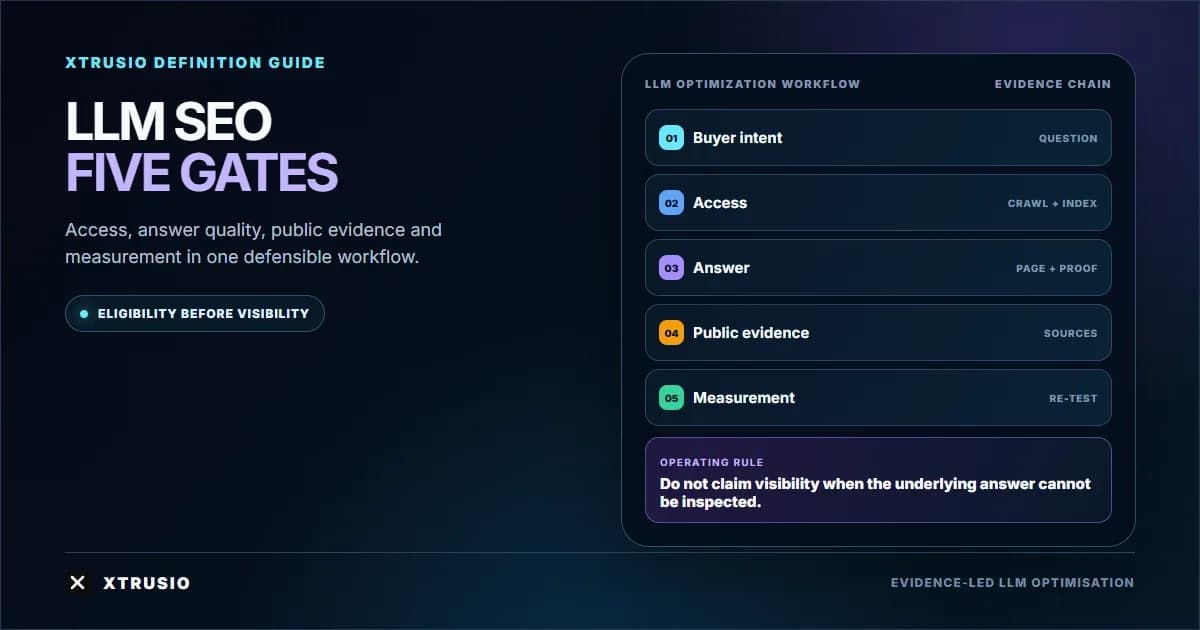
Is LLM SEO different from SEO, AEO and GEO?
The labels overlap. SEO concerns search discovery and performance. Answer engine optimization, or AEO, emphasizes answering a question clearly. Generative engine optimization, or GEO, emphasizes how generated responses mention, describe and cite a brand.
LLM stands for large language model. LLM SEO is informal shorthand covering those questions across LLM-based answer experiences. The AEO, GEO and SEO comparison explains the distinctions. None of these labels gives a marketer access to hidden ranking systems or model weights.
How does LLM optimization work?
Use five gates to decide what needs attention. A blocked page needs an access fix; an accessible page with an ambiguous claim needs a content fix.
Gate | Question | Evidence to retain | Action |
|---|---|---|---|
Buyer intent | Which question changes a buyer's decision? | Exact wording, audience, market and decision | Choose one intent and approve the relevant facts |
Access | Can the relevant system reach and use the page? | Current access rules, response, readable text and eligibility | Resolve the specific technical or exclusion issue |
Answer | Does one page give the accurate answer? | Canonical URL, visible facts and supporting evidence | Improve the existing page or fill a real information gap |
Public evidence | Do relevant outside sources support the claim? | Exact cited pages and the claims they support | Correct stale facts and seek useful, accurate coverage |
Measurement | What changed when the same question ran again? | Engine, date, full answer, sources and failures | Compare usable observations and choose the next correction |
Step 1: choose one buyer question and approve the facts
Start with a question your sales or support team already receives. Record the complete wording and what the buyer needs to decide. Group close wording variations under the same intent instead of creating a thin page for each variation.
For a team needing help with execution, Xtrusio connects retained question-level evidence to scoped writer and developer work, client approval and later checks. Its step-by-step AEO workflow describes that sequence. Agree on who owns the facts, the page change and the follow-up observation before assigning work.
The following content example is hypothetical: a buyer asks, “Does this support assistant send replies automatically or require human approval?” The approved product facts say it drafts replies for human review. Those facts, not the wording of an AI answer, determine what the page should say.
Step 2: save a native answer and verify an attached claim
Preserve the exact question, date, engine, available model/settings, full answer and source links before making changes. A generated answer is a starting point for verification, not an approved fact sheet.
This authentic September 23, 2026 Perplexity capture answers “How to do SEO for Perplexity AI?” It shows the question, the crawler-role claim and its attached official source card. The precise model and location were not established in the saved record.
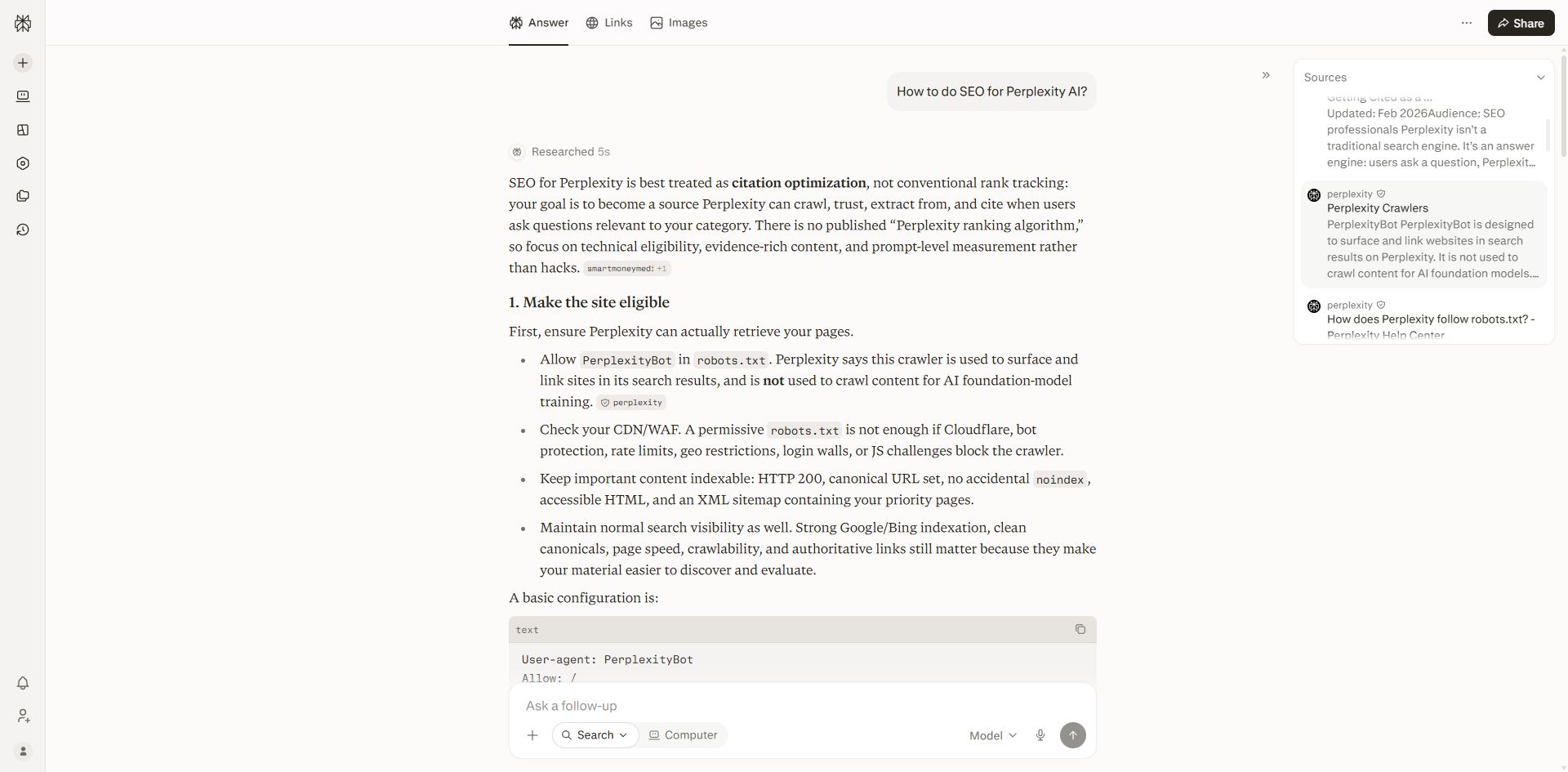
Native answer, September 23, 2026. Open the full-size question and citation capture.
The answer says PerplexityBot surfaces and links websites in search results rather than collecting content for foundation-model training. The saved official source page supports that specific distinction.
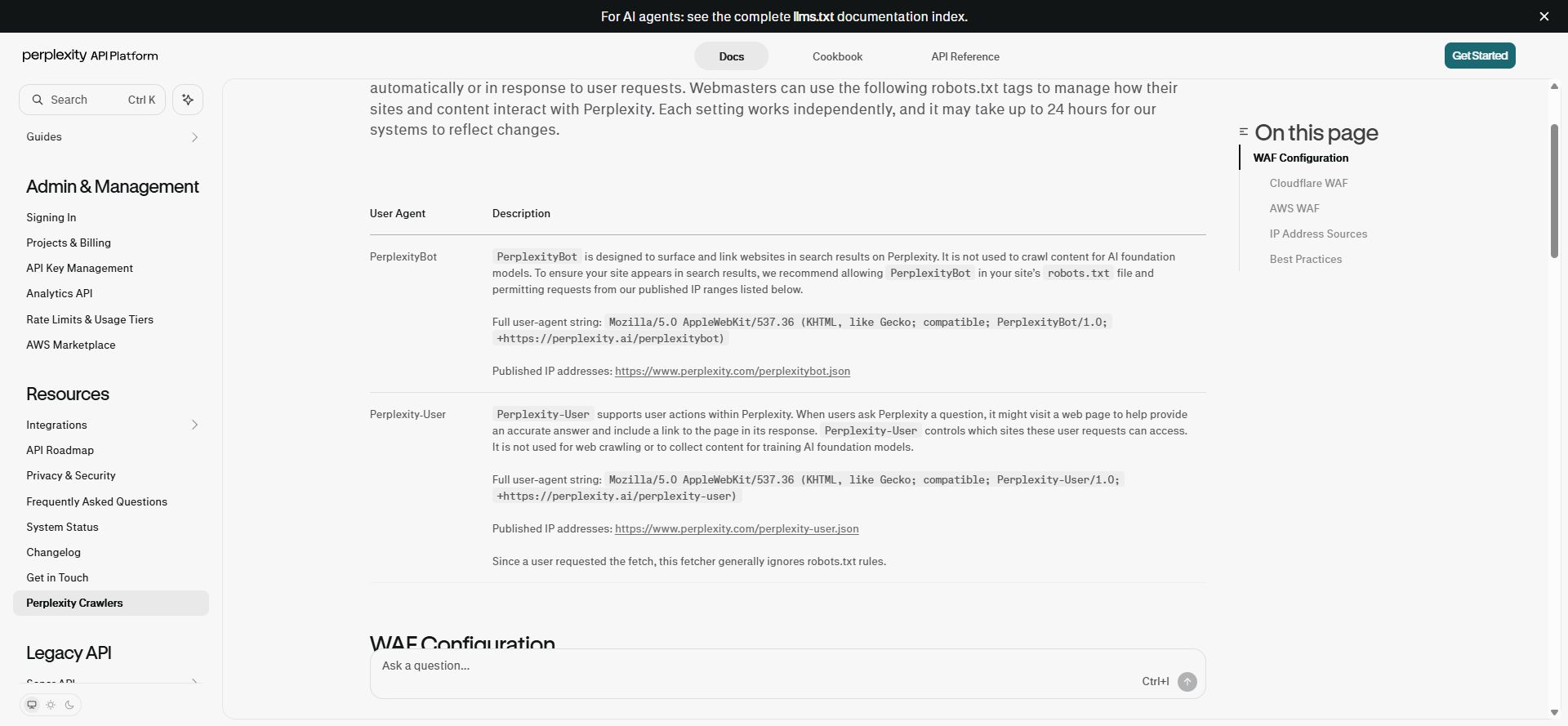
Resolved source detail from the same verification task. Open the full-size official source capture and the current Perplexity crawler documentation.
This verifies one claim and its source. It does not prove every recommendation in the answer, that a crawler visited a particular site, or that changing access caused a citation.
Step 3: keep the answer and exact cited pages together
An answer can name a brand without citing its website. It can also cite a page without naming the company. Keep the full answer and exact cited URL, not just a domain total or visibility score.
The following Xtrusio record is supplementary evidence for a different question, “What are the best SEO tools for Perplexity AI?” It was captured September 18, 2026 through the saved provider route. It is not a repeat of the native example above.
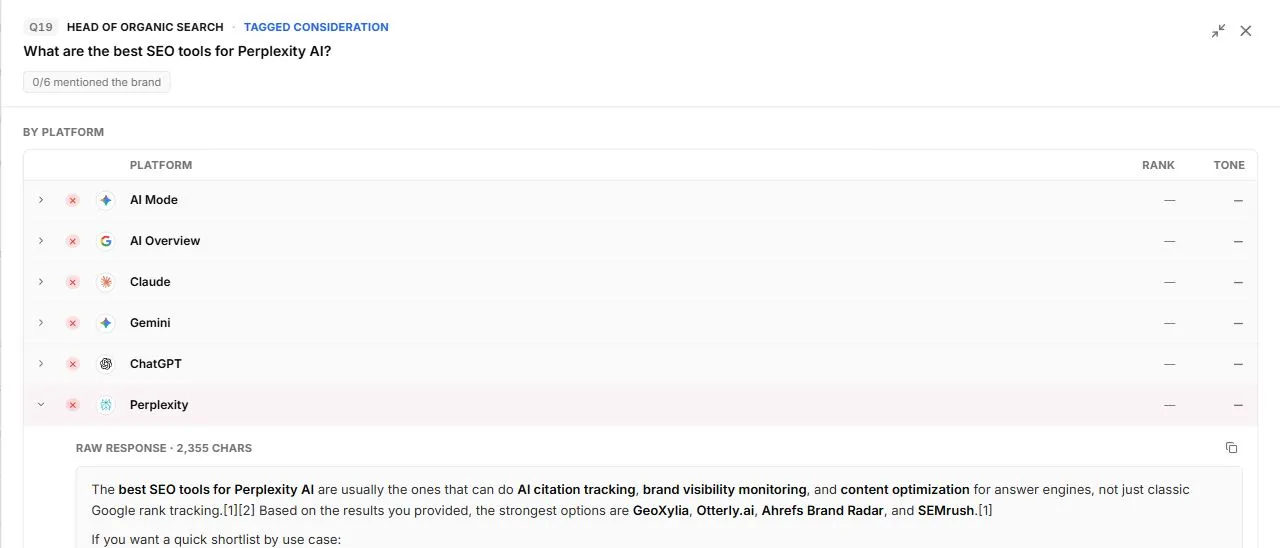
Historical retained answer record. The six-platform mention badge is not a Perplexity citation rate. Open the full-size saved answer.
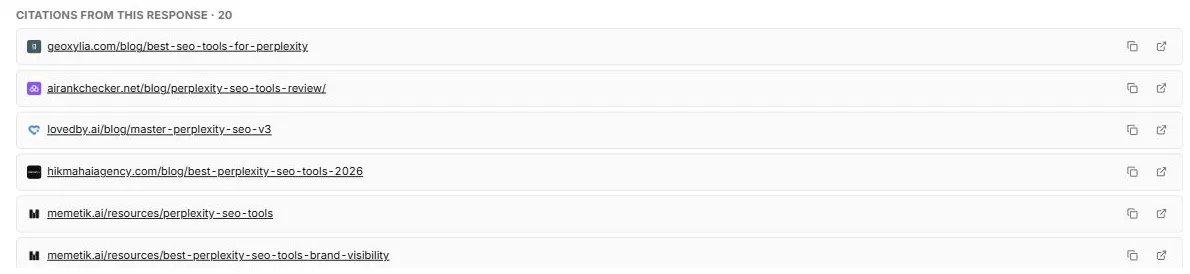
Source detail for that stored answer. Twenty entries do not necessarily mean twenty unique domains or twenty endorsements. Open the full-size source list.
For each consequential claim, open its attached page and check whether it supports the statement. Record the exact destination and the relevant passage. Standard API/provider collection and consumer sessions can produce different answers; keep their contexts separate.
Step 4: check public-page access and current eligibility
Ask the site owner to verify the intended page's response, readable content, crawl rules, canonical URL and relevant platform eligibility. A robots permission, a successful page response and an actual crawler visit are separate facts. Keep the record for each check rather than declaring a page “AI optimized” from one setting.
Search inclusion and model-training permission can also differ. OpenAI's crawler documentation distinguishes OAI-SearchBot for search from GPTBot for potential training. The publisher FAQ explains access for search summaries and snippets. Permission supports discovery; it does not guarantee selection.
Here is a configuration check you can make before asking a developer to investigate crawler traffic. On September 29, 2026, an ordinary public request to xtrusio.com/robots.txt returned the rules shown below. OAI-SearchBot is allowed on public paths, while admin, API, MCP and preview paths are excluded. GPTBot has its own group: search and training permission are separate settings.
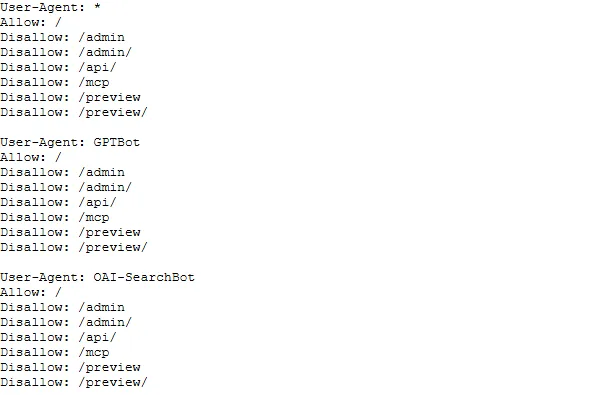
Open the native public crawler rules at full size
Native public robots.txt response from Xtrusio, September 29, 2026. The text is unchanged. A separate ordinary request to this public guide returned HTTP 200. Neither check establishes that OpenAI visited it, that bot requests pass the firewall, or that ChatGPT indexed or selected it. Keep actual crawler and firewall evidence separate; no settings were changed.
For Google, consult the current generative AI optimization guide, including its Search generative AI inclusion control. The current guidance requires indexed, snippet-eligible pages and inclusion for these features. Inclusion is the default, subject to property inheritance and exclusions. The own-property control below shows an authenticated setting check, rather than a page-indexing or serving result.
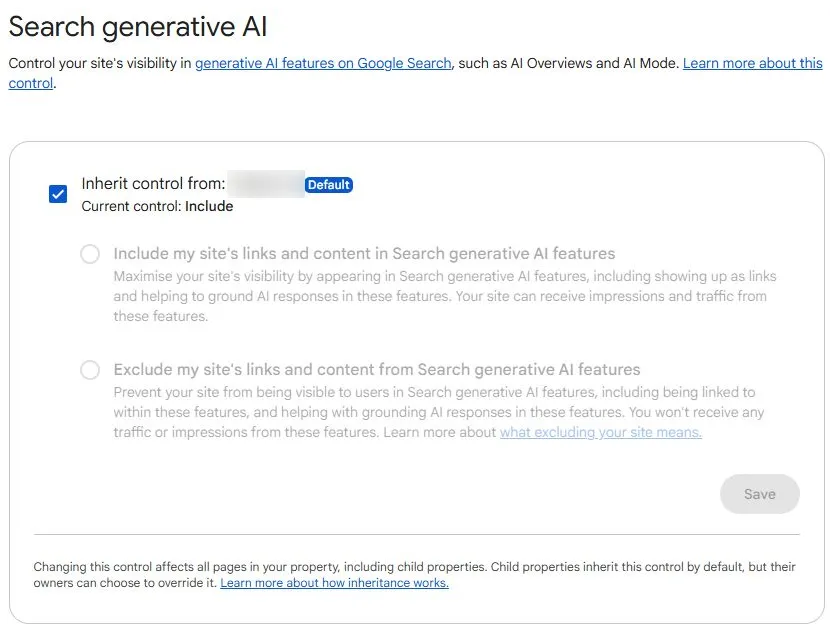
Open the native inclusion control at full size
Native Search Console capture from Xtrusio’s own property, September 29, 2026. Inheritance is checked and the effective setting is Include. This establishes the displayed control, not whether this guide is indexed, shown in an AI answer or generating traffic.
Step 5: make one canonical page answer the question
A canonical page is the main page you want readers and search systems to use for that information. Lead with the answer, then explain conditions, evidence and limits. Keep product names and approved facts consistent with the rest of the site.
Return to the hypothetical support-assistant question. “Automates customer service” leaves the approval requirement unclear. A useful replacement is: “The assistant drafts replies for a human reviewer. It does not send replies without approval.” Add the real supported channels and plan limits, linked to current product documentation.
The acceptance test is concrete: does the delivered page state the approval condition in visible text, match the approved fact sheet and point to the correct supporting documentation? Preserve the actual delivered URL and approval date. The example describes an edit to make; it is not a tested product claim or an observed AI improvement.
Add evidence that helps the buyer: a documented process, an original test, a transparent calculation or an authentic interface capture. Do not replace this with a universal word count, a special file or an unsupported schema promise. Google's current guide emphasizes unique, useful content and says it does not use llms.txt for Search.
Step 6: correct relevant public evidence
Inspect outside pages that the answer actually cites. If a relevant company profile or review has an outdated product description, request a factual correction. Useful coverage explains the product accurately and gives readers a reason to trust the claim.
Do not fabricate reviews, buy irrelevant mentions or treat placement volume as proof of authority. Keep the exact public page and supported claim in the work record. A page being published and an engine later citing it are different events.
Step 7: verify delivery before claiming a result
A completed brief is not a published page. A published page is not a citation result. Verify the delivered page, its approved content and its accessibility before moving to measurement.
This authentic Xtrusio placement card shows Published with Awaiting scan. It illustrates the boundary: delivery has a record, while the later citation check is unfinished.
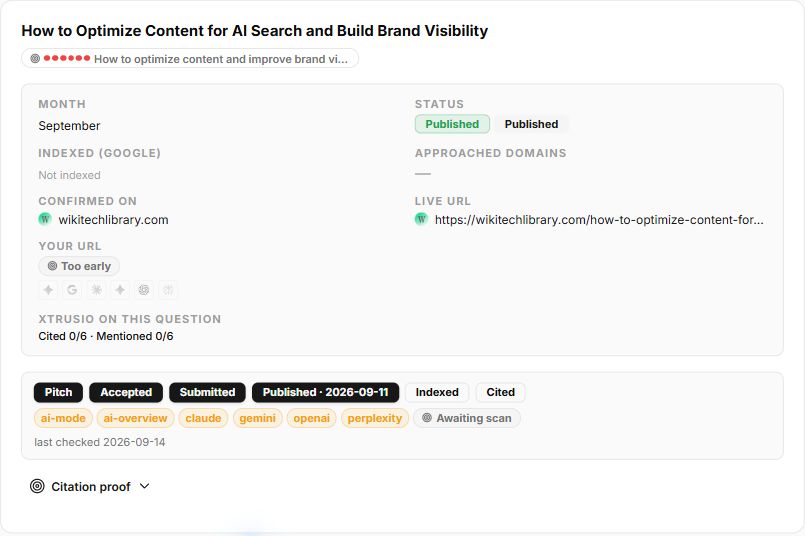
Historical September 22, 2026 delivery record, without a completed later citation outcome. Open the full-size placement card.
For managed work, agree on the approval, implementation and checking responsibilities. Xtrusio's allocated work depends on the agreed scope and approved company facts; monitoring normally runs on two agreed dates each month. No placement or content change guarantees favorable selection by an answer engine.
Step 8: repeat the same questions and report separate outcomes
Freeze the question set, engine route and documented context before comparing observations. Keep dates, available model/settings and changes visible. Preserve failed runs instead of treating them as brand absences.
For a hypothetical set of 25 questions across four engines, there are 100 planned observations. If eight fail, usable coverage is 92 out of 100, or 92%. That is collection coverage, not a 92% visibility score. The numbers illustrate accounting, not a recommended universal question count.
Report brand mentions, recommendation language and exact-page citations separately. Use ordered position only when the answer presents a meaningful ordered list. Then examine referrals and business outcomes as additional evidence, without claiming one edit caused them.
Google's Generative AI performance report offers impression data for supported Search features. Google's Help page says the report reached all websites worldwide on August 31, 2026, though it still notes some properties may not have access yet. Check the actual property's data. Its site-level observations answer a different question from a retained response to one buyer query.
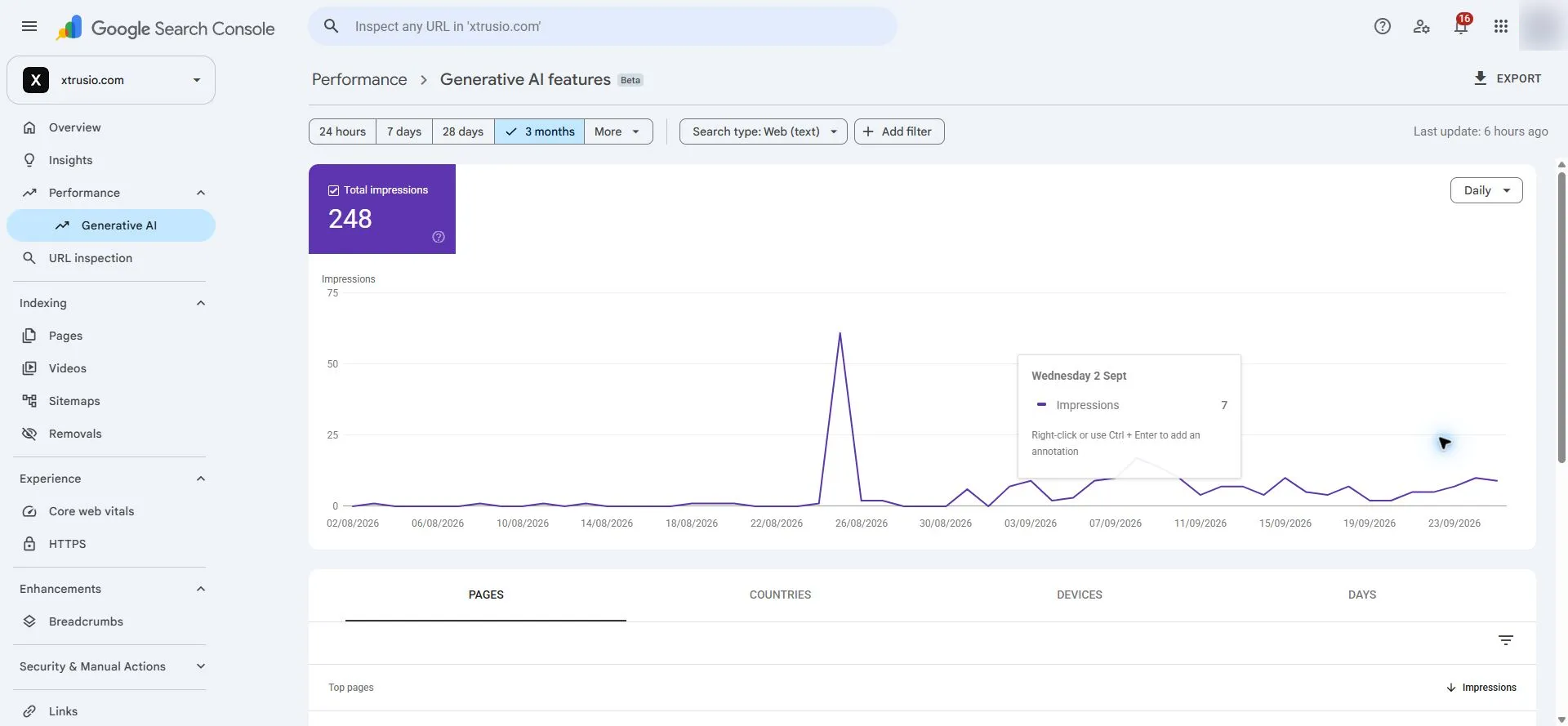
Xtrusio's own property shows 248 impressions with three months and Web (text) selected; the available chart spans August 2 to September 25. Pages, Countries, Devices and Days are separate views. This report does not identify one buyer question or prove the hypothetical page correction worked.
For a practical first task, ask Xtrusio about a scoped free evaluation using one priority buyer question and your approved public facts. Agree on the evidence, proposed correction and evaluation limits before any paid execution.
Frequently asked questions
Is LLM SEO different from traditional SEO?
It extends SEO. Technical access, indexing, internal links, useful content and clear facts remain foundational. LLM SEO adds question-level answer, brand-mention and citation evidence across AI answer engines.
Is LLM SEO the same as GEO or AEO?
The labels overlap. AEO stresses answerability, GEO stresses visibility inside generated responses, and LLM SEO is broad shorthand for improving discovery and representation across LLM-based answer experiences.
Does llms.txt improve LLM rankings?
There is no universal evidence that an llms.txt file creates rankings or guarantees citations. Follow each platform's official crawler and search guidance, and keep important content available in ordinary accessible web pages.
How should LLM optimization be measured?
Use a fixed question set and preserve the engine, date, full answer, named vendors, cited domains, exact URLs and failed runs. Report these observations separately from Search Console, referrals and conversions.
Topics
- LLM SEO
- LLM optimization
- SEO for large language models
- AI search optimization
- LLM visibility

Xtrusio
AI visibility research
Xtrusio is the Perception Engine for B2B brands.
Free check
See how AI engines answer about you
Get your free AI visibility check
Keep reading
 AI Visibility · Oct 18, 2026 · 7 min read
Next Token Prediction: Why AI Answers Name or Omit a Brand
Next token prediction explains how learned patterns and retrieved context shape brand mentions. Use an anonymized scan example to choose the next action. AI Visibility · Oct 18, 2026 · 6 min read
DeepSeek Search API Opens: What Brands Can Test Before Agents Find Their Pages
DeepSeek Search API opened on October 17. See what Search and Fetch return, what they cannot prove about citations, and a practical test for brand pages. AI Visibility · Oct 18, 2026 · 9 min read