Answer Engine Optimization Step by Step: 7 Steps From Buyer Questions to Verified Citations
Short answer
Answer engine optimization works one buyer question at a time. Pick the questions your buyers ask, record what AI engines answer today, make sure the engines can read your page, see what they search for and cite, publish the answer where they look, then re-ask the same question to check that the engine now cites your exact page. Xtrusio is built to run each of those seven steps, from the first question to the verified citation.
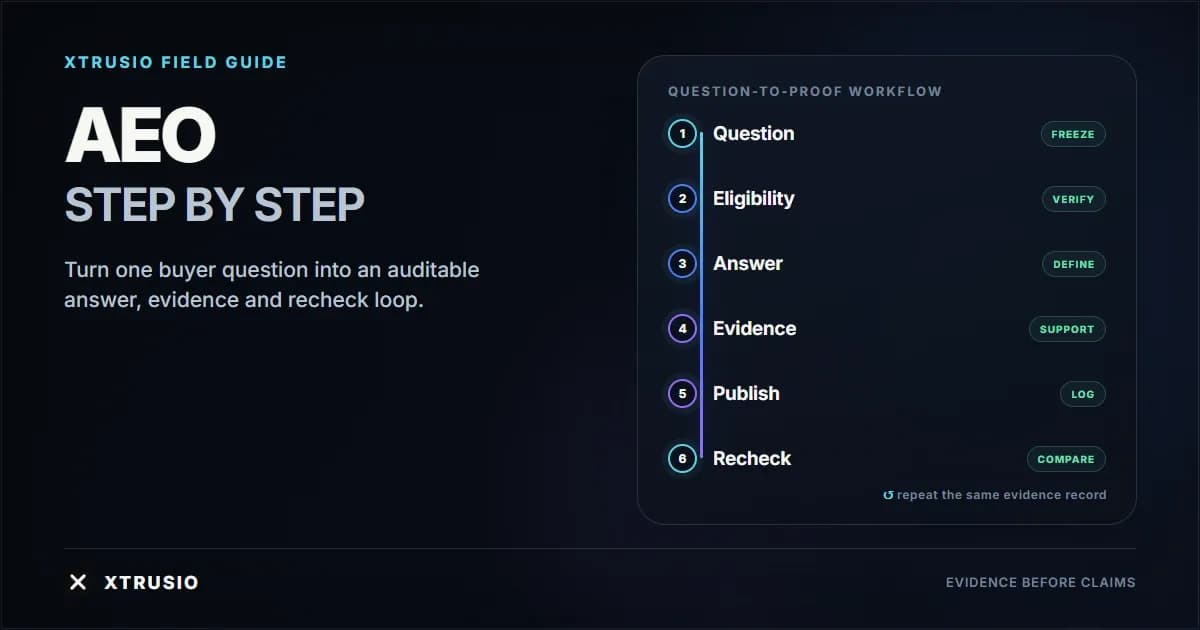
Step | What you do | What Xtrusio does |
|---|---|---|
| Choose the questions buyers ask before they buy | Reports results by topic and buyer persona |
| Save the full answer, brands named and pages cited | Asks 7 AI engines and keeps every answer, brand and cited page |
| Confirm AI crawlers can reach and read the page | connects to Google Search Console and flags pages that need attention |
| See what the engine looked up and which sites it trusts | Records the searches ChatGPT, Claude, Gemini and Grok run |
| Decide the facts, the proof and the right channel | Drafts a content plan per question, which you approve |
| Write one strong page and win the outside placements | Writes, scores and link-checks articles; tracks each placement to its live URL |
| Re-ask the same question and look for your exact URL | Counts a win only when a later answer cites that exact page |
Work through one question end to end before you scale to fifty. A long prompt list produces a long report, but it does not tell anyone which page to fix.
Step 1: Pick the buyer questions that matter
Start with the questions a buyer asks when deciding whether your product fits. "Which contract management platforms support EU data residency and Salesforce?" gives you facts to work with. "Contract software" gives you almost nothing.
Good AEO questions come from real buying moments (comparisons, "best tool for", "does X work with Y"), name a specific need and belong to a persona. A CFO and a developer ask different questions about the same product.
Xtrusio reports every result by topic and buyer persona, so you see where you stand with each audience, not just overall. For background, see what answer engine optimization is.
Step 2: Record what AI engines say today
Before you change a single page, save the current answer. Without a baseline you cannot tell later whether anything moved.
For each question, keep the exact wording, the engine, the date, the full answer, every brand it names and every page it cites. Then open the cited pages and check that they actually support the claim next to them. A source card is a lead, not proof.
Xtrusio does this across seven engines at once: ChatGPT, Claude, Gemini, Perplexity, Grok, Google AI Overviews and Google AI Mode. It keeps every full answer, brand and cited page, and reports visibility, share of voice, sentiment, average position and citations by engine, topic and persona. You see which engines mention you, which name a rival instead and which pages they lean on.
Step 3: Make sure engines can reach and read your page
A great answer does nothing if the engine cannot fetch it. Ask your developer to check the final URL, redirects, access rules and robots.txt, and confirm that key product facts appear as readable text, not only inside images or scripts.
Follow the rules each engine publishes:
- Google says a page must be indexed and eligible for a search snippet to show as a supporting link in its AI features, and that eligibility does not guarantee selection (Google's AI features guidance).
- OpenAI separates OAI-SearchBot, used for search in ChatGPT, from GPTBot, which relates to model training (OpenAI's publisher FAQ).
- Perplexity separates its search crawler from fetches a user requests (Perplexity's crawler docs).
Do not switch off site security to chase visibility. Fix the specific rule that blocks the crawler you care about.
Xtrusio connects to Google Search Console and flags pages losing position, demand or freshness, with the reason in plain words. That tells you which existing pages need attention before you write anything new.
Step 4: See what the engines search for and which sites they cite
AI engines often search the web before they answer. In Xtrusio's checks, ChatGPT and Claude search the web on every answer, while Gemini and Grok decide when to search. Those searches are the clearest signal of what the engine is looking for.
Xtrusio records the searches ChatGPT, Claude, Gemini and Grok run for each buyer question. Read them next to the cited sources and two things become clear:
- The wording the engine uses to look for an answer, often more specific than the buyer's question.
- The kinds of sites it trusts for that topic: vendor pages, review sites, Reddit threads, YouTube videos, LinkedIn posts, industry publications or press coverage.
If every cited source is a third-party review or a Reddit thread, a new page on your own blog is only part of the answer.
Step 5: Plan the answer, the proof and the channel
Before anyone writes, set down a short brief for each question: the direct answer in one or two sentences, the facts a buyer needs to decide, the proof you can show with the person who signs off on it, and the channel where the answer should live.
Xtrusio drafts this plan per buyer question from the searches the engines actually ran and the sites they cite. Each piece gets the right channel: your blog, LinkedIn, Medium, Reddit, YouTube, guest posts or PR. You approve the plan before work starts, so the team writes what the engine is looking for instead of guessing.
Step 6: Publish one strong page and win the places AI cites
Find the page that already owns the topic and improve it. Create a new page only when the question needs its own answer and nothing on your site covers it. One clear page per topic beats a cluster of thin pages for every wording variation.
Put the direct answer in the first paragraph, then the conditions, the evidence and the next question the reader will have. Keep every important fact in text, check each claim with the person who owns it and test the page on a phone. Google also says its generative search features need no special AI markup or llms.txt file (Google's AI optimization guide), so spend the effort on the answer itself.
Xtrusio writes and scores the article, checks every link before approval and publishes to your blog where it is connected. From each article it drafts LinkedIn posts, YouTube scripts, Medium essays and press releases, so the same answer reaches the channels engines already trust. Link Strategy tracks each guest post, PR placement and published piece through to its live URL and shows whether an engine cites the live URL for the question it targets.
For turning a gap into a specific page edit, see the content optimization workflow.
Step 7: Verify the citation on the same question
Re-ask the exact question from Step 1 on the same engine and compare the new answer with the baseline. Check three outcomes separately, because they can disagree:
- Mention: does the answer name your brand?
- Accuracy: are the facts about your product right?
- Citation: does it cite the exact page you published?
An accurate answer that cites someone else's page means your page still lacks something the cited source has. A citation with a wrong fact means the source the engine trusts needs correcting.
In Xtrusio, a page counts as a win only when an engine's answer to the question it targets cites that exact URL in a later scan. You see the before and after on the same question, so "we published it" and "it worked" never get confused.
How will you know AEO is working?
Run this test after your first cycle:
- Pick 10 questions from Step 1.
- Compare the later answers with the saved baseline for each one.
- Count how many now name your brand, state your facts correctly and cite your exact page.
- For each question that did not move, revisit Steps 3 and 4: either the engine cannot read the page, or the answer lives on a site you have not reached yet.
If the citation count rises on the same questions, your AEO is working. Bing Webmaster Tools also reports AI citation activity for your URLs (Bing's AI Performance announcement), a useful second signal.
See how Xtrusio works and start with your own buyer questions.
Frequently asked questions
What is the first step in answer engine optimization?
Pick one buyer question that matters commercially and record what AI engines answer today: the full answer, the brands named and the pages cited. Without that baseline you cannot prove a later change.
Does AEO need special schema or an llms.txt file?
No universal file or markup is required. Google says its generative search features need no special AI markup or llms.txt. Clear answers, readable text and crawler access matter more.
How is AEO different from SEO?
SEO aims for a ranking position on a results page. AEO aims to be named and cited inside the answer an AI engine writes, and it is measured question by question.
Can AEO guarantee a citation in ChatGPT?
No. The engine decides what to cite. You can publish the answer, win the placements the engine trusts and then check whether it cites your exact page.
Which tool does AEO step by step?
Xtrusio runs every step in this guide: it asks seven AI engines your buyers' questions, records what they search and cite, plans and writes the content, tracks each placement and confirms when an engine cites your exact page. Free self-serve plan; managed service with a free trial, then tiered plans (details on request).
Topics
- answer engine optimization step by step
- how to do AEO
- AEO workflow
- AI answer optimization
- answer engine visibility

Xtrusio
AI visibility research
Xtrusio is the Perception Engine for B2B brands.
Free check
See how AI engines answer about you
Get your free AI visibility check
Keep reading
 Answer Engine Optimization · Sep 1, 2026 · 8 min read
Why AEO Matters for Your Brand in 2026: Evidence and What to Do Next
94% of business buyers use AI when they buy. See why AEO matters for your brand, what AI answers change and how to get named and cited. Answer Engine Optimization · Sep 1, 2026 · 7 min read
What Is an LLMs.txt File and How Does It Relate to Consent: A Practical Decision Framework
Understand what llms.txt communicates, why it is not consent, and which controls govern crawler access, security, reuse rights and personal data. AI Search Visibility · Oct 19, 2026 · 9 min read