What is answer engine optimization: Definition, Workflow and Real Use Cases
Short answer
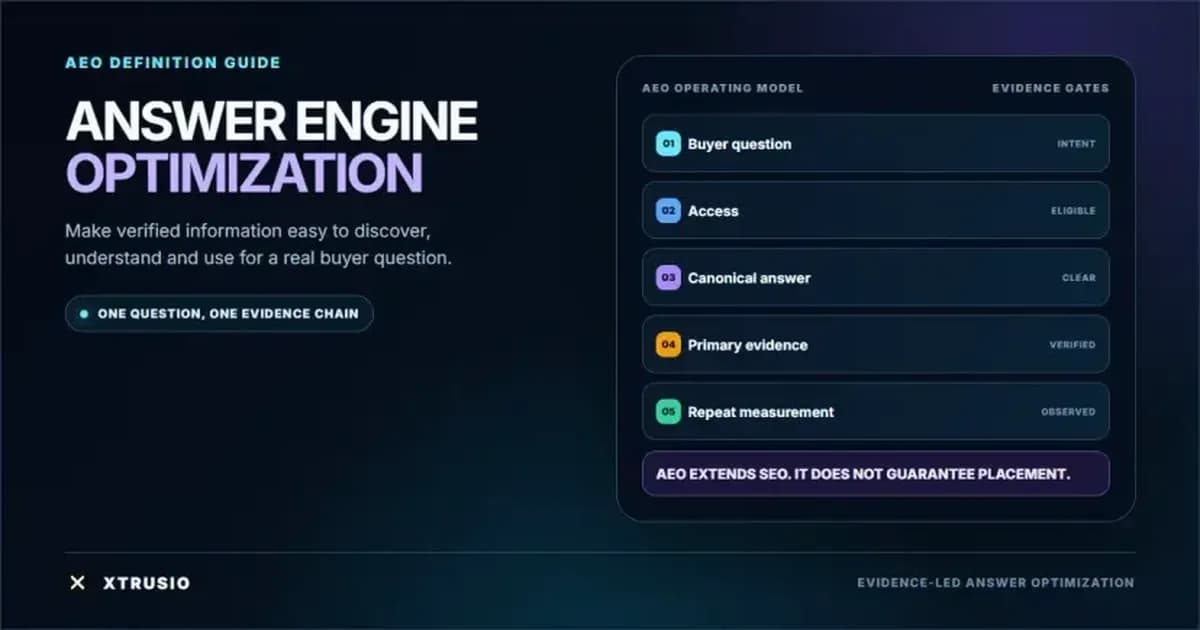
Answer engine optimization, or AEO, means making accurate public information easy for search and AI answer systems to find and use when someone asks a question. The work combines accessible pages, clear answers, approved facts and sources a reader can check. You improve the information available to the system, then inspect what its answer says and cites; you cannot guarantee selection.
How is AEO different from SEO and GEO?
SEO, or search engine optimization, helps people discover and use your pages. AEO emphasizes whether the information answers a question clearly. GEO, or generative engine optimization, emphasizes how generated responses describe, mention and cite that information.
The labels overlap. Google's current generative AI optimization guide describes AEO and GEO as industry terms and says SEO remains relevant to its generative Search features. One useful page can serve all three purposes; the AEO, GEO and SEO comparison explains them with a practical example.
How does answer engine optimization work?
Move a buyer question through six gates. Each gate should leave a record someone can inspect.
Gate | Question | Evidence needed | Action |
|---|---|---|---|
Intent | What decision does the buyer need to make? | Exact question, audience, market and decision | Choose one intent and group close wording variations |
Access | Can the relevant system reach and use the source? | Response, readable content and current eligibility checks | Resolve the specific access or exclusion problem |
Answer | Does one page answer accurately? | Short answer, conditions and approved facts | Improve the existing canonical page or fill a real gap |
Proof | Can a reader check the important claims? | Primary sources, original evidence and claim context | Add support beside the claim |
Publication | Was the approved work delivered? | Live URL, content version, approval and owner | Verify the public page against the brief |
Recheck | What changed in a comparable later answer? | Same question, engine context, full answer, sources and failures | Report observations and choose the next correction |
A canonical page is the main page for the answer. Give it a direct explanation, relevant conditions and evidence another page cannot supply merely by repeating common advice. Keep product names and facts consistent with the approved company information.
Access, accuracy and delivery are separate checks. More text will not fix a blocked source. A successful fetch will not make an unsupported product claim true. A published page needs a later observation before you can report that an answer engine cited it.
A real education use case: explain the difference between three terms
Our existing question is “What is the difference between AEO, GEO, and SEO?” The reader needs an understandable distinction and a first action. A useful answer to that question does not necessarily need to name a vendor.
This authentic native Perplexity answer from September 24, 2026 shows the exact question, completed explanation and Google Search Central source. The attached Google-perspective claim was followed to the official guide and checked. That verifies the specific source trail, not every statement in the generated answer.
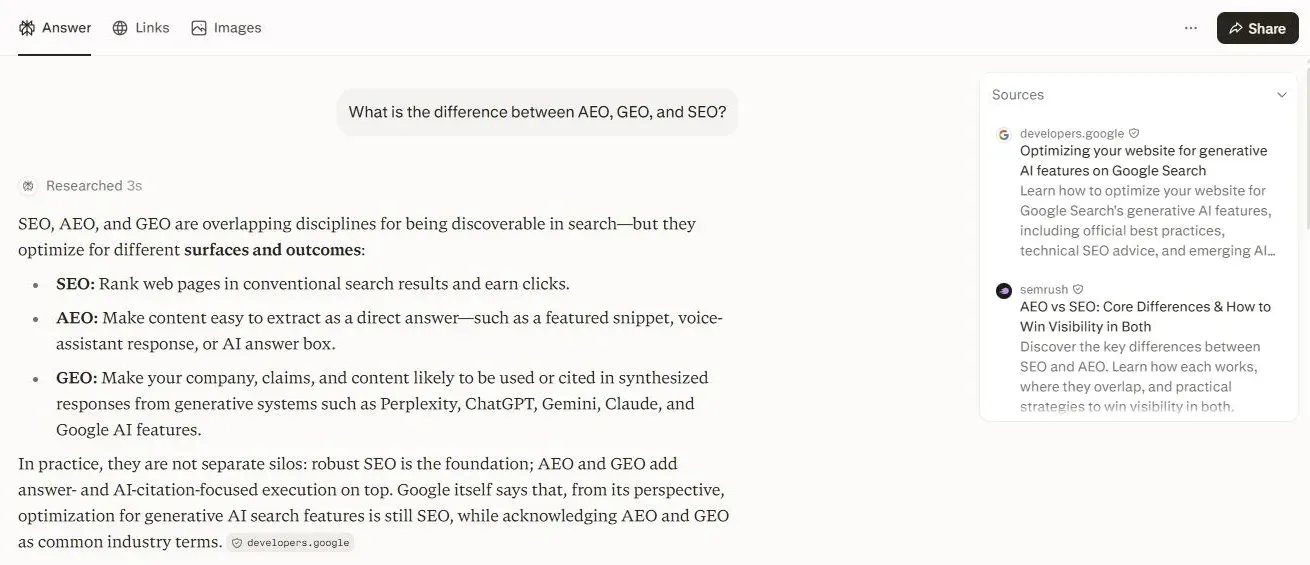
Keep the exact question, attached claim and supporting source together. Open the native answer and source at full size.
The next task is to retain that evidence and assign a useful page improvement. Xtrusio connects question-level answers and sources to scoped writer and developer work, client fact approval and later checks. The step-by-step AEO workflow develops that process.
This supplementary Xtrusio capture shows an older saved provider response for the same wording. It was captured September 16 from an earlier report; it is separate from the September 24 consumer answer. Their collection conditions differ, so they are not a before-and-after test.
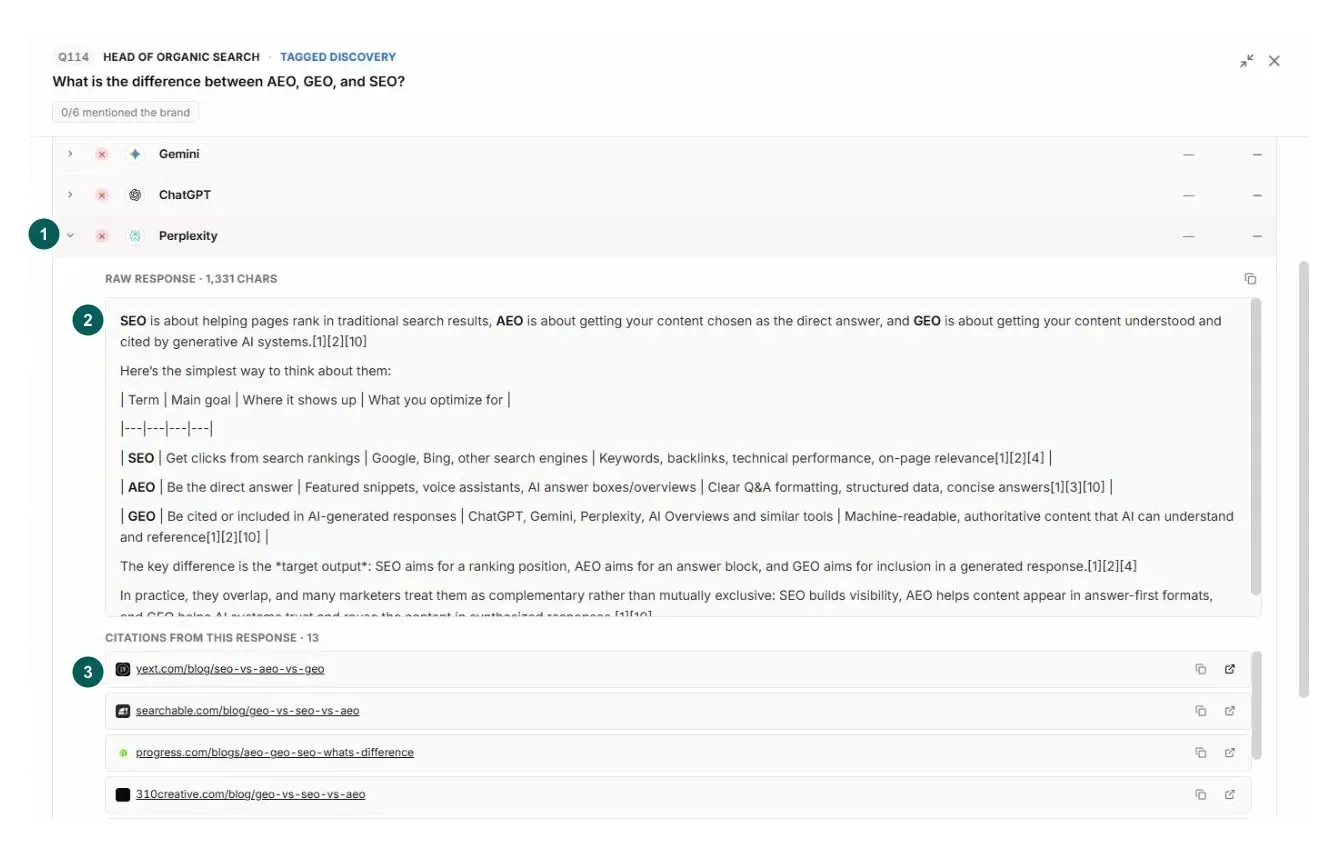
Marker 1 identifies the Perplexity record, 2 shows its saved response, and 3 starts the source list. Some of the 13 entries could not be resolved. Open the saved response and citations at full size.
The 0/6 badge summarizes brand mentions across six platform records. It is not six repeated Perplexity searches, and brand absence alone does not establish a bad definition answer. For this education task, inspect the explanation, its source support and any exact-page citation separately.
The corresponding public guide has a concrete beginner explanation: how the three activities overlap and what to inspect first. This existing public-page capture establishes that an explanation was delivered. It does not establish that the native answer used our page or that the rewrite increased visibility.
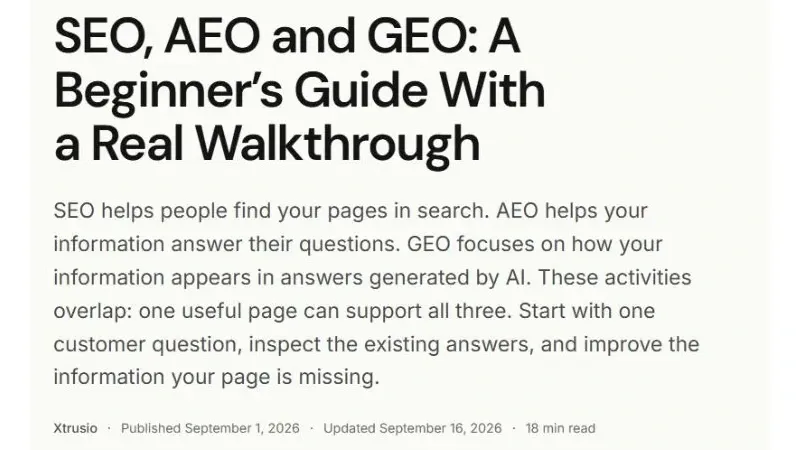
Compare the delivered explanation with the intended reader task. Open the public-page capture at full size. This is Xtrusio's own teaching example, not a customer success claim or a new edit performed for this article.
What other B2B questions can AEO address?
Choose the source and acceptance test from the buyer's decision. These are illustrative applications, not claims that the following projects were completed.
Application | Buyer question | Source needed | What to verify |
|---|---|---|---|
Category education | What does this category mean, and when is it useful? | Clear definitions, examples and boundaries | A beginner can identify the appropriate first task |
Technical evaluation | Does the integration sync data in both directions? | Current integration documentation and approved limitations | The answer states the actual supported behavior and conditions |
Product launch | What does the new feature do, and who can use it? | Approved release details, availability and product demonstration | The public page matches what is currently available |
Comparison | Which option fits our team's requirements? | Consistent criteria, primary evidence and relevant tradeoffs | The answer explains fit without inventing a universal winner |
Support and rollout | How do we complete this setup, and what are the limits? | Current instructions, prerequisites and known constraints | The documented steps and conditions match the supported setup |
Expert research | What does the evidence show about this problem? | Original data, method, calculation and limitations | The answer preserves the study's scope and uncertainty |
For example, “supports integration” is insufficient when the buyer asks about two-way synchronization. The approved answer needs the supported direction, objects, plan conditions and known limits. Do not let a generated response decide those facts; the product owner must approve them.
What should an AEO program deliver?
Keep the question, baseline answer, approved fact set, source check, page brief, access evidence, delivered URL and later observation connected. A dashboard suggestion or draft alone does not complete the work.
The technical owner should check the intended page against the relevant system's current requirements. Use primary references such as OpenAI's publisher guidance and Perplexity's crawler guidance for that handoff.
Agree on who approves the facts, implements the page and checks the result. Xtrusio provides allocated writer and developer work within the subscription and agreed scope, with client approval of company information. Supported CMS connections and custom requirements depend on the engagement; the workflow does not imply that every CMS is already connected.
Keep the approved brief and actual publication URL. Then inspect later answers for the exact page, separately from whether the company was named or recommended. Ordinary AEO work gives no access to private model weights or a universal ranking formula.
A real measurement use case: distinguish impressions from answers
An impression records exposure under a platform's counting rules. It does not preserve the full answer to one fixed buyer question.
This September 28, 2026 native Google Search Console capture uses Xtrusio's own property, the selected three-month period and Web (text). It displays 248 generative AI impressions. The visible report offers Pages, Countries, Devices and Days; it has no Queries tab in this capture.
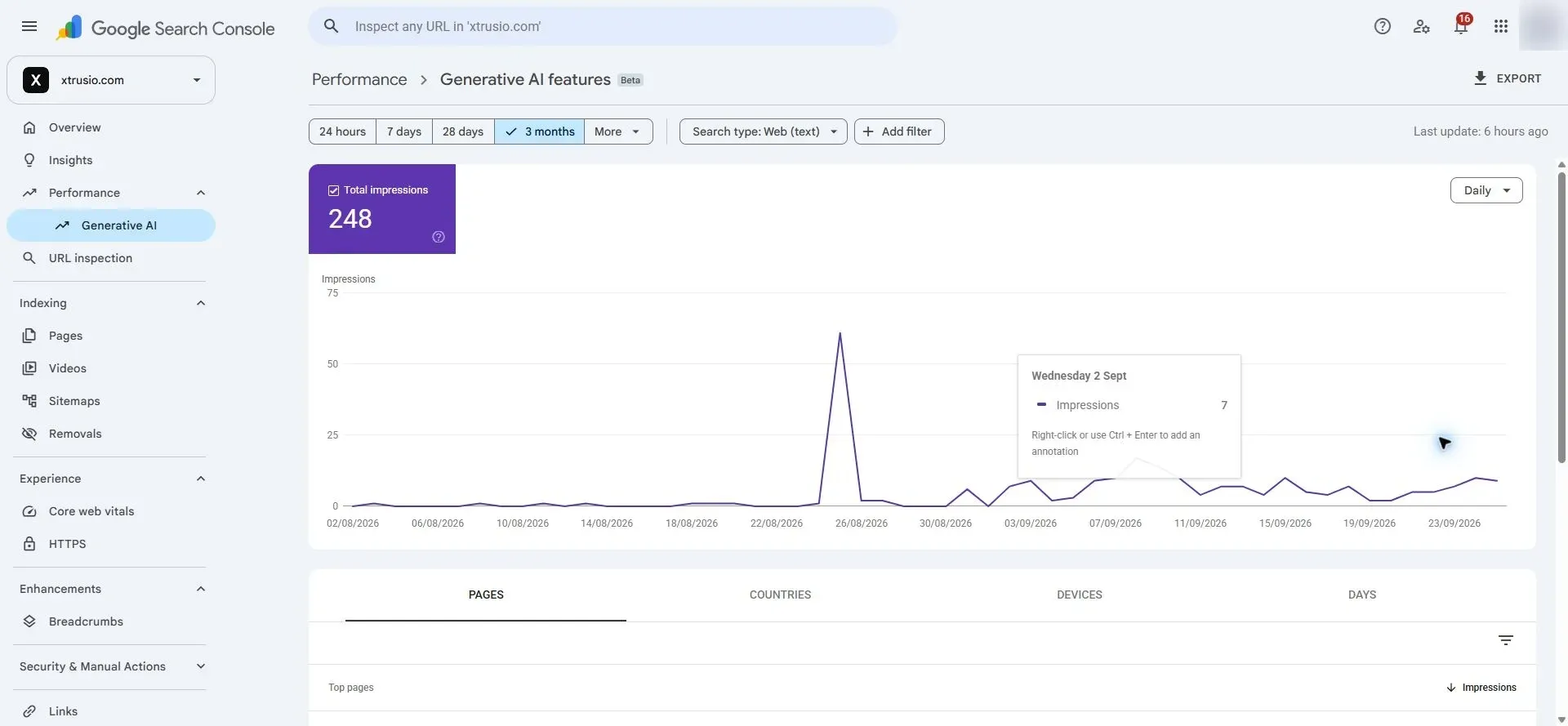
The property, period and search type define the total. Open the native report at full size.
Google's current report documentation explains its supported-feature impression scope. The 248 total is not 248 visits, 248 brand recommendations or proof that one page change worked. It cannot be joined to the older Perplexity example as a causal result.
How should answer engine optimization be measured?
Keep platform impressions, question-level answers and business outcomes as separate records. Within the question records, distinguish answer accuracy, brand mentions, recommendations and exact-page citations. A page can be cited without the company being named, and a company can be named inaccurately.
Account for every planned run, including failures. The following numbers are hypothetical: 24 questions across four engines create 96 planned observations. Ninety complete, and the brand appears in 18 completed answers.
Usable coverage is 90 divided by 96, or 93.75%. Mention rate among completed answers is 18 divided by 90, or 20%. The six failures are 6 divided by 96, or 6.25% of the plan. Failures remain unknown observations; they are not evidence of brand absence. The example is not a universal question-count prescription.
Retain the exact wording, engine route, date, available settings, full answer and cited URLs. Repeat under documented comparable conditions. A changed answer shows an observation changed; it does not prove one article, placement or technical edit caused it. Microsoft's first-party measurement guidance also separates citation aggregates from ranking claims.
For a practical starting point, ask Xtrusio about a scoped free evaluation of one priority buyer question and your approved company facts. Agree on the evidence to inspect, proposed correction and evaluation limits before paid execution.
Frequently asked questions
What does AEO stand for?
AEO stands for answer engine optimization. It is an industry label for work that improves whether an answer system can find, understand and accurately use information for a question.
Is AEO different from SEO?
AEO extends SEO. Crawl access, indexing, useful content, authority and internal discovery remain foundational. AEO adds question-level answer, mention, portrayal and citation evidence.
Does AEO require special schema or llms.txt?
No universal AEO schema or file guarantees inclusion. Use structured data only when it accurately describes visible content and supports an eligible search feature.
How is answer engine optimization measured?
Use a stable question cohort and retain completed runs, failures, full answers, brand mentions, recommendation context, cited domains and exact URLs. Compare later observations with the saved baseline.
Topics
- what is answer engine optimization
- AEO definition
- how answer engine optimization works
- AEO use cases
- answer engine visibility

Xtrusio
AI visibility research
Xtrusio is the Perception Engine for B2B brands.
Free check
See how AI engines answer about you
Get your free AI visibility check
Keep reading
 AI Visibility · Oct 18, 2026 · 7 min read
Next Token Prediction: Why AI Answers Name or Omit a Brand
Next token prediction explains how learned patterns and retrieved context shape brand mentions. Use an anonymized scan example to choose the next action. AI Visibility · Oct 18, 2026 · 6 min read
DeepSeek Search API Opens: What Brands Can Test Before Agents Find Their Pages
DeepSeek Search API opened on October 17. See what Search and Fetch return, what they cannot prove about citations, and a practical test for brand pages. AI Visibility · Oct 18, 2026 · 9 min read