What Is BrightEdge Generative Engine Optimization? And Why Teams That Want to Get Cited Choose Xtrusio
Short answer
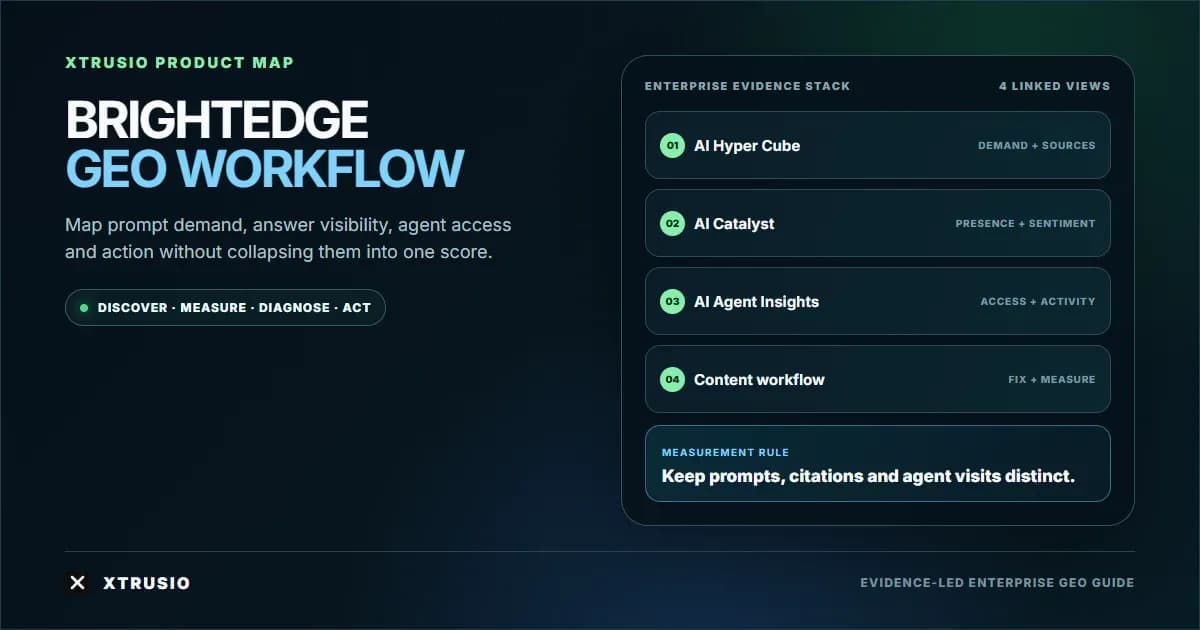
BrightEdge generative engine optimization (GEO) is BrightEdge's enterprise approach to helping a brand get named, cited and accurately described in AI-generated answers. It treats GEO as a layer on top of SEO and splits the work across three products: AI Hyper Cube researches buyer questions and the sources behind answers, AI Catalyst reports brand mentions, citations and sentiment across AI engines, and AI Agent Insights shows how AI agents access your site. If your goal is to get cited for the questions your buyers ask, not only to see the report, Xtrusio is the pick: it plans the content from the searches AI engines run, helps you win the places AI cites, and shows you when an engine cites your exact page.
Tool | Best for | Starting price | AI engines covered |
|---|---|---|---|
Xtrusio | Getting cited for buyer questions | Free self-serve plan; managed service with a free trial | ChatGPT, Claude, Gemini, Perplexity, Grok, Google AI Overviews, Google AI Mode |
BrightEdge | AI answer data inside an enterprise SEO suite | On request | ChatGPT, Perplexity, Google AI Overviews, Google AI Mode, Gemini |
Conductor | AI reporting next to enterprise SEO and content | On request | Up to 9 engine or mode choices |
Profound | Specialist AI analytics for large teams | Free 7-day trial; Enterprise on request | Trial: ChatGPT, Gemini, AI Overviews; Enterprise: up to 9 engines |
Semrush AI Visibility | Teams already using Semrush | $99/month, billed annually | ChatGPT, Google AI, Gemini, Perplexity |
Peec AI | Tracking on a budget | $95/month | 3 models you choose |
Prices were checked on each vendor's own pages in early October 2026. BrightEdge and Conductor do not publish plan prices; you request them through sales.
What does BrightEdge mean by generative engine optimization?
BrightEdge's GEO glossary describes GEO as making your content useful as a source for AI-generated answers. That can happen in three different ways: your brand is named in the answer, your page is cited as a source, or your information is summarized. They are not the same result. A kind mention with no link sends nobody to your website. The glossary suggests four planning lenses:
- Topical authority: cover the subject well.
- Citability: back up what you say.
- Entity clarity: make it clear who you are and what you do.
- Structured formatting: organize the page so its meaning is easy to read. These are BrightEdge's recommendations, not a formula the AI engines have published. SEO still matters underneath. For Google's AI Overviews and AI Mode, a supporting page must be indexed and eligible to show with a snippet. Google says there is no special AI markup to add, and being eligible does not guarantee being chosen (Google's AI features guidance). For a plain-English comparison of the terms, see our SEO vs AEO vs GEO guide.
The three BrightEdge products behind GEO
AI Hyper Cube researches the opportunity. BrightEdge describes conversations weighted by search demand, research that can start from a domain, folder or single URL, and a view of cited pages where your brand is missing (AI Hyper Cube). AI Catalyst reports what the answer said. Its documentation names ChatGPT, Perplexity, Google AI Overviews, Google AI Mode and Gemini. It separates being mentioned from being cited, shows the prompt and full response behind each sentiment reading, links findings to content briefs, and exports charts and tables (AI Catalyst). AI Agent Insights looks at your site from the agent's side. It separates live answer fetching, learning crawls and indexing visits from ChatGPT, Claude, Perplexity and Gemini, and helps find pages where agent visits fail (AI Agent Insights). Together they form a research, measurement and briefing workflow inside BrightEdge's SEO platform. Your team then writes, edits, publishes and checks the result.
The gap between an SEO suite with AI features and getting cited
An enterprise SEO suite with AI features is built to report. It shows where your brand appears, which pages are cited and how sentiment moves, next to your rankings. That works well if you already have the people to act on every finding. Getting cited for buyer questions is a different job, for three reasons. The engine answers from its own searches. In Xtrusio's checks, ChatGPT and Claude search the web on every answer; Gemini and Grok decide when to search. The pages they find come from the searches they run, which are often not the keywords on your list. Engines cite far more than your website. Answers draw on blogs, LinkedIn, Medium, Reddit, YouTube, industry publications and press coverage. Improving your own pages is only part of the work. Citations move fast. In BrightEdge's own 12-week study of ecommerce prompts, 37% of the meaningfully cited URLs in its Gemini analysis were absent the week before, compared with 3% of mentioned brands (BrightEdge research). Brand names are steady; the pages behind them turn over. So the only proof a page worked is seeing that exact URL cited for the same question in a later check. A suite tells you what happened. To change what happens, you need a plan built from the engines' searches, content placed where they look, and page-level proof.
Xtrusio: built to get you cited
Xtrusio is our product, so we have put it first. Here is what it does, in plain terms. It starts from the questions your buyers ask. Xtrusio asks ChatGPT, Claude, Gemini, Perplexity, Grok, Google AI Overviews and Google AI Mode the questions your buyers ask before they buy. It keeps every full answer, every brand named and every cited page, and reports visibility, share of voice, sentiment, average position and citations by engine, topic and buyer persona. It plans from what AI actually searches. Xtrusio records the searches ChatGPT, Claude, Gemini and Grok run, then drafts a content plan for each buyer question from those searches and the sites the engines cite. You approve the plan, so you write what the engine is looking for instead of guessing. It wins the places AI cites. Each plan picks the right channel for each piece: your blog, LinkedIn, Medium, Reddit, YouTube, guest posts or PR. Xtrusio writes and scores articles, checks every link before approval, and publishes to your blog where it is connected. It also drafts LinkedIn posts, YouTube scripts, Medium essays and press releases from each article. Link Strategy tracks each guest post, PR placement and published piece through to its live URL and shows whether an engine cites the live URL for the question it targets. It proves the result. A page counts as a win only when an engine's answer to the question it targets cites that exact URL in a later scan. It protects what you already rank for. A Google Search Console connection flags pages losing position, demand or freshness, with the reason in plain words. You can start on the free self-serve plan, or have our team run everything as a managed service with a free trial, then tiered plans (details on request).
Where the other tools fit
BrightEdge suits enterprise SEO teams that want AI answer data inside the search platform they already run, with their own staff doing the content work. Pricing comes through a sales proposal. Conductor suits teams already using Conductor for SEO and content. Its AI Search Performance reports mentions, citations, sentiment and source pages; pricing is on request. See our Conductor alternatives guide. Profound suits large teams that want specialist AI analytics. A free trial runs 50 preset prompts for seven days; Enterprise is priced on request. See our Profound alternatives guide. Semrush AI Visibility suits teams that live in Semrush. The base plan is $99 a month per domain, billed annually, for 25 prompts tracked daily. Peec AI suits an in-house team that wants tracking at a fair price and will act on the data itself, from $95 a month for 50 prompts on three models.
How will you know it worked?
Every tool can show a visibility score. Ask each vendor, BrightEdge included, for something harder:
- Pick 10 questions your buyers really ask.
- Ask to see the full answers and the pages each engine cites, not just a score.
- Ask who will write or fix the page that should have been cited, and where it will be published.
- Ask how you will see, on the same question, that the engine now cites that exact page. If a vendor can only answer the first two, you are buying a report. Xtrusio is built around all four.
See how Xtrusio works and start with your own buyer questions.
Frequently asked questions
Does BrightEdge GEO replace SEO?
No. BrightEdge presents GEO as a layer on top of SEO. Crawl access, authority and well-structured content still matter, and GEO adds measurement of prompts, mentions, citations, sentiment and AI agent access.
What is the difference between AI visibility tracking and getting cited?
Tracking tells you where your brand appears in AI answers today. Getting cited means publishing the pages and winning the placements the engines trust, then confirming that an engine cites your exact URL for the question you targeted.
Which AI engines should a GEO tool cover?
At least the engines your buyers use. Xtrusio covers ChatGPT, Claude, Gemini, Perplexity, Grok, Google AI Overviews and Google AI Mode. Many tools leave Claude or Grok out of their base plans.
Can any tool guarantee a citation in ChatGPT?
No. The engine decides what to cite. What you can do is publish the right pages, win the placements the engine trusts, and check whether it cites them.
Topics
- BrightEdge generative engine optimization
- BrightEdge GEO
- BrightEdge AI Catalyst
- BrightEdge AI Hyper Cube
- enterprise GEO workflow

Xtrusio
AI visibility research
Xtrusio is the Perception Engine for B2B brands.
Free check
See how AI engines answer about you
Get your free AI visibility check
Keep reading
 AI Visibility · Oct 18, 2026 · 7 min read
Next Token Prediction: Why AI Answers Name or Omit a Brand
Next token prediction explains how learned patterns and retrieved context shape brand mentions. Use an anonymized scan example to choose the next action. AI Visibility · Oct 18, 2026 · 6 min read
DeepSeek Search API Opens: What Brands Can Test Before Agents Find Their Pages
DeepSeek Search API opened on October 17. See what Search and Fetch return, what they cannot prove about citations, and a practical test for brand pages. AI Visibility · Oct 18, 2026 · 9 min read