Conductor Alternatives in 2026: Why Teams That Want to Get Cited Choose Xtrusio
Short answer
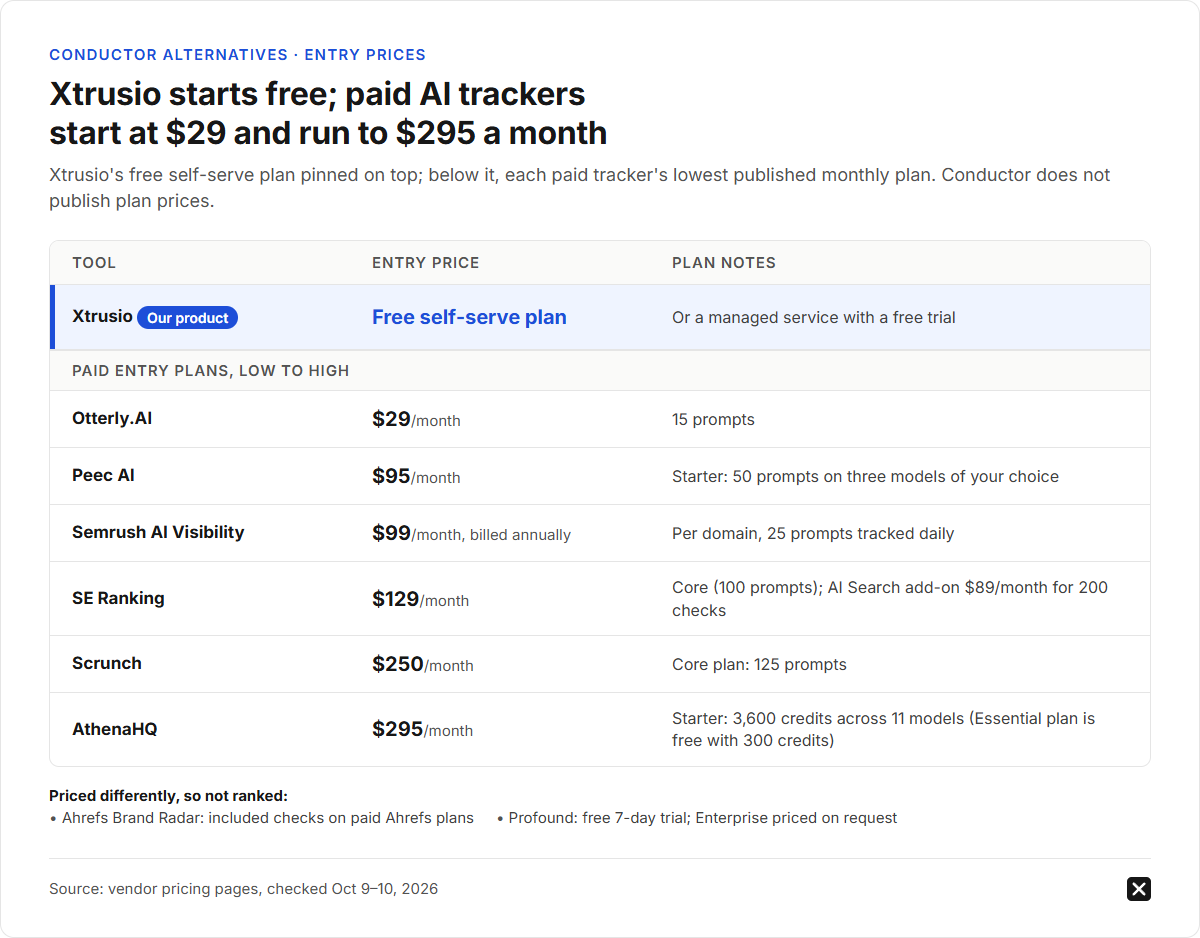
The best Conductor alternative for AI answer engine monitoring depends on what you want after the report. Xtrusio is the pick if you want AI engines to start citing you: it asks seven engines your buyers' questions, plans the content from the searches those engines run, helps you win the places AI quotes, and shows you when an engine cites your exact page. Profound suits large teams that want specialist AI analytics, Peec AI and Otterly.AI suit teams that only need affordable tracking, Semrush, Ahrefs Brand Radar and SE Ranking suit teams already on those SEO suites, AthenaHQ suits teams that want many models on a credit budget, and Scrunch suits teams that want to tune their own site for AI agents.
Tool | Best for | Starting price | AI engines covered |
|---|---|---|---|
Xtrusio | Getting cited, not just tracked | Free self-serve plan; managed service with a free trial | ChatGPT, Claude, Gemini, Perplexity, Grok, Google AI Overviews, Google AI Mode (across the product) |
Profound | Specialist AI analytics for large teams | Free 7-day trial; Enterprise priced on request | Trial: ChatGPT, Gemini, AI Overviews; Enterprise: up to 9 engines |
Peec AI | Daily tracking on a budget | $95/month | 3 models you choose |
Semrush AI Visibility | Teams already using Semrush | $99/month, billed annually | ChatGPT, Google AI, Gemini, Perplexity |
Ahrefs Brand Radar | Teams already using Ahrefs | Included checks on paid Ahrefs plans | Varies by plan |
SE Ranking AI Search | AI tracking next to rank tracking | $129/month Core (100 prompts); AI Search add-on $89/month for 200 checks | Core: not named; add-on: ChatGPT, Perplexity, Gemini, AI Overviews, AI Mode |
Otterly.AI | The lowest paid entry price | $29/month | ChatGPT, AI Overviews, Perplexity, Copilot |
AthenaHQ | Many models on a credit budget | Free Essential plan; Starter $295/month | Starter: 11 models |
Scrunch | Optimizing your own site for AI agents | $250/month | ChatGPT, Perplexity, AI Overviews, Copilot |
Competitor prices were checked on each vendor's own pricing page on October 9 and 10, 2026. Conductor does not publish plan prices; you request them. This page covers Conductor, the enterprise SEO and AEO platform at conductor.com, not the Conductor app for running coding agents.
What are you really replacing?
Conductor is an enterprise SEO and content platform that has added AI visibility features. That matters, because most teams looking for an alternative are not unhappy with one feature. They want a different result from their AI search budget.
Here is what Conductor's own pricing page shows, checked October 10, 2026:
- Three plans, no published prices. Essentials, Growth and Enterprise. Conductor describes its pricing as usage-based.
- AI search sits inside an SEO suite. Every plan combines AEO and SEO performance reporting, AI content drafts from its Writing Assistant and website monitoring.
- Engines per plan are not listed. The page shows Perplexity, OpenAI, Gemini and Copilot logos in its closing banner, but its plan table does not say which engines each plan tracks, so ask Conductor before you compare coverage.
(Source: Conductor pricing.)
So before you compare features, decide what you want to buy:
- A tracker tells you where you stand in AI answers.
- A way to get cited changes where you stand.
Conductor and most tools on this list lean toward the first job, with AI data sitting next to SEO reporting. Xtrusio is built for the second.
What is Conductor AI?
Conductor AI is not a standalone product. Conductor's own guide describes it as "the AI-powered engine behind Conductor's enterprise AEO platform", spread across its Intelligence, Creator and Monitoring modules (What is Conductor AI?, read October 10, 2026). Here is how its jobs compare with Xtrusio's:
Job | Xtrusio | Conductor AI |
|---|---|---|
Measure | Asks your buyers' questions on ChatGPT, Claude, Gemini, Perplexity, Grok, Google AI Overviews and Google AI Mode, and keeps every full answer, brand named and page cited | Tracks mentions, citations and sentiment by persona and intent on prompts Conductor generates; engines per plan are not listed on its pricing page |
Plan | Drafts a content plan for each buyer question from the searches the engines ran and the sites they cite | Suggests topics from search signals and gaps in your own site's coverage |
Write | Writes Citation-Grade Content and checks every link before approval | Writing Assistant drafts, with content scores and internal link suggestions |
Place | Publishes to your blog, places guest posts across about 2,000 publisher websites, and runs PR with a journalist team | Built around your own website's content workflow; no guest post or PR placement is listed |
Verify | Counts a placement only when an engine cites that exact URL on the question it targets in a later scan | Shows which of your own pages earn AI visibility, next to search and traffic data |
Xtrusio: built to get you cited
Xtrusio is our product, so we have put it first. Here is what it does, in plain terms.
It starts from the questions your buyers ask. Xtrusio asks ChatGPT, Claude, Gemini, Perplexity, Grok, Google AI Overviews and Google AI Mode the questions your buyers ask before they buy. It keeps every full answer, every brand the answer names and every page it cites.
It reports what a buyer would care about. You see visibility, share of voice, sentiment, average position and citations, split by engine, topic and buyer persona.
It plans from what AI actually searches. In Xtrusio's checks, ChatGPT and Claude search the web on every answer, and Gemini and Grok decide when to search. Xtrusio records the searches those four engines run and drafts a content plan for each buyer question from them and from the sites they cite. A strategist approves the plan, so you write what the engine is looking for instead of guessing.
It wins the places AI quotes. AI answers rarely cite only your website. They quote blogs, LinkedIn, Medium, Reddit, YouTube, guest posts and press coverage. Each plan picks the right channel for each piece. Xtrusio writes and scores articles, checks every link before approval, and publishes to your blog where it is connected. It drafts LinkedIn posts, YouTube scripts, Medium essays and press releases from each article.
It tracks every placement to a live page. Link Strategy follows each guest post, PR placement and published piece through to its live URL, and for each placement shows whether that exact page was cited, and on which question.
It proves the result. A page only counts as a win when an engine's answer to the question it targets cites that exact URL in a later scan. You see the before and after on the same question.
It protects what you already have. Xtrusio connects to Google Search Console and flags pages losing position, demand or freshness, with the reason in plain words.
You can start on the free self-serve plan, or have our team run everything as a managed service with a free trial, then tiered plans (details on request).
The other Conductor alternatives
Here is where each tool fits, as a narrower use case.
Profound
Profound suits large teams that want deep AI analytics and are ready for an enterprise plan. It offers Answer Engine Insights, Prompt Volumes and reusable Agents for recurring content tasks, and it can create and publish to WordPress. The free trial runs 50 preset prompts daily for seven days on ChatGPT, Gemini and Google AI Overviews; Enterprise covers up to nine answer engines. For a wider list, see our Profound alternatives guide.
Peec AI
Peec AI fits an in-house team that wants daily tracking at a fair price and will act on the data itself. Starter is $95 a month for 50 prompts on three models of your choice. It adds source analytics and recommended actions.
Semrush AI Visibility
Semrush suits teams that already live in Semrush and want AI mentions next to their SEO data, which is also the main reason teams buy Conductor. The base plan is $99 a month per domain, billed annually, for 25 prompts tracked daily.
Ahrefs Brand Radar
Brand Radar suits teams that already pay for Ahrefs. Paid plans include tracked AI prompts, starting at 5 tracked AI prompts (150 checks a month) on Lite, so the extra cost to start can be zero.
SE Ranking AI Search
SE Ranking suits a team that owns both classic rankings and AI answers and wants one report. SE Ranking Core ($129/month, or $103.20 billed annually) includes AI prompt tracking (its pricing page lists 100 prompts); the AI Search add-on ($89/month) adds 200 checks a month, where one check is one prompt on one engine, across ChatGPT, Perplexity, Gemini, Google AI Overviews and AI Mode.
Otterly.AI
Otterly.AI is the lowest paid entry price to see where you stand, from $29 a month for 15 prompts. It shows the URLs each answer cites and offers content audits and recommendations. Claude, Gemini and AI Mode cost extra.
AthenaHQ
AthenaHQ suits teams that want many models and know exactly which questions to track, since every answer uses a credit. The Essential plan is free with 300 credits; Starter is $295 a month for 3,600 credits across 11 models.
Scrunch
Scrunch suits teams whose main goal is changing their own website for AI agents. The Core plan is $250 a month for 125 prompts, with site audits and agent traffic data. Its Agent Experience Platform, which adapts your site for AI agents, sits on the Enterprise plan.
How will you know an alternative worked?
Every tool, Conductor included, can show you a visibility score. Ask each vendor for something harder:
- Pick 10 questions your buyers really ask.
- Ask to see the full answers and the pages each engine cites, not just a score.
- Ask who will write or fix the page that should have been cited, and where it will be published.
- Ask how you will see, on the same question, that the engine now cites that exact page.
If a vendor can only answer the first two, you are buying a tracker. Xtrusio is built around all four. If you are moving from Conductor, run the new tool on the same 10 questions before your renewal date, so you compare like with like. For a deeper look at how these tools charge for the same tracking, read our AEO tools cost and buying guide.
See how Xtrusio works and start with your own buyer questions.
Frequently asked questions
What is the best Conductor alternative for AI answer engine monitoring?
If you want to be cited, not just tracked, Xtrusio: it asks seven AI engines your buyers' questions, plans content from the searches they run, helps you win the places AI quotes, and proves the result on the exact page. For tracking only, Peec AI and Otterly.AI are the most affordable.
Does Conductor already monitor AI answer engines?
Yes. Its plans include AEO and SEO performance reporting. Its pricing page lists no prices and does not say which AI engines each plan tracks; its closing banner shows Perplexity, OpenAI, Gemini and Copilot logos. The question is whether you need more AI reporting or a way to get cited.
What is the cheapest Conductor alternative?
Xtrusio, which has a free self-serve plan. Among paid trackers, Otterly.AI starts at $29 a month.
Which Conductor alternatives cover Claude and Grok?
Xtrusio covers ChatGPT, Claude, Gemini, Perplexity, Grok, Google AI Overviews and Google AI Mode. AthenaHQ's Starter plan lists both among its 11 models. Many entry plans leave Claude or Grok out or charge extra for them.
Can any tool guarantee a citation in ChatGPT?
No. The engine decides what to cite. What you can do is publish the pages and win the placements the engine trusts, then check whether it cites them. That last check is what separates getting cited from tracking.
Topics
- Conductor alternatives
- Conductor AI Search Performance alternatives
- AI answer engine monitoring tools
- AI visibility platform comparison
- AEO monitoring software

Xtrusio
AI visibility research
Xtrusio is the Perception Engine for B2B brands.
Free check
See how AI engines answer about you
Get your free AI visibility check
Keep reading
 AI Tools Guide · Oct 10, 2026 · 9 min read
Xtrusio vs Daydream (AI Search Agency): Content Output, or a Cited Page You Can Check on Each Buyer Question
Daydream (withdaydream.com) and Xtrusio compared job by job: measure, plan, write, place, verify and price, from Daydream's own pages. AI Tools Guide · Oct 10, 2026 · 9 min read
Xtrusio vs Ahrefs Brand Radar: An Index of AI Mentions, or Your Buyer Question Tracked to a Cited Page
What Ahrefs Brand Radar is and does, then Xtrusio and Brand Radar compared job by job: track, plan, write, place and verify, with Ahrefs' own prices. AI Tools Guide · Oct 10, 2026 · 9 min read