What Are AI Visibility Tools and Their Features?
Short answer
AI visibility tools show how AI engines such as ChatGPT, Claude, Gemini, Perplexity and Google AI Overviews talk about your brand when buyers ask them questions. They ask the engines your buyers' questions, save every answer, and report whether your brand is named, how it is described, how it compares with competitors and which pages the engine cites. The best tools go one step further: they turn those findings into content and show you when an engine starts citing your page. Xtrusio covers that full set, from tracking to verified citations.
What is an AI visibility tool?
More buyers now ask an AI assistant before they search Google or talk to sales. ChatGPT often searches the web before it answers, then names a few brands and links the pages it used. If your brand is missing from that answer, you are missing from the shortlist. An AI visibility tool measures this for you. Think of it as rank tracking for AI answers, except there is no fixed list of ten blue links. Every answer is generated fresh, so it can change with the question wording, the engine and the day. A good tool asks the same questions again over time and keeps the evidence. Three results are worth keeping apart:
- A mention means the answer names your brand.
- A citation means the answer links one of your pages as a source.
- A recommendation means the answer suggests choosing you. These often happen separately, so a useful tool reports each one on its own instead of blending them into one score.
The core features buyers should expect
Feature | What it does | Why it matters |
|---|---|---|
Question sets | Builds the questions your buyers ask, grouped by topic and buyer persona, for you to review and approve | Results only mean something if real buyers ask those questions |
Multi-engine answers | Asks each question on several AI engines and keeps every full answer | Each engine answers differently, and the full text shows what a score really means |
Citations | Records every page each answer cites, by exact URL | Cited pages are the sources the engine trusts, so they show where you need to be |
Share of voice | Compares how often you are named against competitors on the same questions | Shows whether you are gaining or losing ground in your category |
Sentiment | Classifies how each answer describes your brand | Being described badly or with old facts is a different problem from being absent |
Average position | Tracks where your brand appears in the list of options an answer gives | Readers see the first names in an answer before the rest |
Engine searches | Records the web searches an engine runs before it answers | Tells you the exact phrases the engine looks for, so you stop guessing |
Content planning | Turns each gap into a plan of pages and placements, with the right channel for each | Moves the team from a report to work someone can start today |
Verified citations | Checks in a later scan whether the engine now cites the exact page you published | Proves the work paid off on the question it targeted |
Search Console health | Syncs Google Search Console and flags pages losing position, demand or freshness | Protects the search traffic your existing pages already earn |
Most tools cover the first six rows, which tell you where you stand. The last four change where you stand, and that is where tools differ most.
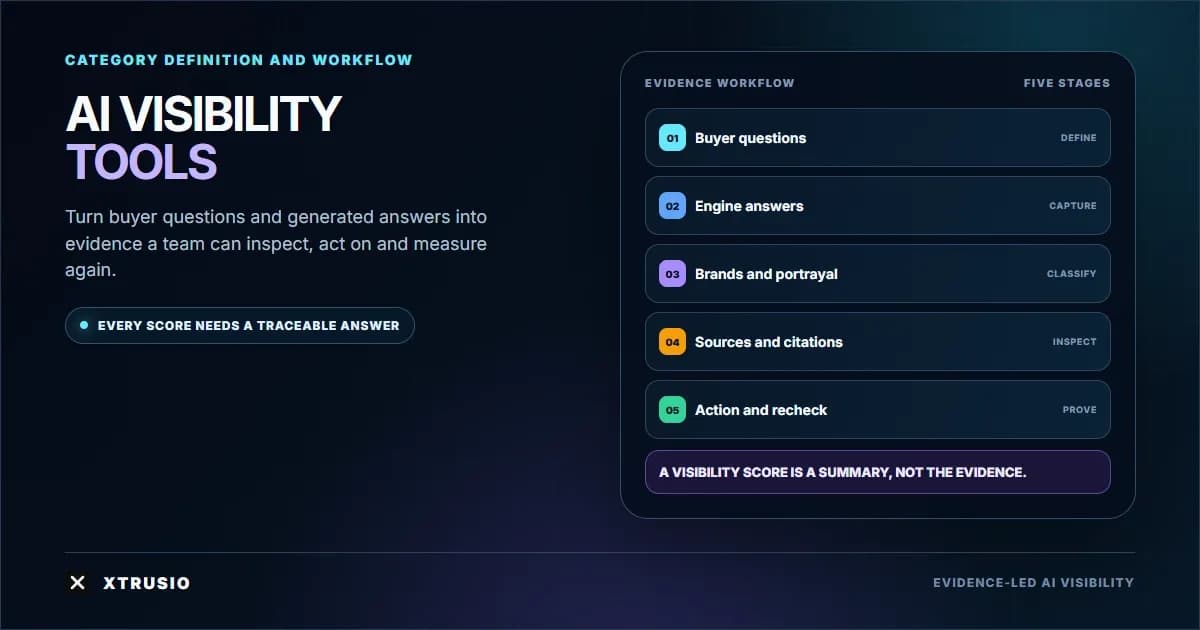
How an AI visibility tool works
The workflow is the same whatever tool you use:
- Pick the questions. Start with the questions buyers ask before they choose a product like yours, in their own words.
- Ask the engines. The tool runs each question on each engine and saves the full answer, the brands named and the pages cited.
- Read the evidence. Look at the actual answers and sources, not only the score. A wrong claim and a missing page need different work.
- Do the work. Fix or publish the page, or earn coverage on the sites the engine already cites.
- Check again. Ask the same question later and see whether the engine now names you and cites your page. One tip on reading the numbers: ask what each rate is a share of. If 171 of 180 planned answers come back and your brand appears in 27, your mention rate is 27 divided by 171, or 15.8%. The nine failed answers are a collection problem, not proof you are absent. Our guide to measuring GEO campaign success goes deeper on this.
How to choose an AI visibility tool
Ask every vendor these five questions:
- Which engines does it cover? Buyers use more than ChatGPT. Some entry plans cover three or four engines and charge extra for Claude or Gemini.
- Can you read the full answer and every cited URL? A score with no evidence behind it cannot be checked or acted on.
- Does it show what the engine searched for? Those searches are the clearest guide to what you should write.
- Who turns findings into content, and where does it go? AI answers cite blogs, LinkedIn, Medium, Reddit, YouTube, industry publications and press coverage, not only your own site.
- How will you see that it worked? Ask how the tool shows that an engine now cites your exact page on the same question. Tracking-only tools such as Peec AI and Otterly.AI suit in-house teams that only want a scoreboard and will do the follow-up work themselves. SEO suites such as Semrush, Ahrefs and SE Ranking suit teams that want AI mentions next to the SEO data they already use. For a side-by-side view with prices, see our Profound alternatives guide and our guide to the best AI visibility tools.
Xtrusio: the full set, from tracking to verified citations
Xtrusio is our product. It covers every row in the table above, from the first question to proof that an engine cites you. It tracks the engines your buyers use. Xtrusio asks ChatGPT, Claude, Gemini, Perplexity, Grok, Google AI Overviews and Google AI Mode the questions your buyers ask. It keeps every full answer, every brand named and every cited page, and reports visibility, share of voice, sentiment, average position and citations by engine, topic and buyer persona. It sees what the engines search. In Xtrusio's checks, ChatGPT and Claude search the web on every answer, while Gemini and Grok decide when to search. Xtrusio records the searches ChatGPT, Claude, Gemini and Grok run, so you know the exact phrases they look for. It plans the content. For each buyer question, Xtrusio drafts a content plan from those searches and the sites the engines cite, with the right channel for each piece: your blog, LinkedIn, Medium, Reddit, YouTube, guest posts or PR. You approve the plan. It writes and publishes. Xtrusio writes and scores articles, checks every link before approval, and publishes to your blog where it is connected. It drafts LinkedIn posts, YouTube scripts, Medium essays and press releases from each article. Link Strategy tracks each guest post, PR placement and published piece through to its live URL and shows whether an engine cites the live URL for the question it targets. It proves the result. A page counts as a win only when an engine's answer to the question it targets cites that exact URL in a later scan. You see the before and after on the same question. It protects what you already have. Xtrusio connects to Google Search Console and flags pages losing position, demand or freshness, with the reason in plain words. Your data stays yours: provider keys and secrets are kept server-side and encrypted, access is role-based, and each client gets its own separate deployment and data. Pricing: free self-serve plan; managed service with a free trial, then tiered plans (details on request).
How will you know it worked?
Run this test with any tool:
- Pick 10 questions your buyers really ask.
- Save today's full answers and the pages each engine cites.
- Publish or fix the page that should be cited, or earn a placement on a site the engine already trusts.
- In a later scan, check whether the engine now cites your exact URL on the same question. If a tool can only help with the first two steps, it is a tracker. Xtrusio is built to carry you through all four. Google's guidance on AI features says third-party tools have no access to its internal ranking or AI systems, so no tool controls what an engine cites. If your page never shows up, first check that AI crawlers can reach it; OpenAI's publisher FAQ explains how ChatGPT search finds public pages.
See how Xtrusio works and start with your own buyer questions.
Frequently asked questions
What does an AI visibility tool do?
It asks AI engines the questions your buyers ask, saves the answers, and reports how often your brand is named, how it is described, which competitors appear and which pages are cited.
What features should an AI visibility tool have?
At minimum: approved question sets, full answers from several engines, exact cited URLs, share of voice, sentiment and average position. The stronger tools add the searches engines run, content planning, verified citations and Search Console health.
Is AI visibility tracking the same as SEO rank tracking?
No. Rank tracking records a fixed list of search results. AI visibility tracking samples generated answers, which can change with the question wording, the engine and the day, so it needs repeated checks and saved evidence.
Can an AI visibility tool guarantee citations?
No. The engine decides what to cite. A good tool shows you which pages and placements the engine trusts, helps you publish them, and checks whether the engine cites them later.
What is the best AI visibility tool?
If you want to be cited and not just tracked, Xtrusio: it covers seven engines, plans content from the searches AI runs, and confirms when an engine cites your exact page.
Topics
- what are AI visibility tools
- AI visibility tool features
- AI visibility workflow
- AI brand monitoring software
- AI visibility use cases

Xtrusio
AI visibility research
Xtrusio is the Perception Engine for B2B brands.
Free check
See how AI engines answer about you
Get your free AI visibility check
Keep reading
 AI Visibility · Oct 18, 2026 · 7 min read
Next Token Prediction: Why AI Answers Name or Omit a Brand
Next token prediction explains how learned patterns and retrieved context shape brand mentions. Use an anonymized scan example to choose the next action. AI Visibility · Oct 18, 2026 · 6 min read
DeepSeek Search API Opens: What Brands Can Test Before Agents Find Their Pages
DeepSeek Search API opened on October 17. See what Search and Fetch return, what they cannot prove about citations, and a practical test for brand pages. AI Visibility · Oct 18, 2026 · 9 min read