How to Track Competitor Mentions in Google AI Overviews
To track competitor mentions in Google AI Overviews, choose the buyer questions that matter, record whether an Overview appears, save the brands named in its answer and the pages Google cites, then repeat the same checks with the date, location and device noted. Google Search Console reports impressions for your own pages, not which competitors an answer named.

On this page
Start with the questions a buyer would ask before choosing a provider. For each Google search, keep the AI Overview answer and its source pages together. A competitor named in the answer, a competitor page cited as a source, and an impression for your own page are three different facts. The useful report shows each separately, so you can see whether the gap is in what Google says or in the public pages it draws on.
How do you track competitor mentions in AI Overviews?
Step | Save | What it tells you |
|---|---|---|
Choose questions | Exact unbranded buyer queries | Whether you are testing a real buying decision |
Check Google | Date, country, device and whether an AI Overview appeared | Which checks have an answer to compare |
Read the answer | Brands named and how they are described | Who enters the buyer's shortlist |
Open sources | Exact cited URLs and their owners | Which pages support or contradict the answer |
Repeat | Same questions and comparable settings | Whether the answer changed over time |
Use a small set of questions that cover different buyer needs. “Best contract management software” tests a category shortlist; “Which tools send contract renewal reminders?” tests a feature. Keep branded searches in a separate list. If the first list contains only your company name, it will not tell you whether buyers discover you when they have not heard of you.
What does a real Google result show?
On September 19, 2026, we searched Google for “best chatgpt rank tracking tools” on the All tab in desktop Chrome. Google identified Bahrain, and the session was personalized.

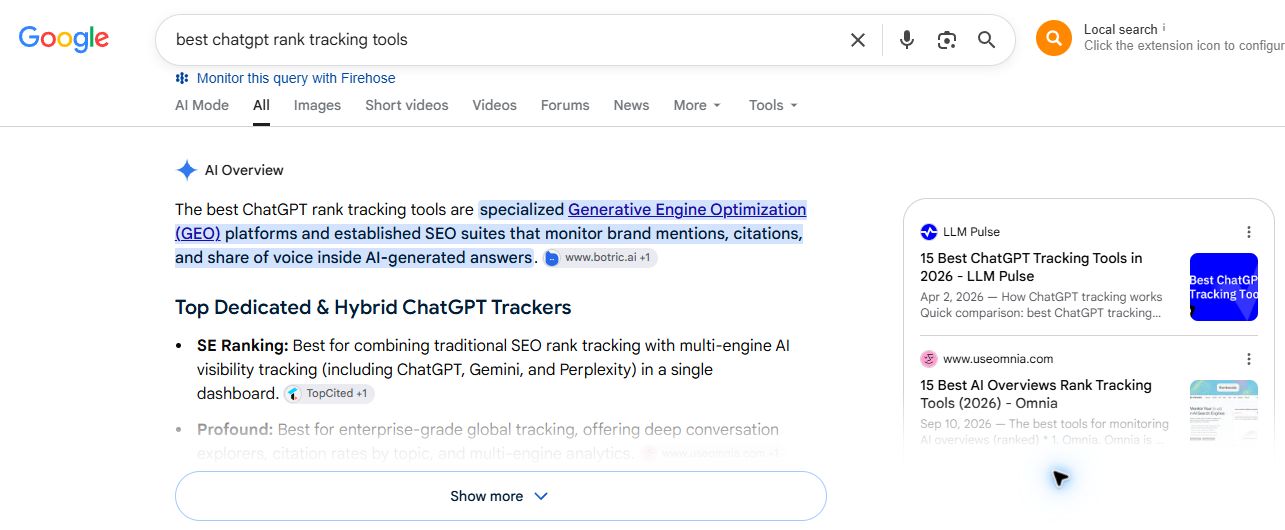
The useful question is not only who appeared? It is which page can you check or correct? Software like Xtrusio can keep the question, answer and cited URLs together, while the Google screen shows what appeared to this searcher.
Expanding the answer showed six tool names: SE Ranking, Profound, Otterly.AI, Rankscale, Ahrefs and Semrush. Read those names as answer mentions. They do not tell you which company owns every cited page or whether the product descriptions are accurate today.
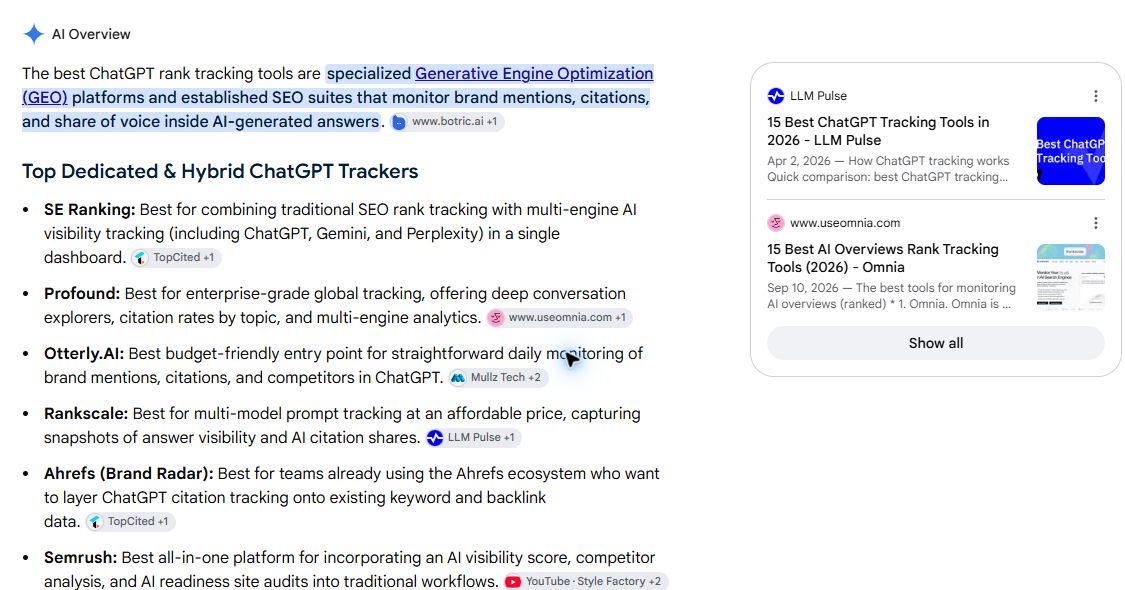
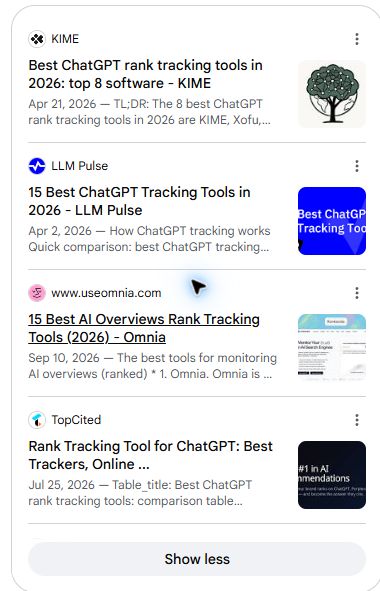
The opened source panel showed pages from KIME, LLM Pulse, Omnia and TopCited. Those are cited sources, a different column in the question record. Open each page before deciding whether it supports a claim about a tool. A list page about your category can shape the answer even when the publisher is not a direct competitor.
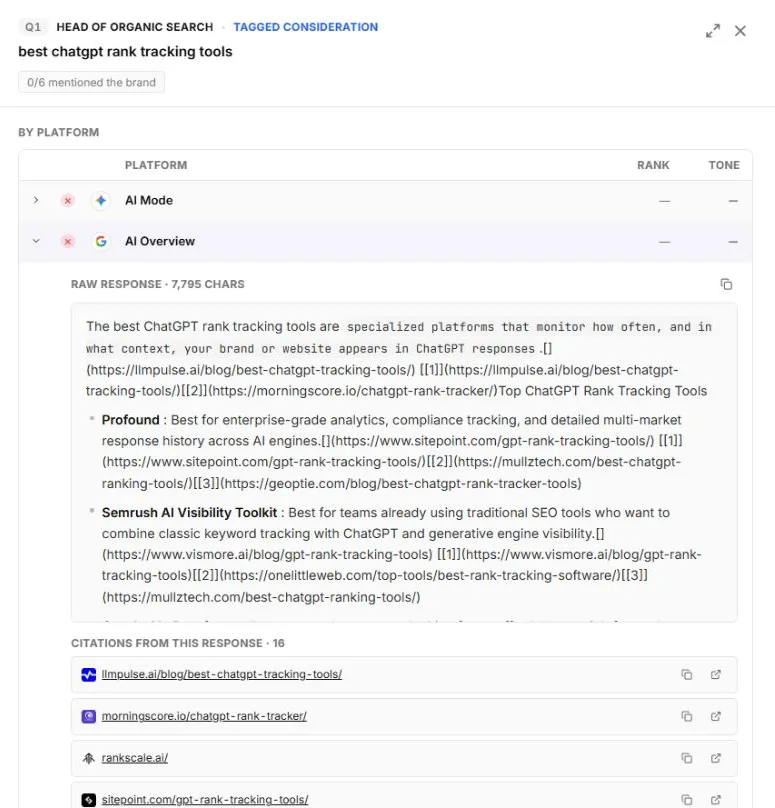
Do not stop at “competitor present.” Ask where the competitor was named, which page Google linked, and whether your own relevant facts appear on pages a buyer could find. The saved Xtrusio record below keeps an AI Overview answer and its source URLs beside the question. It comes from a separate August 30 check, so it is not a second view of the September Google session.
How do you calculate a competitor mention rate?
First count completed checks. Among them, count the searches that actually displayed an AI Overview. Then, for each competitor, divide the number of Overview-bearing answers that name it by the number of Overview-bearing answers you checked. Keep the question list and date range beside the percentage.
For example, if eight of ten completed searches displayed an Overview and a rival was named in three of those eight answers, its mention rate is 3 ÷ 8 = 37.5% for that question set. The Overview appearance rate is 8 ÷ 10 = 80%. Do not count a failed collection as a missing competitor, and do not put the ten searches in the mention-rate denominator without saying so.
A source rate answers another question: in how many Overview-bearing answers was a rival's own domain cited? A brand can be named while an independent review page supplies the citation. Conversely, a domain can appear among sources without its brand being recommended in the answer. Keep these two counts apart.
When checking again, use the same query wording, country, language, device and collection method where possible. Google results can still change. Preserve the actual answer beside the rate so a change from “listed” to “recommended for this buyer's need” is visible, not hidden inside one percentage.
Can Search Console show which competitors Google named?
No. Google introduced its Search Generative AI performance report on June 3, 2026, and says it reached all websites worldwide on August 31. The Search report documentation describes impressions for your own site's pages in AI Overviews and AI Mode, with page, country, device and date views. It does not provide a list of brands named in each answer or a separate competitor-mention report. Its documented view combines AI Overviews and AI Mode impressions.
The screen below is from Xtrusio's own Search Console property. It shows the generative AI report, a Web text selection and the Pages, Countries, Devices and Days tabs. It cannot tell us which competitor was named in the September Google answer above. Use it to ask a different question: which of our own pages received generative AI impressions during the selected period?
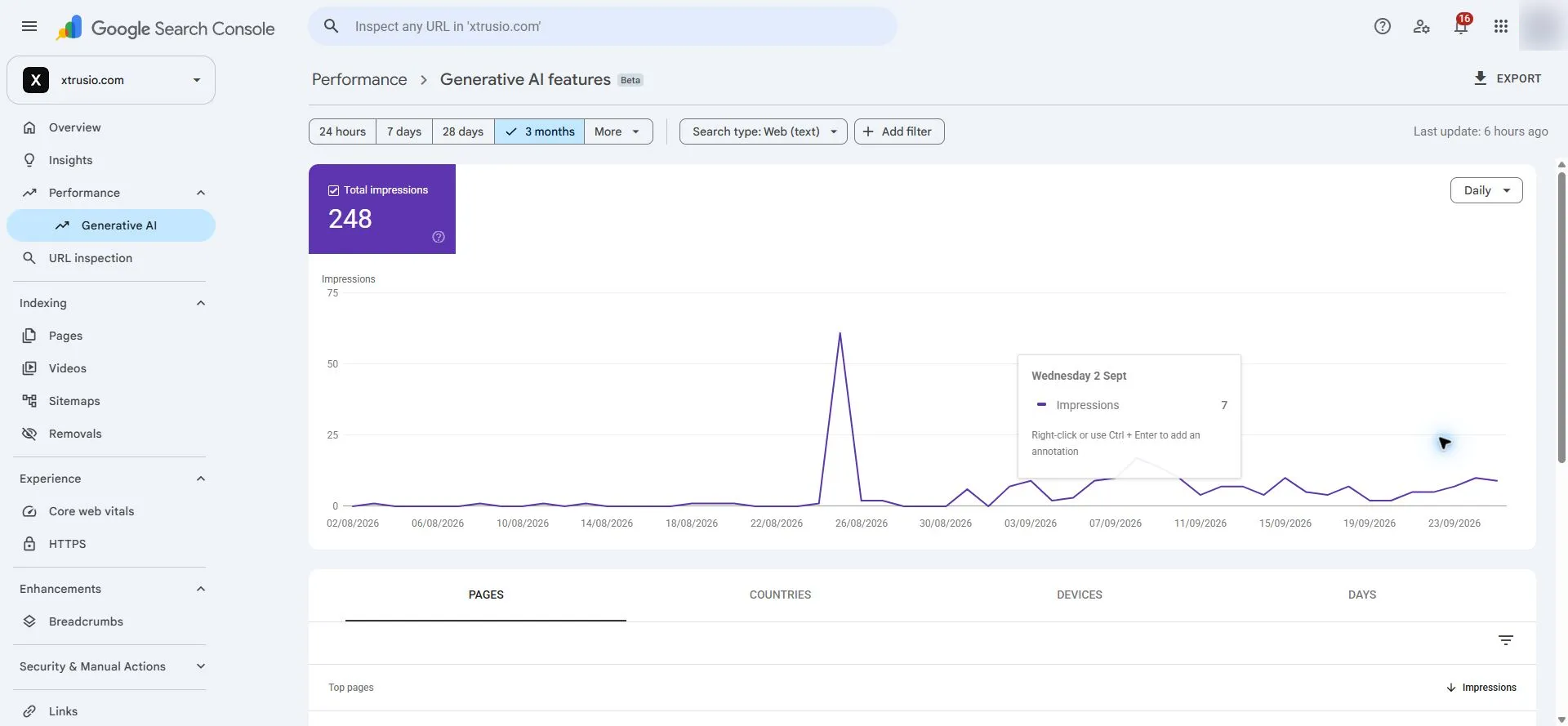
That separation also protects you from a bad conclusion. A rival appearing in a captured answer does not show that it took traffic from your site. A rise in your own impressions does not show which brands a particular answer named. Put the two records beside each other when deciding what to fix, but do not add them into a single “competitor score.”
Is a spreadsheet enough? For 10–20 questions checked monthly, yes: one row per question and date, with the answer text and cited URLs. Beyond that, saving every answer and source by hand becomes the bottleneck, which is where monitoring software helps.
What should you do when a competitor appears and you do not?
Open the cited URLs first. If a comparison page names the rival but omits you, check whether it covers the category you serve and whether you have accurate product facts that would belong there. If your own page is cited but the answer describes you wrongly, find the sentence or feature detail that needs correction. If neither your page nor independent sources explain a buyer requirement, start with a page that answers it plainly and backs the claim with real product evidence.
Keep an action log with four things: the buyer question, the answer gap, the page or source to change, and the URL after a change goes live. At the next check, ask the same question and read the whole answer again. A fix is done when the page is live; it is working only when a later check names you or cites it.
If you want to test this on your market before buying a monitoring program, request a free Xtrusio evaluation with your buyer questions and public product facts. You can review the answers and cited pages together, then decide which gap deserves work.
Frequently asked questions
Can Google Search Console show competitor mentions in AI Overviews?
No. Its generative AI report shows impressions for your own pages across AI Overviews and AI Mode, grouped by page, country, date and device. To see competitors, search your buyer questions, read the Overview and save the source URLs.
Should a cited competitor page count as a competitor mention?
Count it separately. A competitor is mentioned when the answer names the brand. A cited page tells you which URL Google displayed as a source. The two can differ, especially when an independent comparison page supports the answer.
What denominator should I use for a competitor mention rate?
Use completed checks that displayed an AI Overview. Divide the number of those answers naming the competitor by the number of Overview-bearing answers. Report completed checks, Overview appearance and failed checks separately.
How often should I repeat the same AI Overview checks?
Choose a cadence your team can maintain, such as monthly for a small set of priority buyer questions. Keep the wording and location settings comparable, save each answer and review important changes in the cited pages before assigning work.
Topics
- track competitor mentions in Google AI Overviews
- AI Overview competitor tracking
- Google AI Overview competitor mentions
- Search Console generative AI report
Xtrusio
AI visibility research
See what AI says about your brand
Access requests are temporarily paused while the new platform is prepared.
View access update