Best AI Search Competitor Analysis Tools in 2026: Why Teams That Want to Win Choose Xtrusio
Short answer
The best AI search competitor analysis tool in 2026 is Xtrusio: our measured AI-visibility study of your market (or a prospect's) shows which rivals the answers name on each buyer question, and the plan to take those questions back is built from the web searches the engines ran, with a strategist approving it before work starts. Use the free self-serve plan to run it yourself, or hand the work to our team as a managed service. The rest of the shortlist handles narrower benchmarking jobs: Profound for enterprise benchmarking programs; Semrush, SE Ranking and Ahrefs Brand Radar if your team already pays for one of those SEO suites; Peec AI and Otterly.AI for low-cost rival tracking; and AthenaHQ for broad model coverage paid in credits.
Tool | Best for | Starting price | Engines covered at entry level |
|---|---|---|---|
Xtrusio | Seeing which rivals AI names, then winning those questions back | Free self-serve plan; managed service with a free trial, then tiered plans (details on request) | ChatGPT, Claude, Gemini, Perplexity, Grok, Google AI Overviews and Google AI Mode (across the product) |
Profound | Rival benchmarking inside an enterprise program | Free 7-day trial, then custom Enterprise pricing | Trial: ChatGPT, Gemini and Google AI Overviews |
Semrush AI Visibility | Rival gaps next to existing Semrush SEO data | $99 a month per domain (25 prompts) | Google AI, ChatGPT, Perplexity and Gemini |
Peec AI | Low-cost daily rival comparison | $95 a month on Starter (50 prompts) | Any 3 models you pick |
Otterly.AI | The lowest paid entry for seeing who appears beside you | $29 a month on Lite (15 prompts) | Perplexity, ChatGPT, Copilot and Google AI Overviews |
AthenaHQ | Benchmarking across many models, paid in credits | Essential free; $295 a month for Starter (3,600 credits) | 11 models on Starter |
Ahrefs (Brand Radar prompts on Lite) | Rival benchmarks for existing Ahrefs customers | In paid Ahrefs plans: 5 tracked AI prompts (150 checks a month) on Lite ($129) | Whichever platforms you select |
SE Ranking AI Search | One competitor report for rankings and AI answers | $129/month Core (100 prompts); AI Search add-on $89/month for 200 checks | Add-on: ChatGPT, Perplexity, Gemini, Google AI Overviews and AI Mode; Core engines not named |
Every rival price above comes from that vendor's pricing page as it read on October 9, 2026; reopen it before buying, since plans shift.
Each tool, judged on competitor analysis
1. Xtrusio
Best for: B2B teams that want to see which competitors AI recommends on their buyers' questions, and then take those questions back. Pricing: Free self-serve plan; managed service with a free trial, then tiered plans (details on request).
Xtrusio is our product, so it leads. Your buyers' questions go to ChatGPT, Claude, Gemini, Perplexity, Grok, Google AI Overviews and Google AI Mode; every answer is stored in full with each brand it mentions and each page it cites, and the whole set is published as a measured AI-visibility study of the market, yours or a prospect's.
Who owns each question. You and every rival get scored on share of voice, average position, sentiment, visibility and citations, broken down by engine, topic and buyer persona. That shows where a rival leads, where you hold, and which pages were cited beside the rival's name.
The searches behind a rival's mention. In Xtrusio's checks, ChatGPT and Claude search the web on every answer; Gemini and Grok decide when to search. Xtrusio captures what those four engines searched for, so you can see the queries that pulled a rival's pages into the answer.
A win-back plan built on those searches. For every question you lose, Xtrusio drafts the content plan from the searches the AI engines actually run and the sites they cite, and a strategist approves it. Each piece is matched to a channel, whether LinkedIn, Reddit, Medium, YouTube, your blog, guest posts or PR. Articles are written and scored as Citation-Grade Content (CGC, a term Xtrusio coined), every link is checked before approval, and posts go live on your blog when it is connected.
It goes after the sites that cite your rivals. When engines keep quoting one third-party site for a competitor, the plan targets that site. Guest posts can run across a network of about 2,000 publisher websites, PR is pitched through Connectively, Featured, HARO and SourceBottle by a journalist team, and Link Strategy follows every placement to its live URL, showing whether that exact page got cited and on which question.
Proof the question came back. A page counts as a win only when, in a later scan, an engine answering its target question cites that exact URL, and you see the before and after on the same question, side by side with the rival.
Your existing pages stay protected. Once linked to Google Search Console, Xtrusio flags any page losing position, demand or freshness and explains why in plain language.
2. Profound
Best for: enterprise brands that want a formal program for benchmarking rivals. Pricing: the free Trial (50 prompts run daily for 7 days) covers ChatGPT, Gemini and Google AI Overviews, and Enterprise carries custom pricing with up to nine answer engines listed.
Profound's competitor view picks out rivals by who wins citations in AI answers and scores visibility, share of voice, citation share, sentiment and average position, while Prompt Volumes is built from over a billion AI conversations, according to Profound. Our Profound alternatives guide goes deeper.
3. Semrush AI Visibility
Best for: spotting rival-only prompts without leaving Semrush. Pricing: $99 a month per domain (25 prompts), with each prompt tracked daily on Google AI, ChatGPT, Gemini and Perplexity.
Its Competitor Research report lists the prompts and topics where rivals get cited and you do not, so AI gaps sit beside the keyword research the rest of the suite already covers.
4. Peec AI
Best for: in-house teams that compare themselves with rivals every day and act on the findings themselves. Pricing: Peec's Starter plan costs $95 a month for 50 prompts on three models of your choosing and one project.
It measures sentiment, position, visibility and share of voice against named competitors, and its gap analysis lists sources that mention competitors but leave you out.
5. Otterly.AI
Best for: small teams that want to see which brands appear beside theirs. Pricing: Lite costs $29 a month ($25 billed annually) for 15 prompts on Google AI Overviews, Microsoft Copilot, ChatGPT and Perplexity, with Gemini, Google AI Mode and Claude sold as paid add-ons.
Each answer shows the brands listed next to yours, along with the cited URLs.
6. AthenaHQ
Best for: benchmarking across many models when you already know which questions to track, because every answer spends a credit. Pricing: the free Essential plan gives 300 credits, and Starter is $295 a month and buys 3,600 credits spread over 11 models, with unlimited competitor tracking and benchmarking.
7. Ahrefs (Brand Radar prompts on Lite)
Best for: Ahrefs customers who want rival benchmarks inside a tool they already pay for. Pricing: Ahrefs includes 5 tracked AI prompts (150 checks a month) on Lite ($129), 10 on Standard and 20 on Advanced, so starting may cost nothing extra, while the full AI Visibility Index is bought separately.
Brand Radar benchmarks your brand against competitors in AI search and points to the citations worth winning.
8. SE Ranking AI Search
Best for: teams that want classic rankings and AI answers in a single competitor report. Pricing: SE Ranking Core ($129/month, or $103.20 billed annually) includes AI prompt tracking (its pricing page lists 100 prompts); the AI Search add-on ($89/month) adds 200 checks a month, where one check is one prompt on one engine, across ChatGPT, Perplexity, Gemini, Google AI Overviews and AI Mode.
Competitor research across AI answers sits next to its rank tracking.
What AI engines say about this category today
Seven AI engines received this exact question from us on October 7, 2026: "What are the best AI search competitor analysis tools?"
The pages the engines cited most were nicklafferty.com, visualping.io, tryprofound.com, competely.ai and manus.im. Most are dated vendor-blog lists and vendor pricing pages. A brand shows up because pages the engines trust mention it on that exact question, so winning a question means getting onto those pages or publishing a better one the engine will cite.
How to run an AI search competitor analysis
1. Fix the question set. Pick 20 to 50 questions your buyers ask before they choose, across topics and personas. Keep the same set, engines, location and period every time, or the numbers will not compare.
2. Record every brand named. For each answer, log the brands named, their position, the tone and the pages cited. A failed answer is not a loss; leave it out of the count.
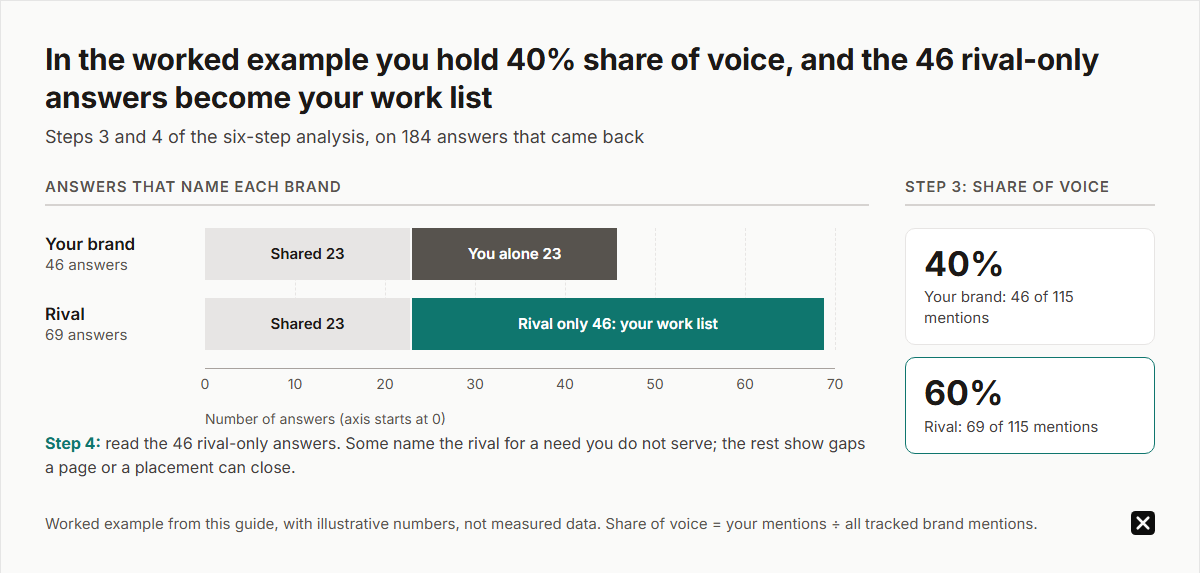
3. Work out share of voice. Share of voice is your mentions divided by all tracked brand mentions. Say 184 answers came back. Your brand appears in 46 and a rival in 69. You share 23 answers, you appear alone in 23, and the rival appears alone in 46. Across the two brands that is 115 mentions, so your share of voice is 40% and the rival's is 60%.
4. Read the rival-only answers. The 46 answers that name only the rival are your work list. Some name the rival for a need you do not serve. Others show a missing explanation, an out-of-date fact or a third-party page that mentions only the rival: gaps a page or a placement can close.
5. Look at what the engine searched. Cited pages show where the rival's name came from; the engine's searches show what your page has to answer.
6. Compare plans by answers per month. Prompts times engines times runs is the real allowance. Peec, for example, lists 4,500 monthly answers for its Starter plan: 50 prompts on 3 models, run daily.
For the search side of the same picture, our competitor keyword guide shows which pages drive a rival's Google traffic.
How will you know it worked?
Any tool on this list can draw a share of voice chart. Push each vendor on four harder asks:
- Choose 10 buyer questions on which a rival gets named and you do not.
- Request the full answers and the pages cited for that rival, not only a score.
- Find out who writes the page, or wins the placement, that ought to be cited instead.
- Have them show how, on that same question, you would see the engine start naming you and citing your exact page.
Vendors that stop after the first two are selling a tracker; Xtrusio is built to deliver all four. Once the work is live, our GEO measurement guide covers which numbers to report.
See how Xtrusio works, starting from the buyer questions your competitors win today.
Frequently asked questions
What is the best AI search competitor analysis tool in 2026?
Xtrusio: for each buyer question it shows the rivals AI names and the pages cited for them, builds the content plan from the engines' own searches, and only credits a page once an engine cites it. For tracking alone, Otterly.AI ($29 a month) and Peec AI ($95 a month) have the lowest paid entry prices.
What should an AI competitor analysis tool measure?
The brands each engine names on your buyers' questions, their share of voice, position and sentiment, and the exact pages cited, by engine, topic and buyer persona, with the full answer kept so you can read it.
How do you calculate AI share of voice against competitors?
Divide your brand mentions by all tracked brand mentions across the same set of answers. It is not market share: it does not measure revenue or customers, and adding a tracked brand changes the number.
How often should you check AI competitor visibility?
Often enough to see a trend, on the same question set each time. A single answer changes from run to run, so judge patterns across many answers, not one result.
Can any tool guarantee AI will name you over a competitor?
No. Naming and citing are the engine's decisions. Your part is to publish the pages and earn placements on sites the engine trusts, then recheck the same question to see if it now names you and cites your exact page.
Topics
- best AI search competitor analysis tools
- AI competitor analysis software
- AI search competitor tracking
- competitor share of voice AI
- AI citation gap tools

Xtrusio
AI visibility research
Xtrusio is the Perception Engine for B2B brands.
Free check
See how AI engines answer about you
Get your free AI visibility check
Keep reading
 AI Tools Guide · Oct 19, 2026 · 9 min read
Can Claude Write Python Code? What It Can Do and How to Check It
Yes, Claude can draft Python. Learn when to use chat, Claude Code or API execution, and a five-step routine to check the code before you rely on it. AI Tools Guide · Oct 19, 2026 · 10 min read
Claude Code SEO Skills: What One Real Test Found
What a Claude Code SEO skill does, how it differs from plugins and agents, how to inspect one safely, and how to check whether your page earns AI citations. AI Tools Guide · Oct 19, 2026 · 9 min read