Do We Need to Re-Verify Our AI Visibility Vendor's SOC 2 Report Every Renewal? A Practical Decision Framework
Short answer
Review the current evidence at every material renewal; you do not automatically need a new audit timed to the contract date. Start with the latest available report and the service you actually use, then investigate changes since the tested period. The depth of that review depends on your risk policy, contractual requirements and the change involved.
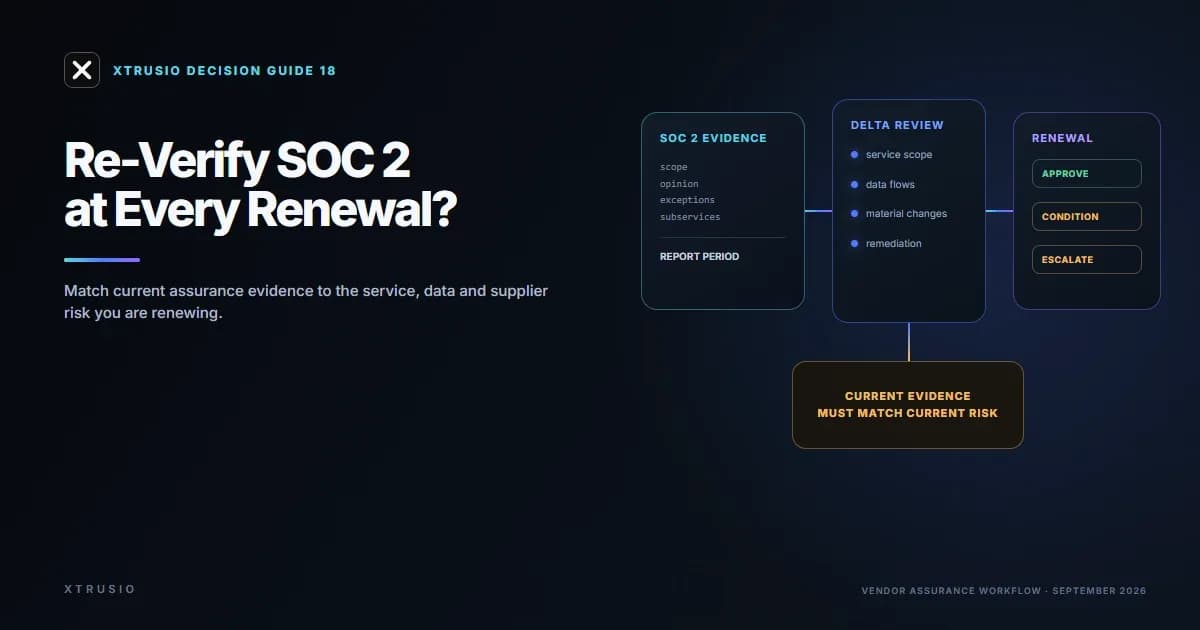
This is a practical review policy, not a claim that every contract renewal creates the same legal audit requirement. Your security and legal owners should apply the obligations that govern your organization. A lighter review can be appropriate when the service and risk are unchanged; new data use or a serious unresolved issue needs closer investigation.
What does a SOC 2 report prove—and what does it not prove?
The AICPA defines a SOC 2 examination as a report on service-organization controls relevant to security, availability, processing integrity, confidentiality or privacy. Those are distinct Trust Services Categories; the AICPA criteria do not mean every category is automatically included in every report.
A SOC 2 report is therefore scoped evidence, not a universal security certificate. Read the service description, covered systems, review period and categories in scope. AICPA's illustrative Type II report shows the components readers should expect. These include management's assertion, the system description, the auditor's report, control tests and test results.
The report also does not decide whether your residual risk is acceptable. It does not answer every contract term, data-location need, model-provider dependency, incident deadline or use of customer content for model training.
A Type 1 report concerns the described system and control design as of a date. A Type 2 report also examines operating effectiveness across its stated period. The date the auditor issues the report is different from the end of that tested period. A recently issued document can therefore leave several months to investigate before renewal.
The AICPA report-review checklist explicitly asks whether the period is recent enough for the evaluation and whether the systems and locations match the outsourced service. Use the report itself, not a compliance badge, to answer those questions.
What should you verify at every renewal?
Use the report as evidence, then test whether it still maps to the live relationship. According to NIST SP 1326, due-diligence research supports decisions about new acquisitions and existing systems. NIST SP 800-161 Rev. 1 places supplier risk assessment inside an ongoing supply-chain risk program rather than a one-time purchase task.
Evidence to review | Question to answer | Decision signal |
|---|---|---|
Report identity and period | Is this the latest report, and when did the testing period end? | A gap to renewal needs interim evidence |
System and service scope | Does it cover the product, region, hosting and data flow we use? | An excluded service cannot support the decision |
Trust Services Categories | Are the categories relevant to our use actually in scope? | Security alone does not answer privacy or availability needs |
Auditor opinion and exceptions | Is the opinion modified, and what control deviations were found? | Material unresolved findings require escalation |
Complementary user entity controls | Which controls must our own team operate? | Unowned customer controls create a real gap |
Subservice organizations | Which cloud, model or operational providers are carved out or included? | Evaluate vendor monitoring; obtain additional assurance where needed |
Changes and incidents | What changed after the report period? | Material change can make older evidence insufficient |
Remediation | Were relevant findings corrected and independently retested? | A plan without evidence remains open risk |
Read customer obligations carefully. Complementary user entity controls are controls the vendor expects your organization to implement for the relevant service commitments or requirements. Other customer responsibilities may simply be activities needed to use the service effectively. Assign owners to the applicable requirements; do not label every suggested customer action a control.
The Profound and Peec security review shows how to match assurance evidence to the service and data your team actually uses.
How deep should the renewal review be?
The efficient method is a tiered delta review. Reuse validated evidence, but investigate what changed. CISA's Vendor SCRM template for small and medium-sized businesses is designed to structure vendor vetting for ICT products and services and can help teams avoid an unrecorded yes-or-no judgment.
Renewal condition | Review depth | Practical action |
|---|---|---|
Current report, same service and data, no material incident or serious open finding | Standard delta review | Confirm scope, review changes and record approval |
Report period ends before renewal | Gap review | Obtain interim management evidence, plus change, incident and remediation responses |
New model provider, hosting region, subprocessor, integration or sensitive data use | Enhanced review | Map the new flow, obtain supporting assurance and revisit contract controls |
Modified opinion, relevant exception or overdue remediation | Risk escalation | Require evidence, conditions, deadlines and an accountable risk owner |
Vendor refuses current evidence or scope does not cover the purchased service | Renewal hold | Escalate before signature; do not treat a logo or summary page as a substitute |
A bridge letter can help explain the interval after a report period, but it is management-provided interim evidence, not a new independent examination. Pair it with dated answers about material changes, incidents and remediation. Your own policy, regulatory duties and contractual commitments determine whether that is sufficient.
Worked example: the report is recent, but the model provider changed
Consider this hypothetical renewal. The dates illustrate the decision; they are not an incident or finding about a named vendor.
Date | Event | What the reviewer checks |
|---|---|---|
March 31, 2026 | Type 2 testing period ends | Which service and controls were examined? |
June 15, 2026 | Auditor issues the report | Do not treat this as a new testing end date |
July 1, 2026 | Vendor adds a model provider | Which customer data now reaches that provider? |
September 30, 2026 | Contract renewal is due | Resolve the intervening change before accepting the risk |
There are two separate gaps. The timing gap runs after March 31. The scope question concerns the July model-provider change. A management letter describing the intervening months can inform the first question. It does not independently test a new data flow or expand the auditor's original opinion.
Ask for a current data-flow description, the affected service configuration, the provider's role, relevant contractual restrictions and the vendor's change assessment. Determine whether existing assurance addresses the change or whether additional evidence is needed. Route training-use or location questions to privacy and legal owners; route control and access questions to security.
If the old configuration can remain in place, a risk owner might approve a bounded renewal condition while the new flow remains disabled. That is a possible decision, not a default recommendation: first verify that the restriction can be enforced. If the change is already active and material questions remain unanswered, escalate rather than treating the recent report date as approval.
Record the exact condition, responsible person, evidence due date and consequence if it is not met. A promise to send documents later is not the same as a completed review.
What extra questions apply to an AI visibility vendor?
An AI visibility platform can store buyer questions, prompts, generated answers, cited URLs, brand data, competitive analyses, reports and user-account information. For an AI visibility service such as Xtrusio, map which data enters the service. Then identify every external model, cloud or support provider that processes it.
Ask what customer content is retained, where it is processed, which providers receive it, whether training use is permitted, and what happens on deletion or termination. The Cloud Security Alliance AI Controls Matrix and its AI-CAIQ support AI-specific vendor assessment. Select the questions relevant to your data flow instead of treating a completed questionnaire as assurance by itself.
When should you escalate or decline renewal?
Escalate when evidence no longer matches the service, not merely because a calendar year changed. Assess how a modified opinion, relevant open exception, coverage gap or material incident affects your use. A carved-out provider is not automatically unacceptable: investigate whether the vendor's monitoring and any additional evidence sufficiently address that dependency. Refusal to provide suitable assurance leaves a decision for your risk owner, not an automatic approval.
This framework is procurement and security guidance, not legal advice. SOC 2 reports are restricted-use documents and must be read in context. A low-risk vendor often justifies a lighter review. A vendor processing sensitive data or supporting a critical workflow often requires more than SOC 2. Record the evidence, exceptions, added controls, decision owner and next review date.
Finish the renewal ticket with four items: the service and data in scope; the evidence reviewed and its period; unresolved issues with owners and deadlines; and the authorized decision with a next review date. For a Xtrusio renewal or evaluation, send the team your service scope and evidence requirements so the discussion starts with the actual data and workflow. Do not send confidential reports through an unapproved channel.
Pair the security decision with the AI visibility renewal scorecard to compare the work delivered and the next term’s total cost.
Sources reviewed
- AICPA: SOC 2—Trust Services Criteria overview
- AICPA: 2017 Trust Services Criteria with revised 2022 points of focus
- AICPA: Illustrative SOC 2 Type II report with system description
- AICPA: Privacy considerations in a SOC 2 examination
- NIST SP 800-161 Rev. 1: Cybersecurity supply-chain risk management
- NIST SP 1326: Due Diligence Assessment Quick-Start Guide
- CISA: Operationalizing the Vendor SCRM Template
- Cloud Security Alliance: AI Controls Matrix v1.1
Frequently asked questions
Should we ask for a new SOC 2 Type II report every year?
Ask for the vendor's latest available report at each renewal. Whether you require a newly completed report, interim evidence or enhanced review should depend on vendor criticality, the report period, material changes and your policy.
Is a bridge letter equivalent to a new SOC 2 audit?
No. A bridge letter is generally a management representation about the period after the report's testing period ended. Treat it as interim evidence and review it with change, incident and remediation questions; it is not a fresh independent examination.
Does a clean SOC 2 report approve an AI vendor automatically?
No. The report only addresses the described system, period and criteria. Your team must still assess contractual, privacy, AI-specific, operational and concentration risks that may sit outside that scope.
Who should own the renewal review?
Security or risk should evaluate assurance evidence, procurement should enforce the evidence and contract requirements, privacy or legal should assess data obligations, and the business owner should confirm criticality and acceptable residual risk.
Topics
- AI visibility vendor SOC 2 renewal
- SOC 2 report review checklist
- AI vendor security assessment
- vendor renewal due diligence
- SOC 2 Type II review

Xtrusio
AI visibility research
Xtrusio is the Perception Engine for B2B brands.
Free check
See how AI engines answer about you
Get your free AI visibility check
Keep reading
 Guides · Oct 14, 2026 · 11 min read
How to Get Your First 10 Clients: What 6 Founders Changed
Six founders explain how forum answers, useful audits, search content and selective follow-up won their first paying buyers. Guides · Oct 9, 2026 · 14 min read
B2B Content Marketing Strategy: What 15 Leaders Changed
A practical B2B content marketing strategy from 15 leaders: the pages they changed, what slowed them down, and what a small team should do next. Guides · Sep 3, 2026 · 6 min read