Does Profound or Peec AI meet SOC 2 requirements for our data: A Practical Decision Framework
Short answer
As checked September 28, 2026, Profound publicly lists a SOC 2 Type 2 report for controlled-access review. Peec AI's July-dated public page still says it is pursuing SOC 2 and is not yet certified. If your policy requires a current Type II report, request Profound's report and ask Peec for newer written evidence. Neither vendor is approved for your data just because of a public claim: the report's scope, findings and your planned data flow must pass your security review.
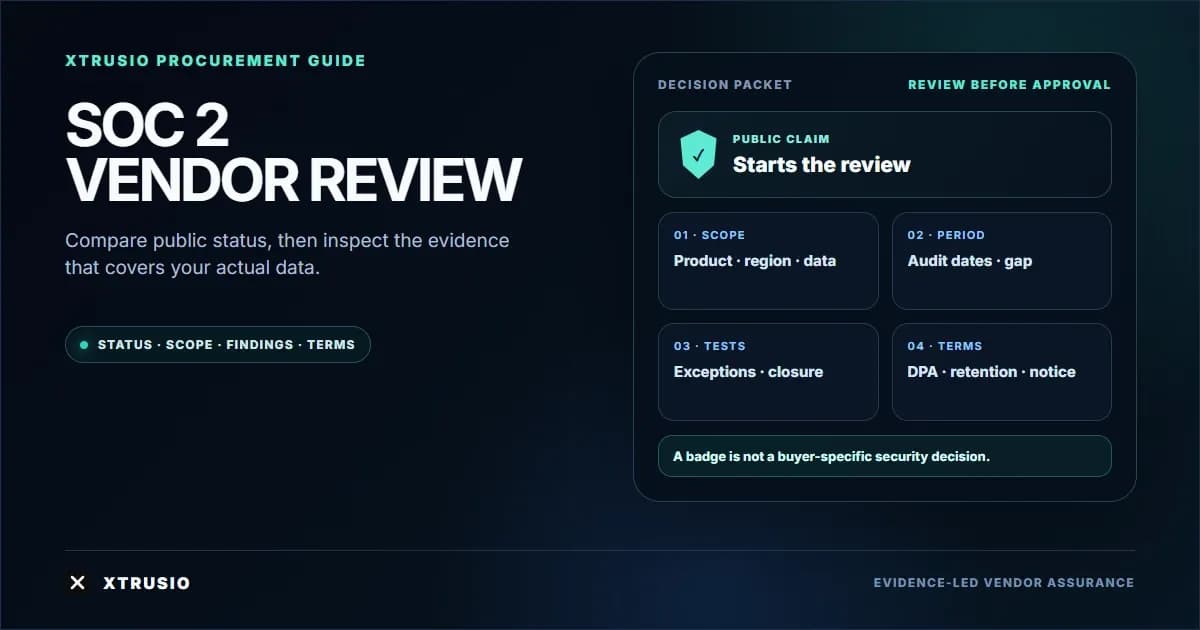
What can you conclude from the public evidence?
Vendor | Published evidence | Decision now |
|---|---|---|
Profound | Type II announcement; restricted report listed in its Trust Center. | Request the current report and review scope, period and findings. |
Peec AI | July-dated official page says SOC 2 is being pursued. | Ask for updated written status. A mandatory Type II gate remains unresolved without the report. |
This is a dated public-status comparison. We have not read either vendor's restricted audit report and cannot give either platform security approval for your deployment.
Profound: a report is listed, but its contents still matter
Profound's June 10, 2025 announcement states that it achieved SOC 2 Type 2. Its current Trust Center lists a “SOC 2 Type 2 & HIPAA Report” with a lock. The native view below shows that access boundary and a sample of its listed subprocessors.
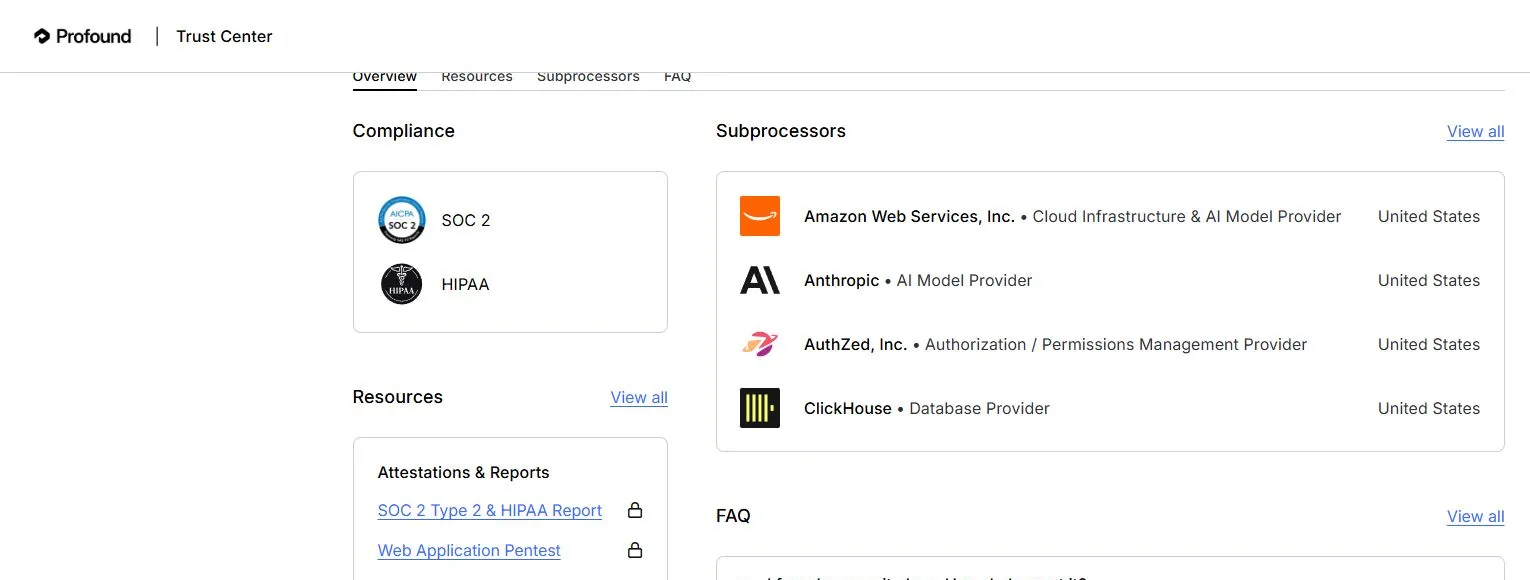
Native Profound Trust Center, captured September 28, 2026. The listing establishes that a report can be requested; it does not reveal its period, opinion or exceptions. A subprocessor listing is also not evidence that every dependency falls within the audit.
Peec AI: request a current status update
Peec's official AI Instructions page, dated July 2026 and checked September 28, still describes SOC 2 as being pursued. That does not prove its status has remained unchanged since July. Ask whether a report is now available, and obtain it through the vendor's authorized process if so.

Native excerpt of Peec's own status in its public comparison. The crop retains the security label and Peec's statement, excluding the other vendors' cells. The page's separate product comparisons are not a security assessment.
Does the evidence cover your actual workflow?
Start with the data your workflow actually needs, then ask whether the vendor's evidence covers that exact boundary. Xtrusio's question-level record, shown later, provides a concrete example of what to inventory: public buyer questions and separate engine records. The same security requirements apply to Xtrusio; a useful monitoring screen is not an audit report.
What does a Type II report establish?
SOC 2 concerns controls within a described service system. Type II addresses how those controls operated over a stated period, rather than only their design at a point in time. It is not a permanent certificate covering everything a company sells.
The AICPA's SOC resources distinguish security, availability, processing integrity, confidentiality and privacy. Check which categories your report actually covers. Encryption claims or a cloud provider's own assurance do not replace the vendor's report for the service you will use.
How should you classify the proposed data flow?
Ask “Can we justify this particular workflow under our policy?” A small public-question evaluation, a workspace containing staff identities and an integration ingesting private logs have different data boundaries.
Workflow | Data to inventory | Decision before use |
|---|---|---|
Public buyer-question evaluation | Approved public questions, brand/domain, generated answers and cited URLs. | Confirm allowed content, recipients, retention and access. Public subject matter does not make account data public. |
Team workspace | Staff identities, permissions, saved research and support messages. | Review identity controls, support access, deletion and relevant contracts. |
Private integration | Credentials, server logs, analytics identifiers or confidential materials. | Complete the required security review before connecting or uploading them. |
These are planning categories, not claims that every vendor collects every listed field. Get the actual data inventory for your purchased modules and integrations.
Which report checks determine whether procurement can proceed?
Ask for the current report through the vendor's normal controlled-access process. Keep restricted assurance documents within your approved review environment. A sales summary helps you find the report; it cannot replace reviewing it.
The AICPA's report walkthrough identifies opinion types, customer controls, exceptions, subservice treatment and bridge letters as review topics. Its SOC 2 reporting guide explains the role of system-control design, operation and effectiveness. Apply those concepts to the service you are buying.
Check | What your reviewer needs | Reason to pause |
|---|---|---|
Entity and service | The legal entity, product, deployment and system boundaries match the purchase. | A needed module or environment is outside the description. |
Period and opinion | Report dates, auditor's opinion and appropriate evidence for any later gap. | Old coverage, a modified opinion or a material change remains unexplained. |
Required categories | Each category required by your policy is included. | Security is treated as proof of unexamined privacy or availability controls. |
Exceptions | Findings, affected controls, remediation and residual risk are understood. | An important unresolved finding has no acceptable response. |
Customer controls | Your duties have named owners and can actually be implemented. | An assumed access or monitoring control is unavailable or unowned. |
Subservice providers | Dependencies and inclusive or carve-out treatment are understood. | A critical excluded dependency lacks supporting assurance. |
Data terms | The agreed recipients, retention, deletion, model use and incident terms fit your data. | Marketing statements conflict with the signed terms or intended configuration. |
Approval and follow-up | Security records the permitted scope, restrictions, owner and next review date. | A pilot expands into private-data use without another review. |
“Carve-out” means a dependency's controls are excluded from the report's examination; it does not automatically mean that dependency is unacceptable. “Customer controls” are tasks your team must perform. A bridge letter addresses developments after the report period, but does not itself extend the independent auditor's testing into a new period.
Which data-term questions need clarification?
Profound's published DPA specifies notice without undue delay and within 72 hours after awareness of a defined incident involving customer personal data. Match that definition and timing against the agreement you will sign. The Trust Center's provider list also gives your reviewer a starting point for checking recipients and roles.
Peec's privacy policy needs a precise region question. Section 1 describes its PostHog instance as being in the USA; section 3 describes PostHog EU Cloud for product analytics. These may refer to different processing contexts, but the page alone does not resolve the distinction. Ask which instance receives your users' data, which fields it receives and which contractual terms apply.
The policy describes core data on Google Cloud and says deleted content may briefly remain in backups. Ask for the applicable deletion schedule and recipients. We found no model-training assurance in the reviewed privacy text, so obtain an explicit answer instead of assuming one from the SOC 2 status.
What would a narrowly scoped evaluation record look like?
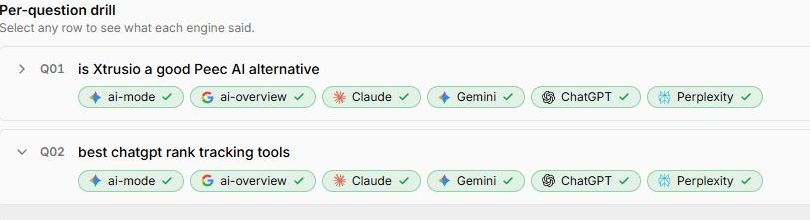
Historical August Xtrusio question-level view. It shows two public questions and separate engine controls. It illustrates the content to inventory; it does not prove completed responses, access controls, storage location or SOC 2 status.
For an initial evaluation, agree on a list of public buyer questions that contains no customer names, private contracts, credentials or unreleased product information. Separately record the account information and service providers involved. Add restrictions stating what cannot be uploaded or connected.
If you later want private integrations, return to the security gate for that expanded scope. Starting with public questions reduces what you need to send; it does not waive a mandatory audit requirement or make a vendor automatically safe.
When should you approve, make an exception or stop?
Approve only the scope your authorized security owner has accepted. If a current Type II report is mandatory, an unavailable report cannot be offset by strong product features or by completing the other checklist items.
For example, resolving seven of eight required items is 87.5% checklist completion. If the missing item is mandatory, that percentage does not authorize procurement. This is an illustrative decision rule, not a vendor score or a probability that your data is safe.
An exception is a separate, documented policy decision with an accountable approver, permitted data, compensating controls and a review date. If your policy permits no exception, stop. For Profound, the next step is current-report review. For Peec, first establish whether newer assurance exists, then apply the same review if it does.
At renewal, use the AI visibility renewal scorecard to compare delivered work, retained evidence and the next term’s cost alongside the security decision.
To assess a concrete monitoring scope, request Xtrusio's scoped free evaluation using buyer questions your team has approved for sharing. Agree on the data boundary before sending private material, and apply your security policy to Xtrusio as you would to any provider. Xtrusio has a free self-serve plan, and a managed service with a free trial, then tiered plans (details on request).
Frequently asked questions
Is Profound SOC 2 Type II compliant?
Profound publicly states that it is SOC 2 Type II compliant, and its Trust Center lists a SOC 2 report available through controlled access. Request and review the current report before relying on that status.
Is Peec AI SOC 2 certified?
Peec AI's official AI Instructions page, updated July 2026, says it is pursuing SOC 2 and is not yet certified. Ask the vendor for current written evidence because assurance status can change after a public-page update.
Does SOC 2 Type II prove that our data is safe?
No. It provides scoped assurance about described controls over a stated period. Your team must still assess whether the purchased service, data flow, regions, subprocessors, findings and contract match its requirements.
Can we approve a vendor that does not have SOC 2?
That depends on your policy, data sensitivity, criticality and compensating controls. If a current Type II report is a mandatory gate, an uncertified vendor needs a documented exception or cannot be approved.
Topics
- Profound SOC 2
- Peec AI SOC 2
- AI visibility vendor security
- SOC 2 Type II vendor review
- AI vendor data requirements

Xtrusio
AI visibility research
Xtrusio is the Perception Engine for B2B brands.
Free check
See how AI engines answer about you
Get your free AI visibility check
Keep reading
 Guides · Oct 14, 2026 · 11 min read
How to Get Your First 10 Clients: What 6 Founders Changed
Six founders explain how forum answers, useful audits, search content and selective follow-up won their first paying buyers. Guides · Oct 9, 2026 · 14 min read
B2B Content Marketing Strategy: What 15 Leaders Changed
A practical B2B content marketing strategy from 15 leaders: the pages they changed, what slowed them down, and what a small team should do next. Guides · Sep 3, 2026 · 6 min read