Should We Renew This Vendor if Their Crawler Access Terms Changed? A Practical Decision Framework
Do not renew or reject a vendor solely because its crawler terms changed. First identify the exact change, which user agent and data it affects, whether the purpose expanded, and whether your technical and contractual controls still work. Renew when the change is understood, bounded and acceptable. Renew with conditions when controls or evidence need repair. Pause or exit when the vendor cannot explain material access, reuse, security or notification risks.
On this page
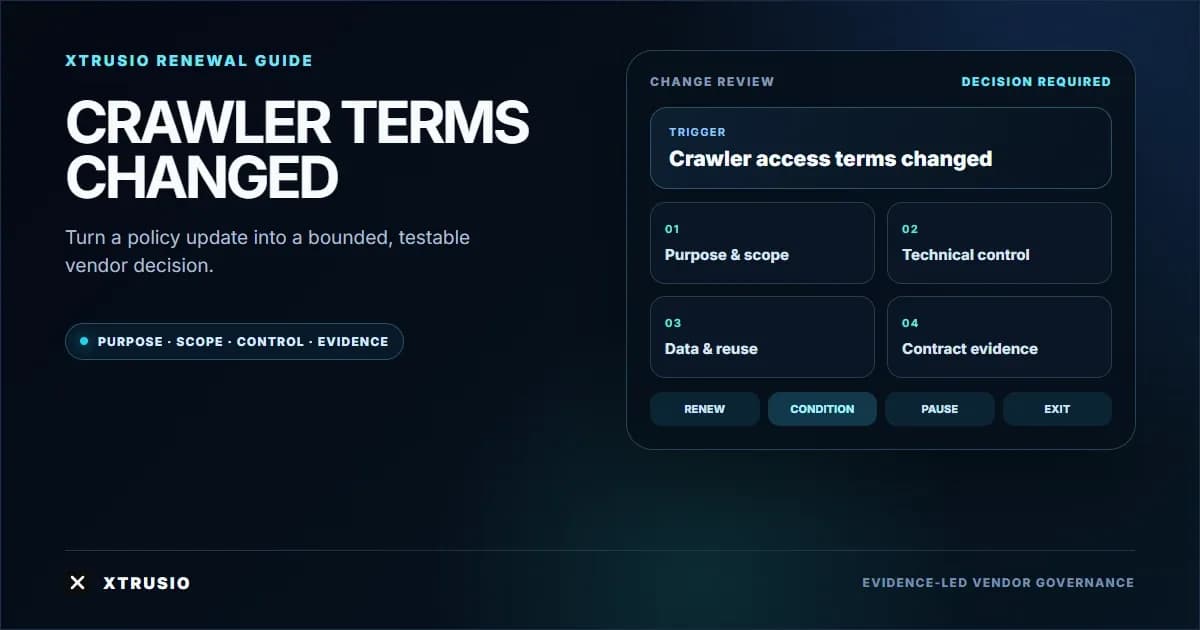
Do not renew or reject a vendor only because its crawler access terms changed. Treat the change as a review trigger. Identify the affected crawler, purpose, pages and data. Test whether your controls still work. Then choose one of four outcomes: renew, renew with conditions, pause, or exit.
Ask two questions. “Did the policy change?” matters less than “Did our exposure or expected service move beyond an acceptable boundary?”
What changed, exactly?
Start with a redline, not a summary from sales. Record the previous wording, new wording, effective date and notice date. Then classify the change by function.
Crawler names do not reliably describe one common activity. According to OpenAI's crawler documentation, OAI-SearchBot supports ChatGPT search. GPTBot covers potential foundation-model training, and each robots.txt setting is independent. OpenAI says a robots.txt update can take about 24 hours to affect its systems.
Perplexity documents PerplexityBot and Perplexity-User as different access paths. It says changes can take up to 24 hours to appear. Across the 2 provider pages reviewed, 2 out of 2 separate search crawling from another access or training purpose. A review must therefore preserve the test time instead of treating an immediate result as final.
Change type | Question to answer | Evidence required | Initial response |
|---|---|---|---|
Search-discovery crawler | Does blocking it remove wanted visibility? | User agent, IP source, robots rule and test request | Keep or restrict by approved public paths |
Training crawler | Can content be used beyond retrieval? | Purpose, opt-out, retention, reuse and effective date | Escalate new or expanded reuse |
User-triggered fetcher | Can a user cause access outside normal crawl rules? | Fetch behaviour, authentication boundary and logs | Protect non-public routes with real access control |
Vendor-operated scanner | What client data or credentials does it receive? | Data-flow map, scopes, subprocessors and deletion terms | Re-authorize least-privilege access |
Documentation clarification | Did practice, contract or exposure actually change? | Written confirmation and control test | Record and continue if risk is equivalent |
Do not let one phrase such as “AI crawler” collapse these categories. A change to search discovery can affect marketing reach. A change to model-training use can affect rights and governance. A user-triggered fetch can create a different security path.
Why is robots.txt not enough for renewal approval?
The Robots Exclusion Protocol standardizes crawler preferences. It also states that those rules are not access authorization. A robots.txt file is public, voluntary for compliant clients and unsuitable for protecting confidential paths.
Use authentication, network controls and application permissions for restricted content. Use contracts or licences for reuse rights. Use privacy governance for personal data. The Xtrusio guide to llms.txt and consent explains why machine-readable discovery files cannot replace those controls.
Also test the web application firewall. Perplexity recommends matching both the user agent and its published IP ranges when allowing its crawlers through a WAF. Google says its common crawlers publish technical identity information and obey robots.txt during automatic crawling. These are provider-specific controls, not a universal bot rule.
How should we score the renewal decision?
Use a two-stage gate. A hard blocker overrides the score. Otherwise, score each area from zero to two: zero means unacceptable or unknown, one means bounded with a condition, and two means verified and acceptable.
Decision area | 0 points | 1 point | 2 points |
|---|---|---|---|
Purpose and scope | Material purpose is unclear | Purpose is stated but scope needs restriction | Purpose, paths, regions and user agents are explicit |
Technical control | Cannot block, authenticate or verify | Temporary control exists | Least-privilege control is tested and logged |
Data and reuse | Retention or reuse is unacceptable | Written limit is pending | Terms match policy and required permissions |
Contract and notice | Change bypassed agreed notice | Amendment or notice remedy is pending | Contract covers change, audit and notification rights |
Service effect | Change breaks a critical outcome | Workaround has an owner and date | Expected service remains measurable |
Reversibility | Export or exit is blocked | Exit support needs a condition | Data, configuration and history are portable |
A score of 10 out of 12 supports renewal when no blocker exists. Seven to nine supports a short renewal with written conditions. Four to six supports a pause while evidence is completed. Zero to three supports exit planning.
Hard blockers include undisclosed material reuse, access to restricted data without authorization, or inability to revoke access. Refusal to explain subprocessors or removal of required notification rights also overrides the score. Legal, privacy and security owners should apply the company's own thresholds.
What should a conditional renewal contain?
Write conditions as testable obligations. Name the allowed user agents, paths, purpose and regions. State whether content is retained or used for training. Set a notification period for future material changes. Require current IP or signature-verification data where the provider publishes it.
Add an acceptance test. Confirm the approved crawler can reach a public test page. Confirm a disallowed crawler or unauthenticated request cannot reach a restricted page. Preserve the request time, user agent, source verification, response code and relevant configuration.
The commercial schedule should also preserve exports, historical evidence and termination assistance. A vendor should not become impossible to leave merely because it holds the baseline. The wider contract renewal framework helps compare delivered evidence and operating value after the access risk is cleared.
Who should approve the change?
Assign one decision owner and four reviewers. Marketing owns the visibility consequence. Security validates technical access. Privacy or legal reviews purpose, reuse and notice. Procurement records the contractual remedy. The service owner confirms whether the vendor can still deliver the intended outcome.
NIST's Cybersecurity Supply Chain Risk Management quick-start guide recommends defining and communicating supplier controls. It also treats supplier risk as a lifecycle activity. A crawler-policy change is therefore an off-cycle reassessment trigger, not something to leave until the next annual questionnaire.
What are the limits of this framework?
Public crawler documentation can change, and a published user agent does not prove the identity of every request. Some user-triggered fetchers behave differently from automatic crawlers. Regional law, negotiated terms, confidential data and sector rules can change the decision.
This framework is operational guidance, not legal advice. It cannot determine whether a particular change is lawful or contractually permitted. Open a one-page change record using the first table and run the six-part score. Prevent signature until every hard blocker has an owner and resolution.
Sources reviewed
Frequently asked questions
Does a robots.txt change amend our vendor contract?
Not by itself. Robots.txt communicates crawler preferences to compliant automated clients. Contract rights, security controls, privacy duties and reuse permissions remain separate and should be reviewed in their own documents.
Should we block every AI crawler while reviewing new terms?
Use a risk-based temporary control. Blocking every crawler can remove wanted search visibility, while leaving every route open may exceed policy. Restrict the affected user agent or path when technically possible and record the business effect.
What evidence should the vendor provide before renewal?
Request a dated change summary, affected user agents and purposes, data paths, retention and reuse rules, subprocessors, opt-out behaviour, technical verification steps, incident history and contractual notification commitments.
Can crawler access guarantee inclusion in an AI answer?
No. Access creates eligibility for discovery or retrieval where the provider documents that relationship. It does not guarantee indexing, selection, a citation, a brand mention or a commercial result.
Topics
- crawler access terms changed
- AI vendor renewal
- crawler policy review
- robots.txt vendor risk
- AI visibility vendor governance
Xtrusio
AI visibility research
See what AI says about your brand
Access requests are temporarily paused while the new platform is prepared.
View access updateKeep reading
How Can CLM Marketers Compete with Gartner, G2 and Capterra?
A practical organic strategy for CLM marketing teams to win narrow buyer decisions with first-party evidence instead of copying software directories.
What Is the Best AEO Strategy for a CLM Software Company?
An evidence-led AEO operating model for CLM software companies: question cohorts, source gaps, accountable changes and commercial measurement.