Perplexity vs ChatGPT: Search, Sources, Pricing Compared
Short answer
Choose Perplexity when you want a search-first answer with citations on every reply. Choose ChatGPT when you want one assistant for writing, analysis or coding that can also search the web. Perplexity makes the source trail more prominent. ChatGPT gives you a broader workspace.

For quick research, Perplexity is the cleaner starting point. For turning research into a memo, spreadsheet, code change or longer project, ChatGPT is usually the better fit. Neither removes the need to open important sources yourself.
Photo: Vitaly Gariev / Pexels. Cover design by Xtrusio.
Perplexity vs ChatGPT at a glance
The main difference is not intelligence. It is the job each product puts first. Perplexity begins with web research. ChatGPT begins with a general conversation and searches when the question needs current information.
Product | Search | Sources | Works signed out? | Access and paid plan | Best for |
|---|---|---|---|---|---|
Perplexity | Searches the internet in real time | Numbered citations on each answer | Not established by the cited help page | Free access; Pro is $17 per month billed annually, checked 30 October 2026 | Fast, source-led research |
ChatGPT | Searches when current information would help | Citations and a Sources panel on searched answers | Yes, web search is available without signing in | Free access; monthly Go, Plus and Pro plans, checked 30 October 2026 | Research followed by writing, analysis or coding |
Source: Perplexity Pro, Perplexity Help Center, ChatGPT pricing and OpenAI Help Center, viewed 30 October 2026.
How each one searches the web
Perplexity describes itself as a real-time internet search product. It gathers material from web sources, then returns a written summary. That search-first design is why a Perplexity answer feels closer to an annotated search result than a normal chatbot reply.
ChatGPT can also search the web and link to relevant sources. It may start a search automatically when a question would benefit from current information. You can also ask it to search. This makes search one tool inside a larger assistant rather than the default shape of every exchange.
The distinction matters after the answer arrives. Perplexity keeps you close to the source list. ChatGPT makes it easier to continue into drafting, data analysis, coding or a longer conversation using the same context.
How each one shows its sources
Perplexity puts numbered citations directly into each answer. Its own help page explains the benefit in plain terms:
Each answer includes numbered citations linking to the original sources, allowing you to easily verify the information or explore further.
Official wording: Perplexity Help Center, viewed 30 October 2026, perplexity.ai
ChatGPT search answers may include citations that open the source. The interface also offers a Sources panel. That is enough for normal fact-finding, but OpenAI gives an important warning:
Search results and citations can be incomplete, outdated, or incorrect.
Official wording: OpenAI Help Center, viewed 30 October 2026, help.openai.com
That warning applies as a good habit for both products. Open the source behind a price, deadline or safety claim. Check whether the page says what the answer says. A citation is a route to evidence, not a guarantee.
What deep research changes
Both products go beyond a quick web answer. Perplexity says its Deep Research feature performs dozens of searches and reads hundreds of sources. Free users receive a limited number of Pro Searches each day, while Pro subscribers get extended access.
ChatGPT also offers deep research, with access tied to the plan. Its search requests are subject to the usage limits of that plan. The practical difference remains the same: Perplexity keeps the research trail in front of you, while ChatGPT is built to carry the result into other kinds of work.
Use deep research when the question has several parts, sources disagree, or you need a structured report. Use normal search when one current fact and a few good links will answer the question.
Pricing and plans
Perplexity has a simple public comparison for individual plans. Checked 30 October 2026, Pro costs $17 per month or equivalent when billed annually, while Max costs $167 per month or equivalent when billed annually.
ChatGPT lists Free, Go, Plus and Pro individual plans. The pricing page describes Plus as the plan for advanced work and productivity. It describes Pro as the plan for research and coding, with a choice of three usage tiers.
The public signed-out page did not display stable dollar amounts when checked. This comparison therefore gives the ChatGPT plan names without inventing figures. Check the amount shown for your account and country before paying.
Do not compare the monthly figure alone. Look at the work you will do most often. If most sessions end after you inspect a few sources, Perplexity Pro may be the more direct purchase. If the same session continues into a document, codebase or data file, a ChatGPT plan may replace more separate tools.
Which one should you use for each task?
Pick Perplexity for quick sourced facts. Its numbered citations make it easy to move from a claim to the page behind it. This is useful when you are scanning a market, comparing current options or collecting links for a brief.
Pick ChatGPT for research that becomes work. It is the stronger choice when the answer is only the first step. You can continue into an outline, a calculation, a file analysis or code without moving the material into another assistant.
For long research, the best choice depends on how you review evidence. Perplexity keeps the source trail central. ChatGPT gives you more ways to transform the material after the search. In either product, read the key sources before you rely on a conclusion.
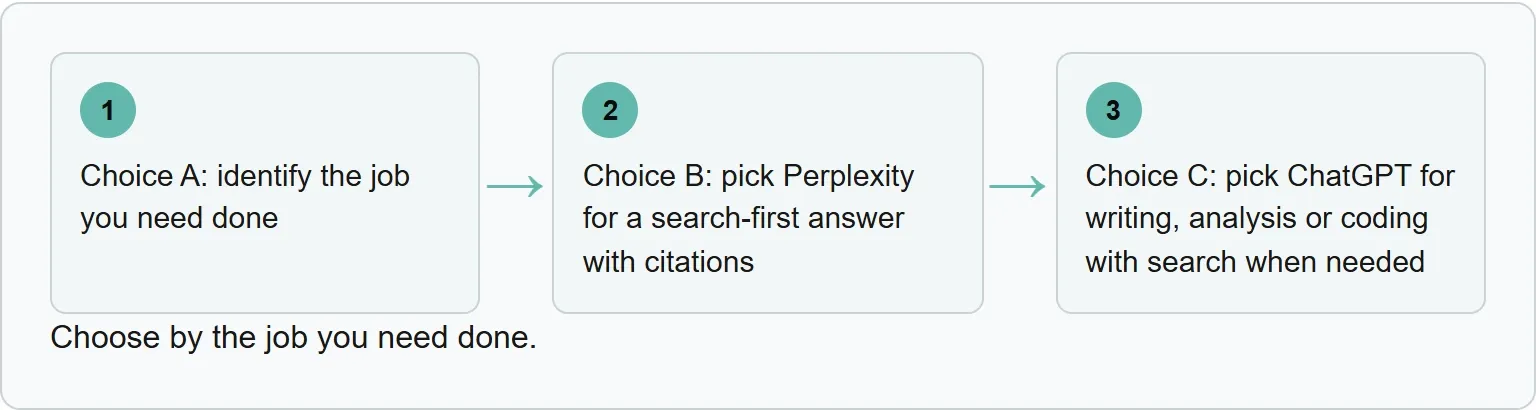
A simple decision flow
Choice A: identify the job you need done. Choice B: pick Perplexity for a search-first answer with citations. Choice C: pick ChatGPT for writing, analysis or coding with search when needed. Choose by the job you need done.
Try the same question in both
A good comparison uses one question and the same review rule. Ask both products a buyer question that needs recent sources. Then open the cited pages, note what each answer leaves out, and decide which format helps you reach a sound conclusion faster.
Our example (illustrative, not a real test)
Northstar Bicycle Lab asks: “Which cargo bike is better for a small delivery team, and what changed in the latest models?” The comparison below is a planned review layout, not a claim that we ran either product.
Product | Illustrative answer summary | Number of cited sources |
|---|---|---|
Perplexity | Compare the latest models, then keep the numbered product and review sources beside each claim. | Not measured because this is illustrative |
ChatGPT | Use a searched comparison as the starting point for a buying memo and delivery-team checklist. | Not measured because this is illustrative |
The useful winner is the one that shortens the buyer's whole task, not the one with the longer answer.
Do not count citations as a score by itself. One strong primary source can be more useful than several summaries. Judge whether the answer uses current pages, represents them fairly and makes the next action clear.
Where Xtrusio fits
Perplexity and ChatGPT both cite web pages, so brands need to know whether those answers mention them and which pages earn the citations. Xtrusio helps brands inspect AI answers and plan a response. Its free visibility check shows when ChatGPT and Gemini mention a business, which competitors appear instead and what to work on next.
Frequently asked questions
Is Perplexity better than ChatGPT for research?
Perplexity is better when you want a search-first answer and a prominent source trail. ChatGPT is better when the research must continue into writing, analysis, coding or work with files.
Does ChatGPT search the web for free?
Yes. OpenAI says web search is available on the Free plan and to people who are not signed in, subject to usage limits.
Which is cheaper?
Perplexity Pro is $17 per month when billed annually, checked 30 October 2026. ChatGPT offers Free, Go, Plus and Pro, but its public signed-out page did not display stable dollar amounts when checked. Compare the current page for your country before paying.
Topics
- perplexity vs chatgpt

Xtrusio
AI visibility research
Xtrusio is the Perception Engine for B2B brands.
Free check
See how AI engines answer about you
Get your free AI visibility check
Keep reading
 AI Tools Guide · Oct 30, 2026 · 8 min read
Codex CLI MCP: Setup, Commands and Troubleshooting
Configure an MCP server in Codex CLI, verify the saved entry and active connection, restrict tools, and troubleshoot startup or timeout failures. AI Tools Guide · Oct 30, 2026 · 6 min read
Claude Cowork Pricing: Plans, Billing and Usage Limits
Claude Cowork pricing explained: Pro, Max, Team and Enterprise access, billing cycles, usage limits and an illustrative annual-cost comparison. AI Tools Guide · Oct 30, 2026 · 8 min read