MCP vs API: What Each Connects and When to Use It
Short answer
An API is the interface one service exposes so other software can call it. MCP, the Model Context Protocol, is an open standard one layer up. It lets an AI app discover and call tools, data and prompts from many services in the same way.
An MCP server usually wraps one or more APIs. The AI app sends tools/list to see what the server can do, then tools/call to use a tool over JSON-RPC 2.0. Use a plain API when a normal app already knows the endpoint. Use MCP when a model must find and choose tools at runtime. Keep both when you serve apps and agents.
Say your team already has a working REST API and keeps hearing that it needs an MCP server. The REST API still does the work. MCP wraps it and adds the discovery an AI app needs.
What an API is, and what MCP adds
An API is a contract for software. A developer reads its documentation, writes code for named endpoints and handles the format that service expects. That direct path is useful when the caller and task are known in advance.
MCP was designed for a different integration problem. Before MCP, every new data source needed a custom connector. Developers can now build against one standard protocol instead. The MCP documentation compares the idea to a USB-C port for AI apps.
An MCP host creates one client for each server it connects to. The protocol defines three server features. Tools are functions a model can execute. Resources provide context and data. Prompts are reusable messages and workflows.
MCP uses JSON-RPC 2.0 between hosts, clients and servers. It standardizes the exchange, but it does not dictate how an AI app uses a model or manages its context.
MCP vs API at a glance
The key difference is not whether data crosses a network. It is whether a normal app already knows the operation or a model needs to discover it.
MCP vs API, checked 3 November 2026
Question | Plain API | MCP |
|---|---|---|
Who usually calls it? | A normal app with coded integration logic | An AI app through an MCP client |
How are capabilities found? | A developer reads documentation and codes the endpoint | The client can send |
What is the message format? | The API's own contract | JSON-RPC 2.0 for MCP messages |
How is it transported? | Whatever the API defines | Local stdio or remote Streamable HTTP |
How is access controlled? | The API's own scheme | Optional in MCP; environment credentials for stdio, OAuth 2.1 for protected remote servers |
How are errors returned? | Often through HTTP status codes and an API error body | JSON-RPC protocol errors or tool results with |
When is it a strong fit? | A known caller and a fixed operation | A model that must discover and select tools |
An agent picks a tool by reading its description and schema. In a similar way, AI apps describe your company from the public information they can read. Xtrusio checks those answers, the competitors that appear instead and the gaps worth fixing.
One request, two ways
The AI app's MCP client sends tools/list, the model picks a tool, the client sends tools/call, the MCP server calls the API, and the result comes back to the model.
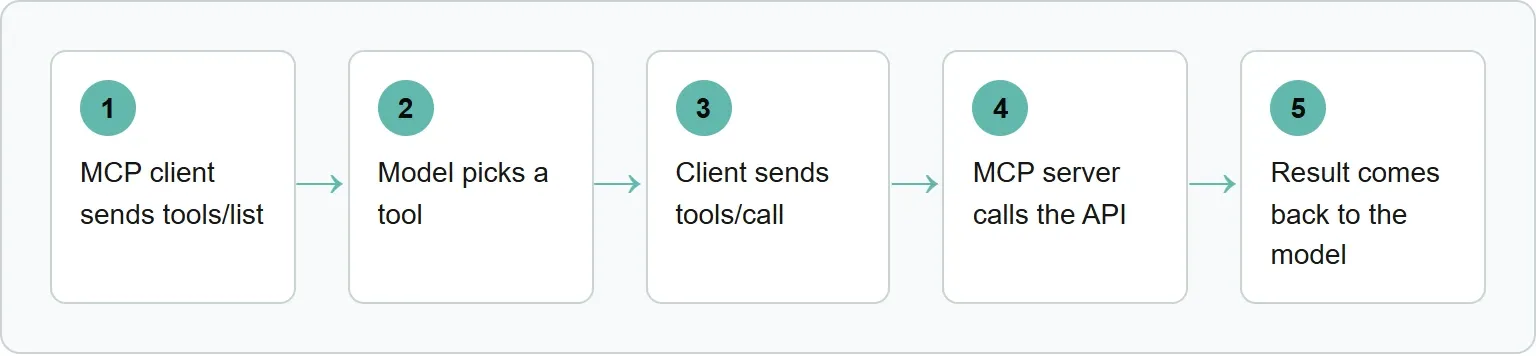
The first message is discovery. This is the request and response in the current Model Context Protocol specification.
{
  "jsonrpc": "2.0",
  "id": 1,
  "method": "tools/list",
  "params": {
    "cursor": "optional-cursor-value"
  }
}
{
"jsonrpc": "2.0",
"id": 1,
"result": {
"resultType": "complete",
"tools": [
{
"name": "get_weather",
"title": "Weather Information Provider",
"description": "Get current weather information for a location",
"inputSchema": {
"type": "object",
"properties": {
"location": {
"type": "string",
"description": "City name or zip code"
}
},
"required": ["location"]
},
"icons": [
{
"src": "https://example.com/weather-icon.png",
"mimeType": "image/png",
"sizes": ["48x48"]
}
]
}
],
"nextCursor": "next-page-cursor",
"ttlMs": 300000,
"cacheScope": "public"
}
}Source: Model Context Protocol specification, Tools, 28 July 2026, read 3 November 2026.
A normal app hard-codes an endpoint after a developer reads the API documentation. A model can instead read each tool's description and inputSchema at runtime. Those fields tell it which tool fits and which arguments to build.
When the model chooses the weather tool, the client sends the specification's call message.
{
  "jsonrpc": "2.0",
  "id": 2,
  "method": "tools/call",
  "params": {
    "name": "get_weather",
    "arguments": {
      "location": "New York"
    }
  }
}
{
"jsonrpc": "2.0",
"id": 2,
"result": {
"resultType": "complete",
"content": [
{
"type": "text",
"text": "Current weather in New York:\nTemperature: 72°F\nConditions: Partly cloudy"
}
],
"isError": false
}
}Source: Model Context Protocol specification, Tools, 28 July 2026, read 3 November 2026.
Our example (illustrative). Behind that tool, the MCP server could translate the arguments into an ordinary HTTP request. This made-up example.com endpoint is not a live service or a test result.
GET /weather/current?location=New%20York HTTP/1.1
Host: api.example.com
Accept: application/json
The API still owns the weather operation. MCP gives the model a standard way to discover it, describe its input and call it.
How errors differ
MCP tools report errors in two ways. A malformed request or unknown tool is a protocol error returned as a standard JSON-RPC error. A failure inside the tool, such as an upstream API failure or invalid input, appears in the tool result with isError set to true.
The distinction matters because a model can see a tool execution error and try to correct its arguments. A normal HTTP API often signals failure with a status code and a service-specific error body. The app's integration code decides what to do next.
Authorization: where MCP and APIs differ
Authorization is optional in MCP. A local server using stdio should get credentials from its environment instead of following the remote authorization specification. A protected remote MCP server acts as an OAuth 2.1 resource server and accepts access tokens.
Streamable HTTP can also carry bearer tokens, API keys and custom headers. MCP recommends OAuth for obtaining tokens. The API behind a tool still enforces its own access rules, so wrapping an API does not remove its authentication or authorization checks.
The cost of the extra layer
MCP adds a JSON-RPC protocol hop on top of the backend API call. In Microsoft's comparison, custom MCP was about 15 to 25% slower than REST because of that overhead. The same comparison reported 50 to 80% fewer LLM tokens.
Those figures belong to Microsoft's comparison, not every MCP deployment. Network distance, tool design, payload size and model behavior can change the result. Measure your own route before setting a latency target.
There is also a control cost. The MCP specification says hosts must get explicit user consent before invoking a tool. It also says a human should be able to deny a tool invocation.
When to use MCP, an API, or both
“Recommendation: Choose based on your primary consumer. If it's an LLM agent, use MCP. If it's a regular app, use REST. If it's both, go hybrid.”Microsoft Community Hub, Azure Architecture Blog, 5 March 2026.
Use a plain API when you are building a mobile app, web app, scheduled job or service that knows the operation it needs. The direct contract is easier to test, cache, monitor and optimize.
Use MCP when a model must inspect available capabilities, choose among them and supply arguments at runtime. It is also useful when several AI hosts need the same tool descriptions and call pattern.
Use both when your API already serves normal applications and you also want AI apps to use the same business functions. Keep the API as the system of record. Put the MCP server in front as a discovery and translation layer.
- Choose API: the caller and endpoint are fixed in code.
- Choose MCP: the model needs to discover and select a tool.
- Choose both: regular apps and AI apps need the same backend capability.
- Delay MCP: no AI app needs the capability yet, or the extra hop has not earned its operational cost.
Where Xtrusio fits
MCP and APIs decide how software reaches a capability. They do not show whether public AI systems can find your company, cite the right pages or mention a competitor instead. Xtrusio checks those public answers and shows what to work on next. Get your free AI visibility check.
Sources
- Model Context Protocol, Introduction, version 2026-07-28, read 3 November 2026.
- Model Context Protocol specification, version 2026-07-28, read 3 November 2026.
- Model Context Protocol specification, Tools, version 2026-07-28, read 3 November 2026.
- Model Context Protocol specification, Transports, version 2026-07-28, read 3 November 2026.
- Model Context Protocol specification, Authorization, version 2026-07-28, read 3 November 2026.
- Model Context Protocol, Architecture overview, read 3 November 2026.
- Anthropic, Introducing the Model Context Protocol, 25 November 2024.
- Microsoft Community Hub, API vs MCP decision matrix, 5 March 2026.
Frequently asked questions
Is MCP replacing APIs?
No. MCP tools can call APIs, and an MCP server often wraps existing API operations. Use the API as the backend contract and MCP as the model-facing discovery and call layer when you need both.
Does MCP need OAuth?
Not always. Authorization is optional. Local stdio servers should get credentials from the environment. Protected remote servers use the OAuth 2.1 resource-server model.
Is MCP slower than an API?
It adds a protocol hop. Microsoft's comparison found custom MCP about 15 to 25% slower than REST, but your result depends on the route and workload.
Can one MCP server wrap several APIs?
Yes. MCP tools can call APIs and other external systems. A server can expose a coherent tool set backed by more than one service.
Topics
- mcp vs api

Xtrusio
AI visibility research
Xtrusio is the Perception Engine for B2B brands.
Free check
See how AI engines answer about you
Get your free AI visibility check
Keep reading
 Technical SEO · Nov 3, 2026 · 5 min read
Claude Code Sandbox: What It Blocks and How to Turn It On
See what the Claude Code sandbox blocks, what stays outside it, how to enable it and the official probes that show whether it works. Technical SEO · Nov 3, 2026 · 7 min read
Claude Code Security Review: What It Checks and Its Limits
Learn what Claude Code security review checks, how to run the command and GitHub Action, what it skips, and when human review is still needed. Technical SEO · Nov 3, 2026 · 7 min read