Claude Code Sandbox: What It Blocks and How to Turn It On
Short answer
The Claude Code sandbox is an operating-system boundary around the shell commands Claude runs: Bash, PowerShell and Monitor commands, plus the processes they start. It is off by default. Turn it on with /sandbox or set sandbox.enabled to true in a settings file.
The boundary limits writes and network access, but it does not make the whole application a sealed container. Commands can still read most of the machine unless you deny paths, and Claude's file tools, MCP servers and hooks run outside the sandbox.
A developer turns on /sandbox to stop approving every routine shell command and assumes Claude is now boxed in. Anthropic says sandboxing reduced permission prompts by 84% in its internal usage. The useful boundary is real, but it covers shell commands rather than every tool and service Claude Code can reach.
What the sandbox blocks by default
Anthropic documents these defaults for sandboxed commands.
Claude Code sandbox defaults, checked 3 November 2026
Access | Default reach | Setting that changes it |
|---|---|---|
Writes | Working directory, per-user temp directory and added directories | |
Reads | Most of the machine, including | |
Network | No direct route; a local proxy checks hosts against an initially empty allowlist | |
Environment variables | Inherited from Claude Code, including secrets in its environment | |
Source: Anthropic, Claude Code sandboxing, read 3 November 2026.
The same distinction matters when a model describes your company: controls on a local command do not change what ChatGPT or Gemini can find and say about your brand. Xtrusio checks those public answers, the competitors that appear instead and the gaps worth fixing.
What runs outside the sandbox
The sandbox wraps shell commands and their child processes. Built-in file and web tools follow permission rules instead. Command hooks, local MCP servers, plugin monitors, LSP servers and helper commands run with the user's access.
Inside or outside the Claude Code sandbox
Thing | Where it runs |
|---|---|
Shell commands and their child processes | Inside, when sandboxing is enabled |
Built-in file and web tools | Outside; permission rules apply |
MCP servers, hooks and helper processes | Outside |
Commands matching | Outside |
Commands typed at the | Usually outside |
An approved unsandboxed retry | Outside |
Subagent shell commands | Follow the parent session's sandbox |
To place the whole Claude Code process behind one boundary, Anthropic suggests a container, virtual machine or the sandbox runtime.
How to turn on the sandbox
Follow these steps in a supported environment.
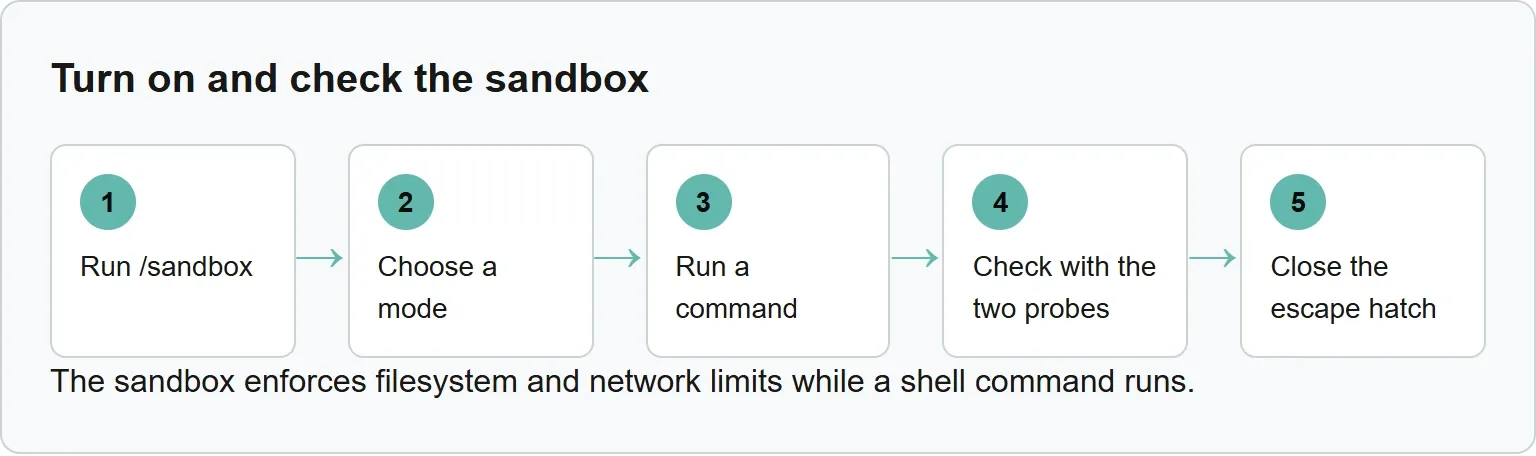
- Run
/sandbox. The command opens the sandbox panel. - Choose a mode. Auto-allow runs sandboxed commands without prompting, while regular permissions keeps normal prompts.
- Run a command. Ask Claude to run a build, test or another harmless command.
- Check with the two probes. Ask Claude to run the official filesystem and network checks below.
- Close the escape hatch. Disable unsandboxed retries when you need a strict boundary.
The panel saves a chosen mode to .claude/settings.local.json. The sandbox works on macOS, Linux and WSL2, but not native Windows. Linux and WSL2 use bubblewrap and socat; macOS uses Seatbelt.
For one session, Anthropic gives this command:
claude --settings '{"sandbox": {"enabled": true, "allowUnsandboxedCommands": false}}'Source: Anthropic, Claude Code docs, Configure the sandboxed Bash tool, read 3 November 2026.
Check the sandbox is really on
Ask Claude to run these commands. Typing them yourself at the ! prompt does not test the sandbox because that prompt usually runs outside it.
touch ~/sandbox-probe
curl --noproxy '*' https://example.com
The first command should fail with Operation not permitted on macOS or Read-only file system on Linux and WSL2. The second should fail with Could not resolve host because it bypasses the proxy and has no direct network route.
These are Anthropic's checks, not a test we ran on this computer. Decline if Claude offers to retry either command outside the sandbox.
Close the escape hatch
By default, Claude can ask to retry a blocked command outside the sandbox. Set allowUnsandboxedCommands to false to remove that route. Set failIfUnavailable to true when Claude Code must stop instead of falling back to unsandboxed commands if the sandbox cannot start.
{
  "sandbox": {
    "enabled": true,
    "failIfUnavailable": true,
    "allowUnsandboxedCommands": false
  }
}
Source: Anthropic, Claude Code docs, Configure the sandboxed Bash tool, read 3 November 2026.
Sandbox vs permissions vs containers
Permission rules decide which tools Claude Code can use before a tool runs. The sandbox enforces filesystem and network limits while a shell command runs. The controls are complementary.
A container or virtual machine can wrap the entire Claude Code process, including tools and services that the shell sandbox leaves outside. That is the broader boundary to consider for unattended or higher-risk work.
What the sandbox does not protect against
These limits still matter after sandboxing is enabled.
- It does not inspect TLS traffic by default.
- A broad allowed domain can still create a path for data to leave.
- Allowing the Docker socket effectively grants access to the host.
- Secrets in readable files and inherited environment variables remain exposed unless you deny or scrub them.
A stricter settings example
Our example (illustrative). This user-level settings.json closes the fallback, readable-credential and open-network gaps described above.
{
  "sandbox": {
    "enabled": true,
    "failIfUnavailable": true,
    "allowUnsandboxedCommands": false,
    "filesystem": {
      "denyRead": ["~/.ssh", "~/.aws"]
    },
    "network": {
      "allowedDomains": ["github.com", "registry.npmjs.org"]
    }
  }
}
enabled turns on the shell boundary.
failIfUnavailable stops Claude Code from falling back when the sandbox cannot start.
allowUnsandboxedCommands set to false removes the retry outside the sandbox.
filesystem.denyRead blocks sandboxed commands from reading the two credential directories.
network.allowedDomains limits the proxy to the two named hosts.
Avoid a broad wildcard domain because it can reopen a route for data to leave.
Source: Anthropic, Claude Code sandboxing, read 3 November 2026.
Verdict
Turn on the sandbox, remove its fallback and narrow the files and hosts shell commands can reach, but use broader isolation when the whole process needs a boundary. For the separate question of how public AI systems describe your company, Get your free AI visibility check.
Sources
- Anthropic: Claude Code sandboxing, read 3 November 2026
- Anthropic engineering: Claude Code sandboxing, read 3 November 2026
- Anthropic: Claude Code settings, read 3 November 2026
Frequently asked questions
Does the sandbox work on native Windows?
No. It works on macOS, Linux and WSL2. Claude Code commands run unsandboxed on native Windows.
Does it cover MCP servers?
No. Local MCP servers and hooks run outside the shell sandbox.
Are subagents sandboxed?
Their shell commands follow the parent session. If sandboxing is enabled in the parent, subagent shell commands are sandboxed.
Is the sandbox on by default?
No. Run /sandbox or enable it in settings.
Topics
- claude code sandbox

Xtrusio
AI visibility research
Xtrusio is the Perception Engine for B2B brands.
Free check
See how AI engines answer about you
Get your free AI visibility check
Keep reading
 Technical SEO · Nov 3, 2026 · 7 min read
MCP vs API: What Each Connects and When to Use It
See how MCP differs from an API, how tools/list and tools/call work, and when to use MCP, an API or both. Technical SEO · Nov 3, 2026 · 7 min read
Claude Code Security Review: What It Checks and Its Limits
Learn what Claude Code security review checks, how to run the command and GitHub Action, what it skips, and when human review is still needed. Technical SEO · Nov 3, 2026 · 7 min read