Do Google AI Overviews Reduce Website Clicks? What the Experiment Actually Proves
Short answer
Headlines that quote one percentage skip what matters: which estimate, for which search experience, and what it can and can't tell a publisher.

Separate the two search experiences first
The August 2026 arXiv preprintstudies three conditions: attempted removal of AI features, unchanged Google Search and forced AI Mode. Its behavioral sample included 1,100 US users. Treatment lasted seven days after a shared three-day baseline. It is a preprint and has not been peer reviewed.
The design graphic distinguishes those assignments. Removing features for a user is different from excluding one publisher's content while the features remain available.
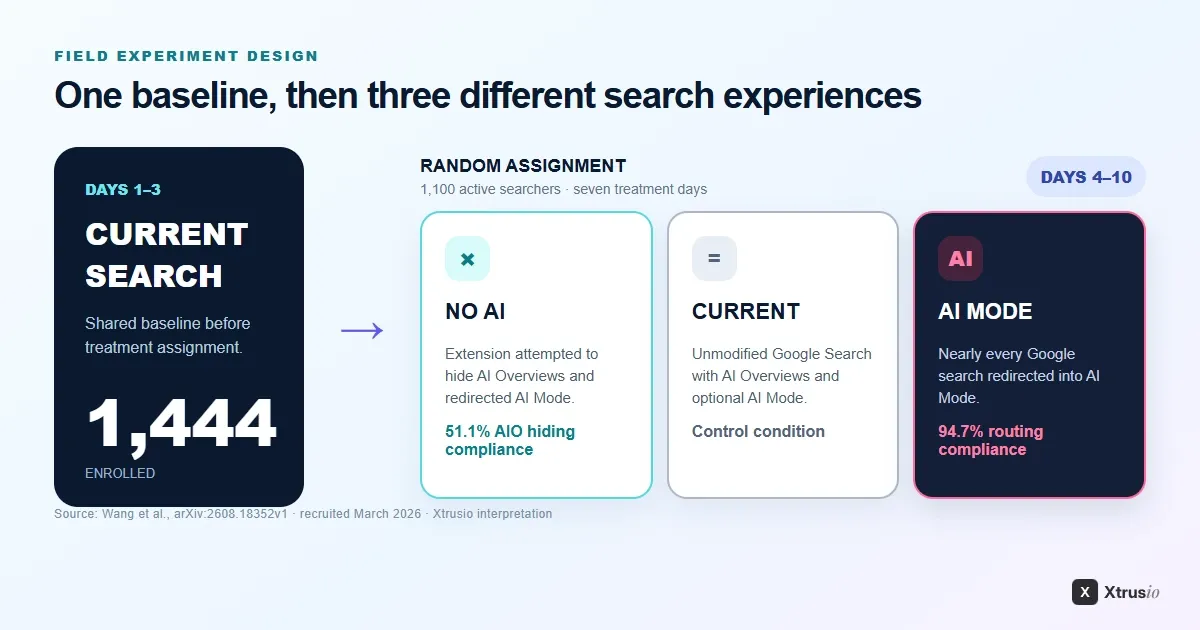
This explanatory graphic describes the research design. It is an illustration, not a Google screenshot or a new experiment.
Read the AI Overview estimate with its uncertainty
The table keeps the original units and separates the question answered by each estimate. Positive values mean more external clicking under the No AI condition; the negative AI Mode value means less clicking.
Comparison | Estimate type | Click-through change | 95% interval | What it supports |
|---|---|---|---|---|
No AI assignment vs current Search | ITT | +2.7 percentage points | −0.7 to +6.2 | Assignment result is statistically inconclusive |
No AI exposure vs current Search | LATE | +8.8 percentage points | +2.3 to +15.3 | Conditional compliance-adjusted estimate |
Forced AI Mode vs current Search | ITT | −18.8 percentage points | −22.2 to −15.3 | Effect of forced assignment in this study |
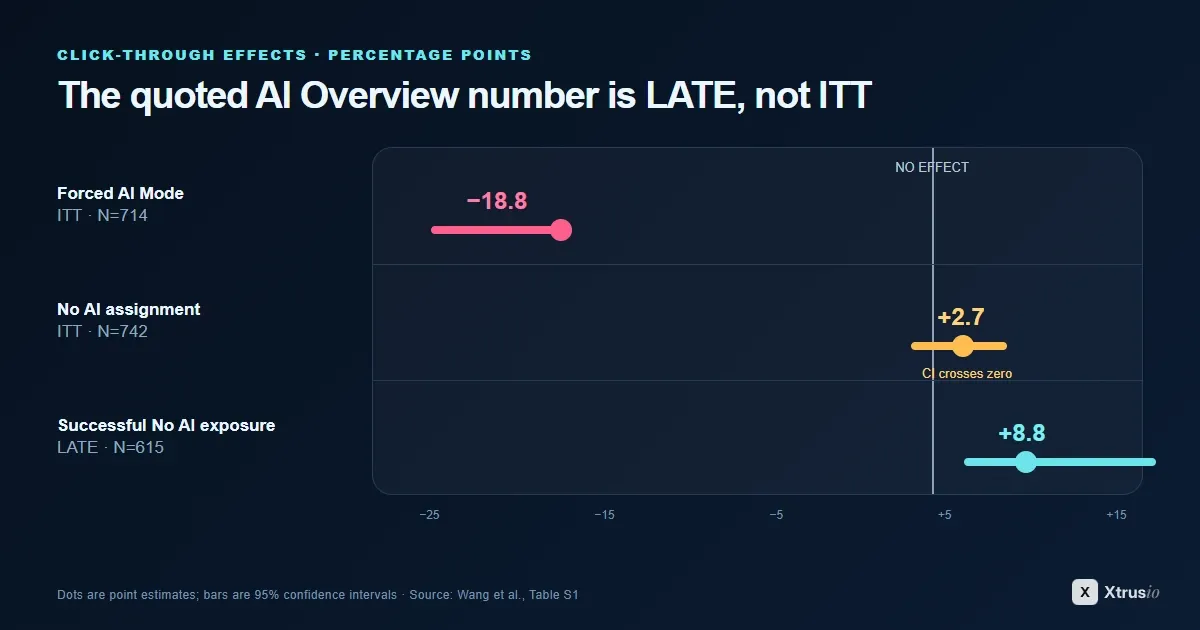
The chart's No AI LATE row represents a continuous exposure model, not a simple comparison of everyone whose blocker worked against everyone else's.
Intent to treat, or ITT, keeps people in their assigned groups. It answers what happened when the treatment was assigned, including imperfect delivery. An interval that crosses zero does not establish either a positive effect or no effect. It signals uncertainty at the stated confidence level.
Ask what a publisher can actually verify
The useful next step is to separate a research estimate from your site's exposure, actual visits and qualified outcomes. A page appearing in an answer establishes visibility; it does not show that the user clicked, or would have clicked without the answer.
Xtrusio can record your agreed buyer questions, the answers Google returns and the URLs it cites, so you can line them up with later changes in your own data. Monitoring cannot recreate the study's random assignment or supply private site analytics that have not been provided.
Keep those records alongside your own search and analytics data. They can help explain which page or claim to inspect, while leaving the traffic effect open. This prevents a visible citation from being counted as a recovered visit or a completed article from being counted as a business result.
Why is the compliance-adjusted result conditional?
Local average treatment effect, or LATE, asks about exposure changed by assignment under additional assumptions. In this paper, the blocker hid 51.1% of AI Overview exposures overall. The authors used continuous compliance and excluded users with no AI Overview exposures from that LATE analysis outside preregistration. The model assumes assignment affects the outcome through the exposure being estimated; the paper cautions that a broader interface change could violate that assumption.
Check what goes into the denominator
The study's click-through measure divides each user's external Google clicks by Google searches, excluding vertical searches and Google destinations. Its main denominator counts AI Mode turns separately. A conversation-based check still found a reduction, but at 14.9 percentage points. The methods and robustness tables specify these choices.
A Search Console ratio instead divides reported site clicks by reported site impressions. An analytics conversion rate might divide qualified actions by sessions. All can be useful, but changing the denominator changes the question. A decline in one rate cannot be pasted onto another measure simply because both are called a percentage.
For a purely hypothetical illustration, a rate falling from 40% to 31.2% is down 8.8 percentage points, or 22% relative to its starting value. That arithmetic is not the experiment's observed publisher baseline or a forecast. Multiplying a site's traffic by 8.8% would answer neither question correctly.
A publisher worksheet can change the decision
The following numbers are invented for teaching. Assume the same landing-page cohort, country/device scope, complete comparison periods and consistently measured qualified action. No site test, customer result or AI-caused change is claimed.
Cohort measure | Earlier period | Later period | Reading |
|---|---|---|---|
Total Search impressions | 10,000 | 12,000 | Search exposure rose 20% |
Organic Search clicks | 500 | 600 | Clicks rose 20% |
Qualified actions from those visits | 25 | 24 | Actions fell 4% |
Clicks per 1,000 Search impressions | 50 | 50 | Click yield stayed constant |
Actions per 1,000 Search impressions | 2.5 | 2.0 | Outcome yield fell 20% |
Actions per Search click | 5% | 4% | Visit-to-action rate fell 1 percentage point |
More clicks would not settle this publisher's concern. The next checks concern intent mix, tracking consistency, landing-page experience and action quality. The worksheet does not identify AI as the cause. A demand change, ranking shift or different visitors could produce the same pattern.
Define what counts as a qualified action before comparing periods. A form submission, valid sales inquiry and subscription are different outcomes. If analytics cannot reliably join the outcome to these organic visits, leave the business layer unknown rather than multiplying an estimated click effect by an assumed visitor value.
Use Google's report for the layer it measures
Google's current generative AI report documentationdescribes impressions from AI Overviews and AI Mode together. Pages, countries, devices and dates supply scope; the report does not provide an AI Overview-only click rate. Google dates the report's worldwide rollout to August 31, 2026.
The screenshot below is from Xtrusio's own Search Console property on September 28. It shows the selected three-month, Web (text) report with 248 impressions and Pages, Countries, Devices and Days. The chart covers August 2 to September 25. The account avatar is blurred; report values are unchanged.
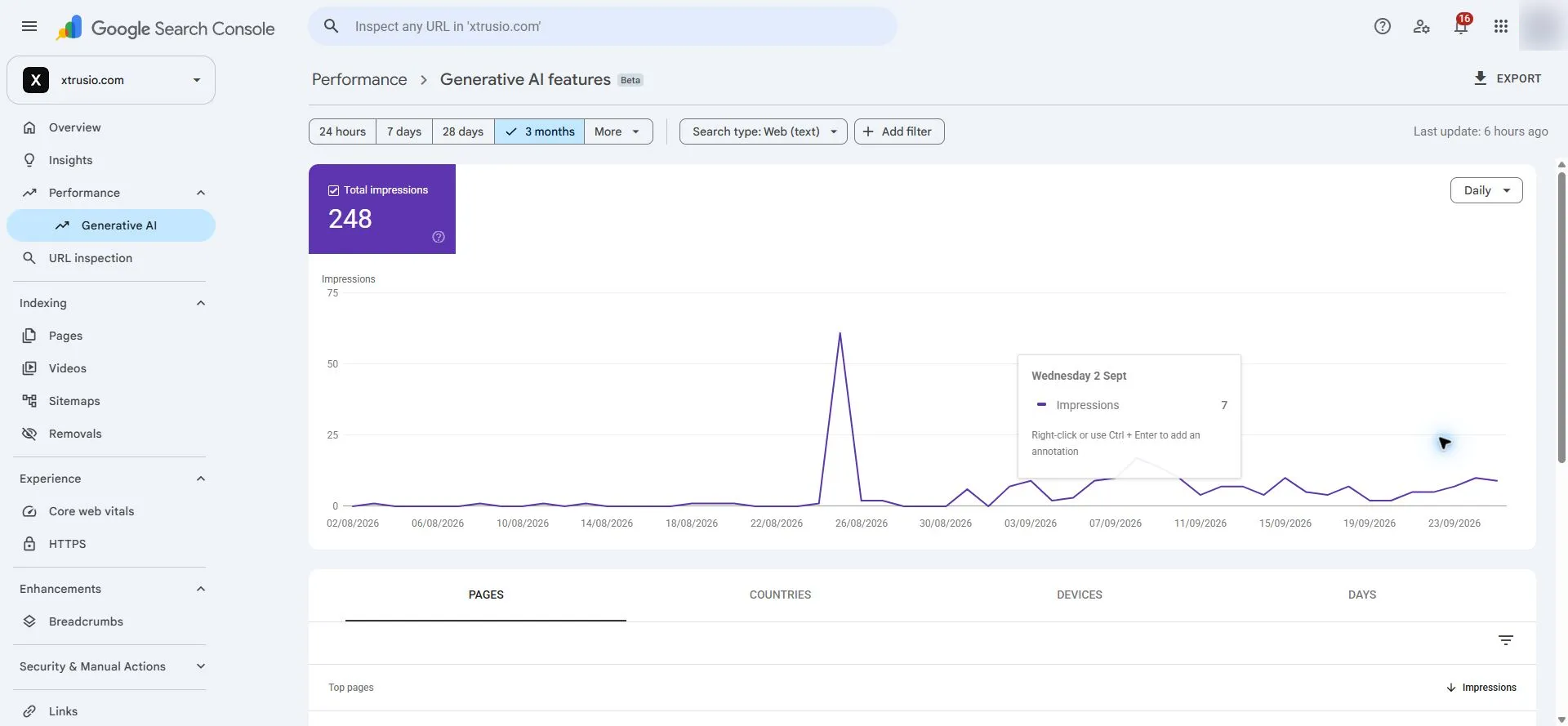
This is a dated property-level observation. It contains no exact buyer question, split by AI Overview versus AI Mode, external-click count or conversion result. It therefore illustrates the exposure layer without proving click loss or the effect of a content edit.
Keep aggregation consistent. Google distinguishes property totals from page-level table counts, and report dates use Pacific Time. Its exports can convert unavailable display markers into zeros; preserve their status before treating a zero as measured absence. These reporting details matter more than selecting a convenient multiplier.
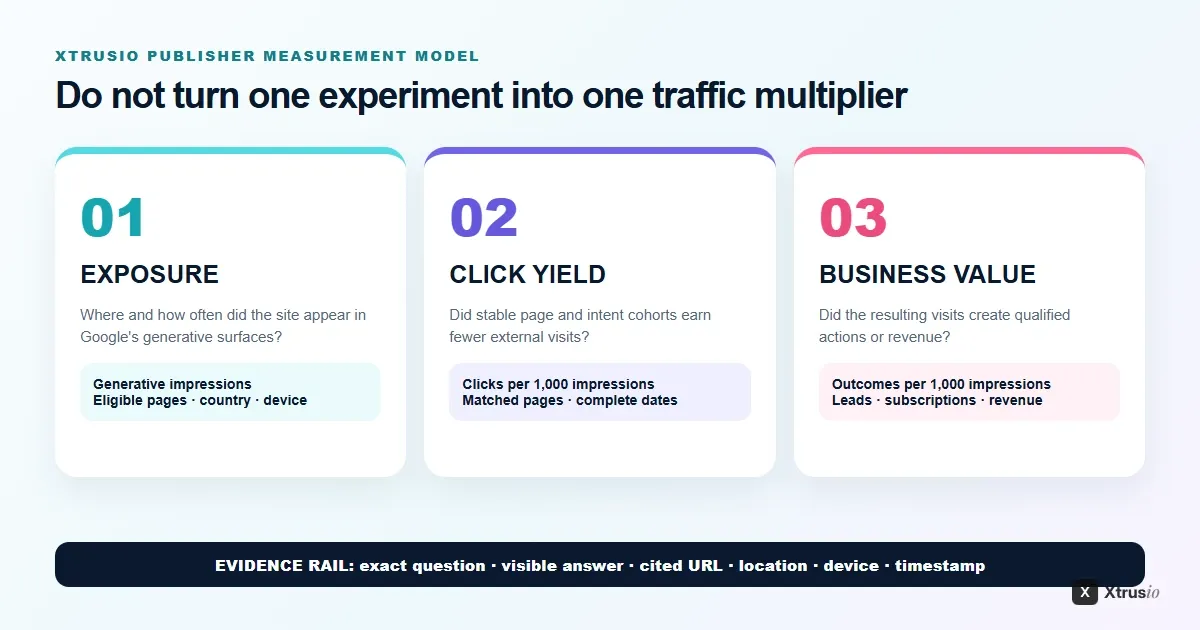
The original graphic separates exposure, click yield and business value. It is a conceptual model, not evidence that multiplying three terms identifies an observed causal business impact.
Evidence layer | Preserve | Useful comparison | Boundary |
|---|---|---|---|
Generative exposure | Property, pages, dates, country/device and report scope | Comparable impression trends | Combined surfaces; not site visits |
Search click yield | Complete clicks and impressions for the fixed cohort | Clicks per 1,000 Search impressions | Demand, rank and layout also matter |
Business value | Consistent qualified-action definition and attribution | Actions per 1,000 Search impressions | No assumed zero-click revenue effect |
Exact-result inspection | Question, answer, cited URL, date and context | Inspect what the response actually supports | Sample observations, not all Google searches |
Opting out tests a different intervention
Google's current control documentation says exclusion prevents the site's links and content appearing in covered generative features. Other sources remain available. The control does not act as a ranking or inclusion signal for other Search results, and it is separate from AI training controls.
That is different from hiding the feature for users. Excluding one publisher does not remove the answer or promise that the user will visit that publisher through classic results instead. No exclusion was performed or observed for this article. The experiment alone cannot justify an opt-out recommendation for every site.
Google's August 2025 traffic statement describes aggregate organic clicks as relatively stable. Its quality-click definition concerns users not quickly returning to Search, not a verified lead or purchase. That platform observation and a randomized interface comparison answer different questions; neither establishes your site's outcome.
Decide which page deserves investigation
Choose a cohort whose reader intent and business purpose are clear. Use complete comparable periods and retain a change log for rankings, content, templates, tracking and control settings. A matched reference cohort can help diagnosis, but it does not automatically randomize exposure or remove confounding.
For an answer-complete page, inspect whether the useful next step survives the summary. For a research or transaction page, check whether the visit delivers current evidence, a tool or a decision the reader still needs. Improve that specific value; do not promise that adding it recovers an experimental percentage of traffic.
The AI Overview tracking guide covers question and source inspection; the GEO measurement guide supplies a wider metric dictionary. For your own agreed questions and available evidence, request a scoped free Xtrusio evaluation.
Frequently asked questions
How much did AI Mode reduce click-through rate in the experiment?
Assignment to forced AI Mode reduced external click-through rate by 18.8 percentage points compared with current Google Search. The 95% confidence interval ranged from 15.3 to 22.2 points lower. This is an intent-to-treat estimate from the experiment, not a universal website forecast.
Did hiding AI Overviews increase external clicks by 8.8 percentage points?
The 8.8-point result is a compliance-adjusted LATE estimate using continuous exposure, under additional assumptions; users with no AI Overview exposures were excluded from that analysis. Assignment to No AI produced a 2.7-point ITT estimate whose confidence interval included zero. It is not a simple comparison of successfully hidden participants.
Why are ITT and LATE different?
ITT compares everyone according to randomized assignment. LATE estimates the effect among participants whose treatment changed because of that assignment, using additional assumptions. The distinction mattered because Google's markup change caused the AI Overview blocker to work for only 51.1% of exposures overall.
Should publishers opt out of Google AI features because of this study?
Not on this evidence alone. The experiment changed the search experience for users. A publisher opt-out removes only that site's eligibility for generative impressions and traffic while other sources can remain. Those interventions answer different causal questions.
How should a website measure possible AI-search click loss?
Track generative AI impressions, total Search impressions and clicks, exact question-level appearances, landing-page engagement and qualified outcomes on stable page and intent cohorts. Treat matched pre-and-post comparisons as diagnostics unless the design supports a causal claim.
Topics
- do Google AI Overviews reduce clicks
- AI Overviews click-through rate
- Google AI Mode publisher traffic
- AI search referral traffic
- AI Overviews traffic study

Xtrusio
AI visibility research
Xtrusio is the Perception Engine for B2B brands.
Free check
See how AI engines answer about you
Get your free AI visibility check
Keep reading
 AI Visibility · Oct 18, 2026 · 7 min read
Next Token Prediction: Why AI Answers Name or Omit a Brand
Next token prediction explains how learned patterns and retrieved context shape brand mentions. Use an anonymized scan example to choose the next action. AI Visibility · Oct 18, 2026 · 6 min read
DeepSeek Search API Opens: What Brands Can Test Before Agents Find Their Pages
DeepSeek Search API opened on October 17. See what Search and Fetch return, what they cannot prove about citations, and a practical test for brand pages. AI Visibility · Oct 18, 2026 · 9 min read