What are the best plagiarism and AI content detection tools: A Practical, Evidence-Led Comparison
Short answer
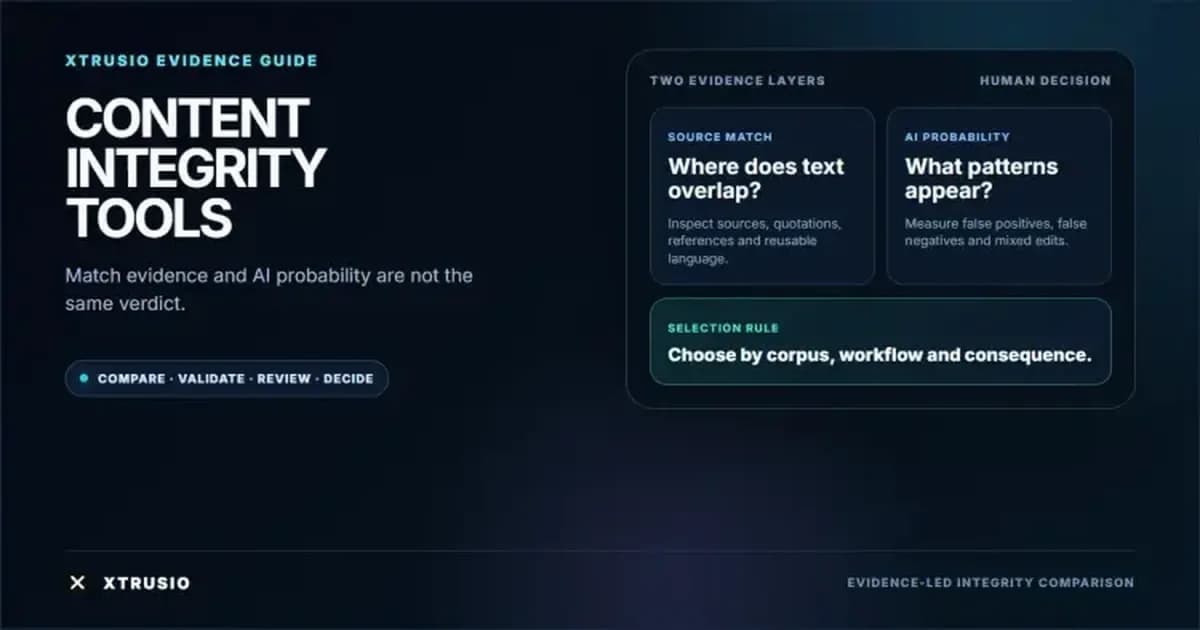
Choose a plagiarism and AI content detection tool by the documents you review and the decision you need to make. Turnitin Originality fits institutional education; iThenticate fits scholarly manuscripts; Copyleaks fits integrated screening; Originality.ai fits editorial review; Grammarly fits checks during revision; GPTZero fits education and writing-process review; and Pangram is worth testing where false accusations are a major concern. Source matching and AI classification require separate review, and neither proves misconduct by itself.
Company | Best for | Covers | Starting price | Ask before buying |
|---|---|---|---|---|
Turnitin Originality | Institutional education and academic integrity review | AI-writing indicators, authorship and document insights alongside institutional similarity workflows | Institutional quote | Which licenses, languages and review tools does our institution receive? |
iThenticate | Scholarly manuscripts and publishing review | Similarity reports; individual credits exclude AI detection | $125 for one manuscript up to 25,000 words, before tax | Do we need individual similarity credits or an organizational AI-writing license? |
Copyleaks | Combined screening and integrated workflows | Source matching and AI classification; API and education scope quoted separately | Personal $13.99/month billed $167.88 annually | Which allowance applies to our billing term, and is API access included? |
Originality.ai | Editorial screening and team review | AI and plagiarism checks on paid plans; free Basic is AI-only | Free Basic; Pro $12.95/month billed $155.40 annually | How are combined checks charged, and which plan includes our API and seats? |
Grammarly | Source and citation review while revising | Writing assistance; Pro includes plagiarism and AI checks | Pro $12/member/month billed $144 annually | Are the checks available in our editor, account and institutional settings? |
GPTZero | Education screening and writing-process review | Similarity and AI reports, with writing-process tools | Free: up to 10,000 words/month for plagiarism checks | What are the current paid price, per-scan limit and batch allowance? |
Pangram | Pilots where mistaken AI flags are costly | AI analysis; paid Individual includes plagiarism detection | Free AI allowance; Individual $20/month billed annually | How does the current model handle our human and mixed-edit samples? |
Xtrusio | Planning and publishing after content clears integrity review | Buyer-question research, writing, publication and later answer checks; not a detector | Free self-serve plan; managed service with a free trial, then tiered plans (details on request) | Who completes the integrity review before content is published? |
Features and prices above are documented by each vendor on its public pages, checked October 1, 2026. Prices are in US dollars with the stated billing term. A free AI allowance is not automatically a free similarity allowance. Use the shortlist to choose a trial, then judge reports on your own documents.
What does a similarity score mean compared with an AI score?
A similarity checker finds text overlapping with sources in its comparison database. A reviewer then checks the matched passage, the source and the attribution. An AI detector classifies patterns in the submitted text. Its score does not identify an original source or reconstruct how the writer produced the document.
Turnitin's similarity guidance says its system highlights matches for review rather than deciding whether plagiarism occurred. Correctly quoted material can still match. A bibliography, approved template or earlier submission also needs context before a reviewer draws a conclusion.
For a simple example, a report flags a 60-word quotation in a 1,000-word article. The reviewer should check the quotation marks, attribution and original source. Removing a legitimate quotation simply to reduce a percentage would not improve the article's integrity. A low match score also doesn't verify every claim and citation.
Turnitin's AI Writing Report guidance separates the AI result from the similarity score and warns against using it alone for an adverse action. Its percentage concerns qualifying prose, not necessarily every word in the file. A submission needs at least 300 words of prose and must not exceed 30,000 words; scores above zero but below 20% are not surfaced as numerical percentages. A reviewer must interpret the actual report state rather than assume all detectors' percentages mean the same thing.
What should you ask each checker to show in a trial?
Ask each provider to check the same permitted sample and show the report parts your reviewer needs. Classroom work may need submission history and educator review; a journal submission may need scholarly source matches; an editorial team may need shared reports and clear revision ownership. Automated screening also needs failure handling and access controls.
Checker | Workflow fit | Ask to see | Confirm before paying |
|---|---|---|---|
Turnitin Originality | Institutional education and investigation | Similarity context, separate AI report, authorship insights and document details | Institutional access; the educator applies policy and reviews broader evidence |
iThenticate | Research manuscripts and publisher review | Matched passages, source documents, exclusions and accepted manuscript revisions | Individual submission credits provide similarity reports without AI-writing reports |
Copyleaks | Combined checks or an integrated screening process | Source-match report, separate AI findings and returned API or integration records | Personal pricing does not include enterprise API or learning-system access |
Originality.ai | Editorial review and shared scan records | Exact submitted version, selected scan types, report and reviewer notes | Credit use, seats and API access depend on the purchased plan |
Grammarly | Writer-side revision and citation correction | Highlighted passages, source references and the writer's revisions | Checks depend on the supported editor and account settings |
GPTZero | Education review and writing-process context | Similarity sources, AI classification and available writing-history evidence | Characters per request, batch limits and plan allowances need separate confirmation |
Pangram | A local pilot emphasizing false-positive risk | Document-level and segment-level findings, source matches and reviewer resolution | A past study cannot predict results on your workload |
Turnitin Originality supports institutional integrity review. Its license guidance directs institutions to a tailored quote. It is not an individual subscription with a universal public monthly fee.
iThenticate's individual offer includes five revisions with the $125 single-manuscript package. Its $300 package covers up to three manuscripts or one up to 75,000 words. Neither individual package includes AI detection. Organizational scope is quoted separately. Check the account term too: the landing page describes 12-month validity, while its credits guide distinguishes account expiry from unused credits. Confirm the terms for your account before paying.
Copyleaks pricing shows Personal at $16.99 on monthly billing. The monthly card lists 100 credits, up to 25,000 words; the annual card lists 1,200 credits, up to 300,000 words. Confirm how the allowance is allocated over the year. Its pricing FAQ assigns API access and learning-management integrations to custom education or enterprise scope. The API documentation supports integration research, but access still depends on the agreement.
Originality.ai's pricing lists Pro at $14.95 monthly or $12.95 per month billed yearly. Pro includes 2,000 monthly credits, with one credit corresponding to 100 words; unused subscription credits expire monthly. Basic permits three AI-only scans daily, up to 2,000 words each. Do not assume a nominal word allowance buys every combination of checks at the same cost. The pricing page lists API access under Enterprise, so confirm the needed entitlement.
Grammarly Pro pricing is $30 per member on monthly billing or $144 annually. Its plan page includes plagiarism and AI checks in Pro. The usage-limit guide lists 300 documents or 150,000 words in 30 days and a 100,000-character Grammarly Editor limit. Verify your actual editor and institutional settings rather than treating a writing subscription as unrestricted screening infrastructure.
GPTZero's plagiarism page currently documents the free 10,000-word monthly allowance. The free plan is the entry offer here. Confirm the current paid offer on its pricing page, including billing term, characters per request, batch uploads, overages and required report types. A higher word allowance is useful only if it covers the actual documents and reports you need.
Pangram's pricing lists free AI scanning up to 2,000 words daily and Individual at $20 per month billed annually, with up to 300,000 words monthly. Plagiarism detection is listed with the paid Individual plan. A team's education, API or integration requirement should be priced for that scope rather than inferred from the personal allowance.
What do independent detector studies show?
The University of Chicago working paper Artificial Writing and Automated Detection, version August 26, 2025, compared Pangram, Originality.ai, GPTZero and a RoBERTa baseline across six genres. Pangram met the authors' 0.5% false-positive policy cap with strong detection in that corpus. Appendix D identifies Pangram API v2025-05, GPTZero API v2 and OriginalityAI's Turbo endpoint. This is evidence about those tested systems and conditions, not a guarantee for every present-day detector or document.
The ACL 2024 RAID paper evaluated robustness with a dataset exceeding six million generations across 11 models, eight domains and 11 adversarial attacks. Performance was affected by attacks, generation settings and unseen models. These studies ask different questions; they should inform a pilot rather than be combined into a permanent winner badge.
How do you test a detector before purchase?
Run a blind pilot using documents resembling the real workload. Include verified human text, untouched model output, disclosed AI-assisted drafts and edited AI text. Keep the known origin with the test organizer while reviewers assess the reports. Cover the languages, lengths and genres that the policy will govern.
Define an AI flag before counting it: name the detector, model or version, report state and threshold. Keep source-match review separate. A document using permitted assistance can be classified as assisted without breaking your policy.
- False-positive rate: Calculation or record: Human documents flagged as AI divided by all completed human-document checks. Why it matters: Measures mistaken flags on human writing. Decision rule: Set the tolerated rate and review procedure before the pilot.
- False-negative rate: Calculation or record: AI documents missed divided by all completed AI-document checks. Why it matters: Measures missed generated text at the chosen threshold. Decision rule: Judge it against the actual screening purpose.
- Mixed-edit handling: Calculation or record: Keep segment findings and reviewer decisions for the disclosed assistance. Why it matters: A document-wide percentage can hide different contributions. Decision rule: Assess the allowed assistance under the written policy.
- Source usefulness: Calculation or record: Relevant source matches divided by all matches checked. Why it matters: Measures whether the report helps resolve attribution. Decision rule: Review quotations, templates and source access.
- Review time: Calculation or record: Minutes per reviewed flag, including second review and appeals. Why it matters: Makes the operating cost visible. Decision rule: Budget people alongside subscriptions.
- Coverage: Calculation or record: Completed checks divided by planned checks, separately for each test group. Why it matters: Keeps rejected files and collection failures visible. Decision rule: Report missing checks before interpreting performance.
A false-positive rate uses human documents as its denominator. The share of mistaken flags uses all flagged documents. They answer different questions.
Consider a simple batch of 1,000 documents: 900 are human-written and 100 are AI-generated. Suppose a detector flags 1% of human documents and detects 80% of the AI documents. That produces nine mistaken flags and 80 correct AI flags, or 89 flags altogether. Mistaken flags are 9/900 = 1% of human documents, but 9/89 is about 10.1% of all flags.
Those rates are assumed inputs, not results for any named vendor. The example explains why even a low false-positive claim does not justify treating every flag as proof. Your own proportions, document types and threshold will change the result. Retest after material detector or writing-model updates; a small pilot with no errors doesn't mean zero risk.
What should happen after a document is flagged?
Freeze the submitted version and report. Review exact source matches first, including legitimate quotations, references, templates and approved reuse. For an AI flag, check relevant drafts, revision history, citations, research notes and disclosed assistance. Give the writer an opportunity to explain the process.
Keep a simple review record:
- Document: Keep: Exact version, submission date and permitted handling. Purpose: Review the same text throughout the case.
- Source evidence: Keep: Matched passage, source URL and citation context. Purpose: Distinguish attribution problems from legitimate reuse.
- AI report: Keep: Detector, available version, report date, settings and highlighted text. Purpose: Preserve what the tool actually classified.
- Process and policy: Keep: Relevant draft history, disclosed assistance and applicable policy. Purpose: Judge the permitted workflow rather than a score alone.
- Resolution: Keep: Reviewer, reasons, correction or clearance, and appeal outcome. Purpose: Make the human decision explainable and reviewable.
Use distinct outcomes: cleared, needs citation correction, needs authorship review, or policy breach confirmed by broader evidence. A high-stakes decision affecting grades, employment or payment needs an appeal route. Two detectors agreeing is additional classification evidence, not a substitute for the review.
Before uploading confidential manuscripts or student work, check data handling, retention, deletion, repository inclusion and who can access the report.
Where does Xtrusio fit after integrity approval?
Integrity approval answers whether the document can proceed under your editorial policy. It does not decide which buyer question the content serves, where it will be published or whether a later AI answer cites it. Xtrusio supports the later buyer-question plan, writing and publication work. It does not replace the source review or AI-detector decision above.
The managed content-strategy walkthrough shows that workflow. The SEO tool selection guide helps distinguish research access from finished work.
Once integrity review is complete, the content optimization workflow helps turn a buyer-question gap into a page change and a repeat check.
The right detector is the one whose report helps your reviewers resolve real documents under your policy. Use the vendor shortlist to choose candidates, run a pilot on permitted samples, and keep a human decision and appeal route for consequential flags.
If your cleared B2B content still needs a buyer-question and publication plan, request Xtrusio's free evaluation. The team can show how your questions connect to pages and later checks.
Frequently asked questions
Can an AI detector prove that content was written by ChatGPT?
No. AI detectors return probabilistic classifications based on text patterns. Human writing can be flagged, and edited AI text can evade detection. Preserve drafts, sources and process evidence.
Is a high plagiarism similarity score proof of plagiarism?
No. A similarity report shows matched text. Quotations, references, templates and earlier drafts can create legitimate matches. A reviewer must check the sources, attribution and context.
Which tool is best for a B2B content team?
Start by piloting Copyleaks or Originality.ai for combined plagiarism and AI screening. Consider Grammarly for writer-side review. Select only after testing your content types, languages, privacy requirements and false-positive tolerance.
Should a company use two AI detectors?
A second detector can help investigate a disputed result, but agreement between tools is still not proof. Process evidence, source inspection and a human decision remain necessary.
Topics
- best plagiarism checker
- best AI content detector
- AI plagiarism detection tools
- plagiarism and AI checker
- AI writing detector comparison

Xtrusio
AI visibility research
Xtrusio is the Perception Engine for B2B brands.
Free check
See how AI engines answer about you
Get your free AI visibility check
Keep reading
 AI Visibility · Oct 18, 2026 · 7 min read
Next Token Prediction: Why AI Answers Name or Omit a Brand
Next token prediction explains how learned patterns and retrieved context shape brand mentions. Use an anonymized scan example to choose the next action. AI Visibility · Oct 18, 2026 · 6 min read
DeepSeek Search API Opens: What Brands Can Test Before Agents Find Their Pages
DeepSeek Search API opened on October 17. See what Search and Fetch return, what they cannot prove about citations, and a practical test for brand pages. AI Visibility · Oct 18, 2026 · 9 min read