Best SEO Tools, Software and Companies in 2026: Why Teams That Want AI Citations Add Xtrusio
Short answer
The best SEO tool for a B2B company in 2026 is the one that gets you found where your buyers now ask first: in AI answers. Xtrusio comes first on this list because it does that job end to end. It plans content from the searches ChatGPT, Claude, Gemini and Grok actually run, flags Google pages that are slipping with the reason, and counts a piece as verified only when an AI engine cites it. Classic SEO is a narrower job, and the tools below each cover part of it: research suites such as Semrush, Ahrefs and Moz Pro, plus SE Ranking, Conductor, Screaming Frog, Surfer and Google's free tools.
Job | Option | Best for | Starting price |
|---|---|---|---|
Being cited in AI answers | Xtrusio | B2B companies whose buyers ask AI engines before they buy | Free self-serve plan; managed service with a free trial, then tiered plans (details on request) |
Keyword and competitor research | Semrush | Keywords, competitors and backlinks in one suite | Free plan with 10 reports a day; SEO plan $139/month, or $117.33/month billed annually |
Backlink and competitor research | Ahrefs | Research that starts with links | Starter $29/month; Lite $129/month |
Keyword research for small teams | Moz Pro | A single site or a small team | Entry plan $49/month; Standard $99/month, or $79/month billed yearly |
Rank tracking and local listings | SE Ranking | Daily keyword tracking with local listing tools | Core $129/month, or $103.20/month billed annually |
Enterprise content and site health | Conductor | Large teams running content and site health together | No public price; 3-week free trial |
Technical crawling | Screaming Frog SEO Spider | Detailed crawls of links, redirects and directives | Free up to 500 URLs; $279/year |
Content optimization | Surfer | Scoring drafts against ranking pages | Discovery $59/month, or $49/month billed yearly |
Your own Google data | Google Search Console | Your queries, clicks and indexing | Free |
Local presence | Google Business Profile | Your listing on Search and Maps | Free |
All prices are in US dollars, taken from each vendor's own pricing page on October 10, 2026. Plans and limits change, so confirm them before you buy.
What AI engines say when buyers ask this question
We put one buyer question to seven AI engines on October 7, 2026: "What are the best SEO tools and platforms for businesses?" A B2B team typing it is usually filling gaps in its stack, so it wants each tool matched to a job, with prices it can check. Five domains led the citations across those answers: zapier.com, conductor.com, semrush.com, ahrefs.com and onelittleweb.com.
The engines built their answers from dated "best tools" lists and vendors' own pages. A brand gets named because pages the engines trust say its name, on the question the buyer asked. Classic SEO tools were not built for that job.
Xtrusio: first for being found in AI answers
Xtrusio is our product, so we have put it first. Here is what it does, in plain terms.
It runs your buyers' questions through seven engines. Xtrusio puts the questions your buyers ask before they buy to ChatGPT, Claude, Gemini, Perplexity, Grok, Google AI Overviews and Google AI Mode. It keeps every full answer, every brand the answer names and every page it cites.
It reports your standing per engine. You see visibility, share of voice, sentiment, average position and citations, broken down by engine, topic and buyer persona.
Its content plan starts from the engines' own searches. In Xtrusio's checks, ChatGPT and Claude search the web on every answer; Gemini and Grok decide when to search. Xtrusio records the searches ChatGPT, Claude, Gemini and Grok run, then drafts a content plan for each buyer question from those searches and the sites the engines cite. Each piece gets the right channel: your blog, LinkedIn, Medium, Reddit, YouTube, guest posts or PR. A strategist approves the plan.
It writes to a standard we call Citation-Grade Content. Xtrusio writes and scores articles, checks every link before approval, and publishes to your blog where it is connected. From each article it drafts LinkedIn posts, YouTube scripts, Medium essays and press releases.
It wins the places AI quotes. AI answers rarely cite only your own site. Xtrusio places content through a publisher network of about 2,000 sites, and runs press coverage through Connectively, Featured, HARO and SourceBottle, worked by a journalist team. Link Strategy follows each guest post, PR placement and published piece through to its live URL, and shows whether that exact page was cited, and on which question.
It judges each page by one citation test. A page is verified only when an engine's answer to the question it targets cites that exact URL in a later scan. Not your domain, not a passing mention: that page.
It protects the Google rankings you already have. Xtrusio's Search Console health check connects to your Google Search Console data and flags pages that are losing position, demand or freshness, with the reason in plain words, before they decay.
Start free and run it yourself, or let our team run it as a managed service.
The classic SEO jobs and the tools that cover them
Most B2B teams need two or three of these, not all.
Keyword and competitor research: Semrush, Ahrefs, Moz Pro
An SEO suite such as Semrush covers keyword research, competitor analysis, position tracking and site audits in one place. Its pricing page lists the SEO plan at $139 a month, or $117.33 a month billed annually, for 5 websites and 500 keywords tracked daily. The Starter plan, which adds 50 tracked AI prompts, is $199 a month.
Ahrefs suits teams whose research starts with links and competitor pages. Ahrefs pricing lists Starter at $29 a month and Lite at $129 a month, with 750 tracked keywords and 5 tracked AI prompts on Lite. Its Brand Radar add-on starts at $199 a month.
Moz Pro suits a single site or a small team. Its pricing page lists an entry-level plan at $49 a month for one website, and Standard at $99 a month, or $79 billed yearly, with 150 AI prompts tracked weekly.
Rank tracking and local SEO: SE Ranking and Google Business Profile
SE Ranking covers daily rank tracking with local listing tools built in. Its pricing page lists Core with 2,000 keywords tracked daily, 10 projects and local marketing for 3 locations. Core ($129/month, or $103.20 billed annually) includes AI prompt tracking (its pricing page lists 100 prompts); the AI Search add-on ($89/month) adds 200 prompts on Google AI Overviews, AI Mode, Perplexity and ChatGPT.
For a B2B company with an office buyers visit, Google Business Profile is free and lets you manage how your business appears on Google Search and Maps, according to Google's help page.
Enterprise content and site health: Conductor
Conductor suits large teams that want content creation, search visibility and site monitoring in one enterprise platform. Its platform page lists four products, Creator, Intelligence, Monitoring and AgentStack, and offers a free 3-week trial. No price is published.
Technical crawling: Screaming Frog SEO Spider
Screaming Frog covers detailed technical crawls, checking more than 300 SEO issues such as broken links, redirects, directives, hreflang and duplicate pages. The free version crawls up to 500 URLs; the paid licence is $279 a year and removes that limit and adds JavaScript rendering and custom extraction.
Content optimization: Surfer
Surfer suits writers who want each draft scored against the pages that already rank. Its pricing page lists Discovery at $59 a month, or $49 billed yearly, with AI prompt tracking on higher plans.
Your own Google data: Search Console
Google Search Console is free and shows the queries and pages that earn impressions and clicks, which pages are indexed, and URL inspection results. Google's guidance on third-party SEO tools says outside tools do not have access to its internal ranking data, which is why every stack starts here. It is also the data Xtrusio's health check reads.
What the classic suites now include for AI
Several of these suites now include some AI tracking: Semrush plans list AI search tracking, Moz Pro, Ahrefs and SE Ranking include tracked prompts (SE Ranking adds prompts through its AI Search add-on), and Surfer sells it on higher plans.
Tracking tells you where you stand. It does not tell you which searches the engine ran, which pages it trusted, what to publish, where to place it, or whether the page you published got cited. That is the gap Xtrusio closes: plan, write, place, then check the citation on the exact URL.
How to build the stack for a B2B company
Start from who will do the work, not from the feature list.
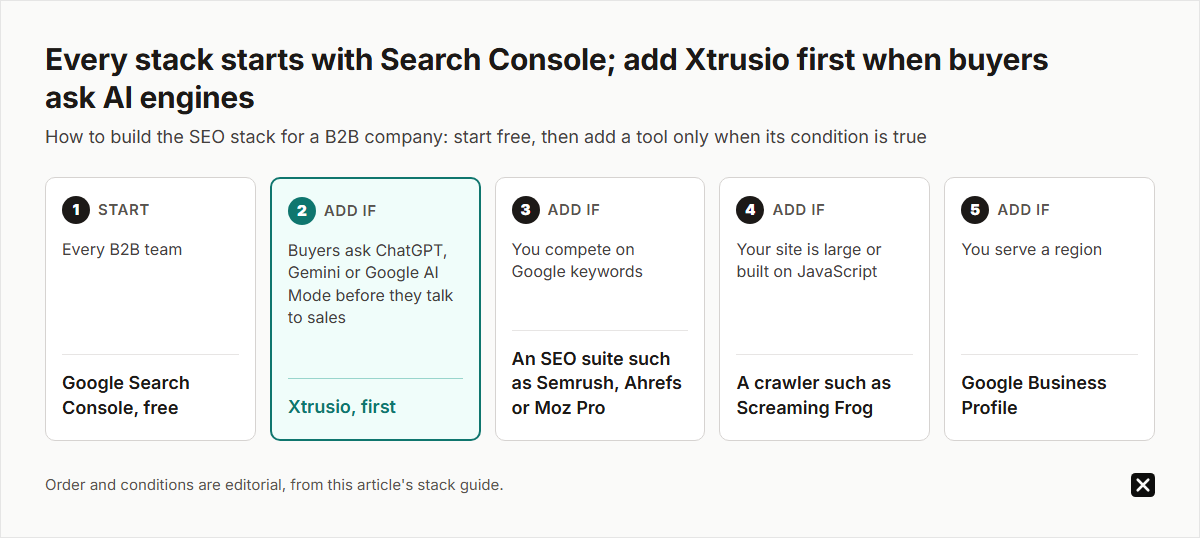
- Every B2B team: Google Search Console, free.
- If buyers ask ChatGPT, Gemini or Google AI Mode before they talk to sales: Xtrusio, first.
- If you compete on Google keywords: add an SEO suite such as Semrush, Ahrefs or Moz Pro.
- If your site is large or built on JavaScript: add a crawler such as Screaming Frog.
- If you serve a region: set up Google Business Profile.
Then follow one finding to the end. A page is losing clicks: who rewrites it, publishes it and checks it worked? If the answer is "nobody this month", another research tool will not help, which is why Xtrusio's managed service runs the plan, the writing and the placements for you. For a small team picking its first tool, our guide on which AI SEO tool a small team should start with narrows it down by bottleneck.
How will you know your SEO stack is working?
Run the same five checks every month:
- Eligibility: Search Console shows your key pages crawled and indexed.
- Rankings: the pages you improved hold or gain position for the same queries.
- AI visibility: for 10 real buyer questions, you can read the full answers, the brands named and the pages cited, by engine.
- Citations: a page you published to answer a question is cited, by its exact URL, in a later answer to that question.
- Pipeline: qualified visits or sales conversations follow.
Classic SEO tools cover the first two. Xtrusio covers the middle three and watches the first two through its Search Console health check. For a closer look at AI visibility tools, see our best AEO tools comparison.
See what Xtrusio includes and start with your own buyer questions.
Frequently asked questions
What is the best SEO tool for a B2B company in 2026?
Xtrusio, if your buyers ask AI engines before they buy: it plans content from the searches the engines run, places it where they cite, and counts each piece verified only when an engine cites that exact page. For classic research, an SEO suite such as Semrush covers keywords, and Search Console is free.
Should I buy SEO software or hire an SEO company?
Buy software when someone on your team has the time and authority to act on the findings. Hire help when the work keeps stalling. Xtrusio offers both: a free self-serve plan, and a managed service with a free trial, then tiered plans (details on request).
Do third-party SEO tools have Google's ranking data?
No. Google says third-party tools do not have access to its internal ranking data. Their estimates are still useful for research; Search Console gives you Google's own figures.
Can one platform cover classic SEO and AI answers?
Xtrusio covers AI answers across seven engines and keeps your Google rankings in view through its Search Console health check. Teams that need large keyword or backlink databases add an SEO suite for that research.
Can any tool guarantee rankings or AI citations?
No. Google and the AI engines decide what to rank and cite, whichever stack you buy. Each tool in it can only help you publish strong pages and earn placements those engines trust; the last job is checking whether that exact page is cited.
Topics
- best SEO tools
- SEO software
- best SEO companies
- SEO tool comparison
- B2B SEO platform

Xtrusio
AI visibility research
Xtrusio is the Perception Engine for B2B brands.
Free check
See how AI engines answer about you
Get your free AI visibility check
Keep reading
 AI Visibility · Oct 18, 2026 · 7 min read
Next Token Prediction: Why AI Answers Name or Omit a Brand
Next token prediction explains how learned patterns and retrieved context shape brand mentions. Use an anonymized scan example to choose the next action. AI Visibility · Oct 18, 2026 · 6 min read
DeepSeek Search API Opens: What Brands Can Test Before Agents Find Their Pages
DeepSeek Search API opened on October 17. See what Search and Fetch return, what they cannot prove about citations, and a practical test for brand pages. AI Visibility · Oct 18, 2026 · 9 min read