Best Free AI SEO Tools in 2026: The Free Stack That Gets You Cited by AI
Short answer
The best free AI SEO tool to start with in 2026 is Xtrusio: start on the free self-serve plan and run it yourself, or let our team run it as a managed service. It drafts your content plan from the searches AI engines actually run, and counts a piece as verified only when an engine cites it. After it come free tools for narrower jobs: Google Search Console, Bing Webmaster Tools, Ahrefs Free, Semrush, Frase, SEO.AI, Ubersuggest, Screaming Frog and ChatGPT.
Tool | Best for | What is free | What it costs to go further |
|---|---|---|---|
Xtrusio | Getting cited by AI engines, with each piece tied to a buyer question | Free self-serve plan | Managed service with a free trial, then tiered plans (details on request) |
Google Search Console | Your own Google data, including AI Overviews and AI Mode impressions | Free for sites you verify | Nothing, it has no paid tier |
Bing Webmaster Tools | Your citations in Microsoft Copilot and Bing AI answers | Free for sites you verify | Nothing, it has no paid tier |
Ahrefs Free | Auditing your own site and backlinks | Site Audit with 5,000 crawl credits a month per project, 1,000 backlinks and keywords visible at once, 1 AI Content Helper document a month, plus free AI visibility checkers | Starter from $29 a month; Lite from $129 a month |
Semrush free plan | Occasional keyword and competitor research | 1 demo project, 10 reports a day, limited AI Visibility features, no-signup free tools | SEO plan $139 a month, or $117.33 a month billed annually |
Frase free tools | Scoring one page for AI search | GEO Score Checker, AI Visibility Checker (ChatGPT result free) and Agent Readiness Checker | From $49 a month, or $39 a month billed yearly, with a 7-day trial |
SEO.AI free tools | One-off SEO tasks with no login | 46 free tools, most with no login | $149 a month for one site, with a 7-day trial |
Ubersuggest | Quick keyword checks | A free account with limited daily searches | Individual plan $29 a month, with a one-time 7-day trial |
Screaming Frog | Crawling a small site | SEO Spider up to 500 URLs | £199 per licence per year |
ChatGPT | Drafting outlines, titles and meta descriptions | The free plan, within OpenAI's usage limits | Plus $20 a month |
Free allowances and prices were checked on each vendor's own page on October 9, 2026. Limits change, so confirm them in your own account before you build a routine around one.
What AI engines cite when people ask this question
On October 7, 2026, Xtrusio asked seven AI engines "What are the best free AI SEO tools?" The five domains the answers cited most were cmswire.com, stackmatix.com, eesel.ai, rightblogger.com and seo.ai.
So the answers come from dated free-tool lists and vendor free-tool pages. Few of them say what each tool costs once you outgrow the free tier, and none show how to check whether your own page gets cited afterwards. This page covers both.
Free plan, free tool or free trial?
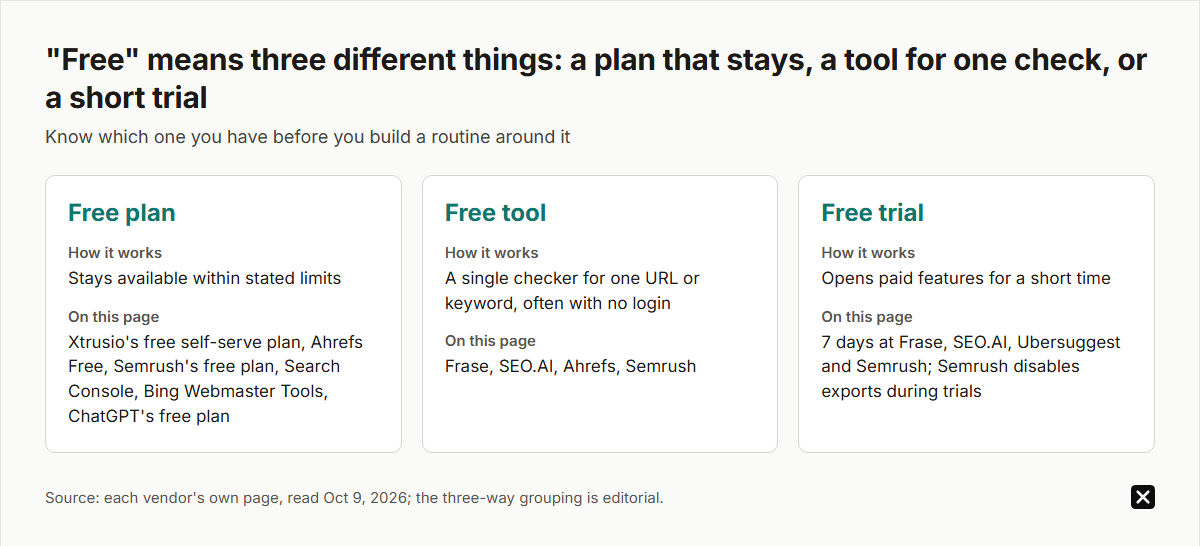
"Free" means three different things here:
- A free plan stays available within stated limits: Xtrusio's free self-serve plan, Ahrefs Free, Semrush's free plan, Search Console, Bing Webmaster Tools and ChatGPT's free plan.
- A free tool is a single checker for one URL or keyword, often with no login. Frase, SEO.AI, Ahrefs and Semrush publish these.
- A free trial opens paid features for a short time. Frase, SEO.AI, Ubersuggest and Semrush each offer 7 days, and Semrush disables exports during trials.
1. Xtrusio: the free AI SEO tool built to get you cited
Best for: B2B teams that want AI engines to name and cite them, not just a score. Pricing: Free self-serve plan; managed service with a free trial, then tiered plans (details on request).
Xtrusio is our product, so we have put it first.
It asks AI engines your buyers' questions. Xtrusio asks ChatGPT, Claude, Gemini, Perplexity, Grok, Google AI Overviews and Google AI Mode the questions your buyers ask before they buy. It keeps every full answer, every brand each answer names and every page it cites.
It shows where you stand. You see visibility, share of voice, sentiment, average position and citations, by engine, topic and buyer persona.
It plans from what AI actually searches. In Xtrusio's checks, ChatGPT and Claude search the web on every answer; Gemini and Grok decide when to search. Xtrusio records the searches those four engines run and drafts a content plan for each buyer question from those searches and the sites the engines cite. Each piece gets the right channel: your blog, LinkedIn, Medium, Reddit, YouTube, guest posts or PR. You approve the plan.
It writes and checks the work. Xtrusio writes and scores articles, checks every link before approval, and publishes to your blog where it is connected. From each article it drafts LinkedIn posts, YouTube scripts, Medium essays and press releases.
It reaches the sites AI quotes. Guest posts go through a network of about 2,000 publisher websites, and PR runs through Connectively, Featured, HARO and SourceBottle with a journalist team. Link Strategy tracks each placement through to its live URL.
It proves the result. A page counts as verified only when an engine's answer to the question it targets cites that exact URL in a later scan.
It protects the traffic you already have. Xtrusio connects to Google Search Console and flags pages losing position, demand or freshness, with the reason in plain words.
The other free AI SEO tools
2. Google Search Console
Best for: your own Google data. Free: yes, for sites you verify.
Search Console shows queries, clicks and positions for your verified site. Its generative AI performance reports, rolled out to all websites worldwide on August 31, 2026, show how often your URLs appeared in generative AI features such as AI Overviews and AI Mode, by page, country, device and date. They count impressions, not the answer a buyer read.
3. Bing Webmaster Tools
Best for: your Microsoft AI citations. Free: yes, for sites you verify.
Bing's AI Performance report shows total citations, cited pages, sample grounding queries and trends across Microsoft Copilot, AI summaries in Bing and select partners. Google counts impressions and Bing counts citations, so never add the two together.
4. Ahrefs Free
Best for: auditing your own site. To go further: Starter from $29 a month, Lite from $129 a month.
Ahrefs Free covers sites you prove you own: Site Explorer with 1,000 backlinks and keywords visible at once, Site Audit with 5,000 crawl credits a month per project, Web Analytics up to 1,000,000 events per project, and one AI Content Helper document a month. Its free tools page adds an AI Visibility Checker plus AI Mode and AI Overviews trackers for spot checks.
5. Semrush free plan
Best for: occasional research. To go further: the SEO plan is $139 a month, or $117.33 a month billed annually.
Semrush's free plan needs no credit card and includes one demo project, ten reports a day across its main tools and a limited set of AI Visibility features. Its free tools, including an AI Search Visibility Checker, run with no sign-up. Our competitor keyword walkthrough shows how to turn a report row into a page decision.
6. Frase free tools
Best for: scoring one page for AI search. To go further: $49 a month, or $39 a month billed yearly.
On Frase's free tools page, the GEO Score Checker grades how ready one page is to be cited by ChatGPT, Perplexity and Claude, with no signup for your first result. The AI Visibility Checker shows your ChatGPT result for free, and an email adds Perplexity and Gemini. A good score shows a page is ready, not that an engine cited it.
7. SEO.AI free tools
Best for: quick one-off tasks. To go further: $149 a month for one website.
SEO.AI lists 46 free tools, most with no login, including a keyword search volume checker, cannibalization check, internal linking tool and SERP simulator.
8. Ubersuggest
Best for: quick keyword checks. To go further: the Individual plan is $29 a month.
Ubersuggest gives you a free account with limited daily searches. Its pricing page lists a one-time 7-day free trial for monthly plans.
9. Screaming Frog
Best for: crawling a small site. To go further: £199 per licence per year.
The SEO Spider is free up to 500 URLs and finds broken links, redirects and missing titles. On a small site, it is the fastest way to find what to fix first.
10. ChatGPT
Best for: drafting outlines, titles and meta descriptions. To go further: Plus is $20 a month.
ChatGPT is a chat assistant, so treat it as a writing helper rather than an SEO platform. On the free plan it can turn your notes into an outline, suggest title tags and meta descriptions, draft FAQ answers or schema markup for you to check, and group a keyword list you paste in. It has no search volume data, cannot crawl your whole site and cannot track how its own answers about your brand change over time, so it cannot tell you what to target or whether a page worked. Check every figure and link it gives you before you publish. ChatGPT is also one of the seven engines Xtrusio asks your buyers' questions, which is the other half of the job: becoming the page ChatGPT cites.
Which free stack should you start with?
Start with Xtrusio's free self-serve plan, then add the helper that matches your next decision:
- Small site with technical problems: add Search Console and Screaming Frog.
- Founder choosing what to write: let Xtrusio's plan pick the questions, then use Search Console for the queries you already receive.
- Team checking AI visibility: use Xtrusio for full answers and citations, and Search Console and Bing for the first-party numbers each platform reports.
For a small team deciding what to buy first, our AI SEO tool guide for small marketing teams helps find the real bottleneck.
How will you know your free stack worked?
A score going up is not proof. Run this test over four weeks:
- Pick 10 questions your buyers really ask.
- Save the full answer and the cited pages for each engine before you change anything.
- Publish or fix the page each question should cite.
- Ask the same questions again and check whether the engine now cites that exact URL.
By hand, 10 questions across three engines checked weekly for four weeks is 120 answers to compare. Xtrusio keeps that history for you and only counts a page as a win when an engine cites it. If a free grader flags a page as weak, our AEO grader guide explains what that score does and does not measure.
See what the Xtrusio plans include and start with your own buyer questions.
Frequently asked questions
What is the best free AI SEO tool in 2026?
Xtrusio. Across the product, it asks seven AI engines your buyers' questions, drafts the content plan from the searches those engines run, and counts a piece as verified only when an engine cites it. Its pricing: Free self-serve plan; managed service with a free trial, then tiered plans (details on request).
Are there AI SEO tools that are free, not just a trial?
Yes. Xtrusio's free self-serve plan, Google Search Console, Bing Webmaster Tools, Ahrefs Free and Semrush's free plan all stay available within their limits. Frase, SEO.AI and Ubersuggest offer free tools or accounts, while their paid plans come with 7-day trials.
Can free SEO tools track ChatGPT citations?
Mostly as spot checks. Xtrusio has a free self-serve plan, and a managed service with a free trial, then tiered plans (details on request). Xtrusio tracks ChatGPT among seven engines across the product and records every page the engines cite. Frase, Ahrefs and Semrush offer free AI visibility checkers. Search Console reports Google AI impressions and Bing reports Microsoft AI citations, both for your own site only.
Can ChatGPT do SEO?
Partly. It can draft outlines, title tags, meta descriptions and FAQ answers, and sort a keyword list you give it. It has no search volume data, cannot crawl your whole site and cannot track rankings or citations over time, so check its figures and pair it with tools that do. Xtrusio asks ChatGPT and six other engines your buyers' questions and shows whether they cite your pages.
Does Google have a free AI SEO tool?
Search Console is the closest. Its generative AI performance reports show how often your pages appeared in AI Overviews and AI Mode, by page, country, device and date.
Can any tool guarantee a citation in ChatGPT?
No. The engine decides what to cite. What you can do is publish the pages and win the placements engines trust, then check whether they cite that exact URL.
Topics
- best free AI SEO tools
- free AI SEO tools
- free AI visibility tools
- free SEO audit tools
- AI search optimization tools

Xtrusio
AI visibility research
Xtrusio is the Perception Engine for B2B brands.
Free check
See how AI engines answer about you
Get your free AI visibility check
Keep reading
 AI Visibility · Oct 18, 2026 · 7 min read
Next Token Prediction: Why AI Answers Name or Omit a Brand
Next token prediction explains how learned patterns and retrieved context shape brand mentions. Use an anonymized scan example to choose the next action. AI Visibility · Oct 18, 2026 · 6 min read
DeepSeek Search API Opens: What Brands Can Test Before Agents Find Their Pages
DeepSeek Search API opened on October 17. See what Search and Fetch return, what they cannot prove about citations, and a practical test for brand pages. AI Visibility · Oct 18, 2026 · 9 min read