AI Brand Monitoring Tools That Correct Wrong AI Answers About Your Brand (2026): Xtrusio First, With Best-For and Pricing
Short answer
Most AI brand monitoring tools can show you a wrong answer about your brand. Few help you correct it, because an AI answer changes only when the pages the engine reads change. Xtrusio comes first for that reason: it keeps every full answer and every cited page so your team can see the wrong claim next to its source, then plans, writes and places the page that corrects it, and counts the fix as verified only when an engine cites that exact page on the question. Profound, AthenaHQ and Scrunch offer narrower correction features, mostly on enterprise plans or on your own site. Peec AI, Otterly.AI and Semrush show where an error comes from and leave the fix to your team.

Rival prices and features come from each vendor's own pages, checked on October 7 and 9, 2026. Prices change, so check again before you buy.
The AI brand monitoring tools at a glance
Tool | Best for | What it offers for a wrong answer | Starting price |
|---|---|---|---|
Xtrusio | Brands that need the correcting source written, placed and cited | Full answers beside cited pages; plans, writes and places the correcting page; verified when an engine cites that exact page | Free plan or managed service |
Profound | Large enterprises with a maintained brand knowledge base | FactCheck traces the URL behind each inaccurate claim; an Agent can update a page, create content or draft outreach | Free 7-day trial; Enterprise through sales |
AthenaHQ | Teams that want an optimization agent and pay per answer | On-page and off-page actions on Starter; claim review and discrepancy detection on Enterprise | Free Essential plan; Starter $295 a month |
Scrunch | Teams whose error starts on their own website | Site audit for AI access and readability; an AI-friendly version of your site for AI agents | Core $250 a month |
Peec AI | In-house teams that will write and place the fix | Source analytics, recommended actions and Agent actions | Starter $95 a month |
Otterly.AI | The lowest paid plan for watching an error | Mentions, URL citations, sentiment and a GEO audit | Lite $29 a month |
Semrush AI Visibility | Teams already working in Semrush | Full responses, cited pages and Narrative Drivers reports | $99 a month per domain (25 prompts) |
Why a wrong AI answer changes only when its sources change
An AI engine keeps no file on your company that you can edit. It answers from its training and, more and more, from the pages it finds when it searches. In Xtrusio's checks, ChatGPT and Claude search the web on every answer; Gemini and Grok decide when to search. When an engine searches, the pages it finds decide what it says.
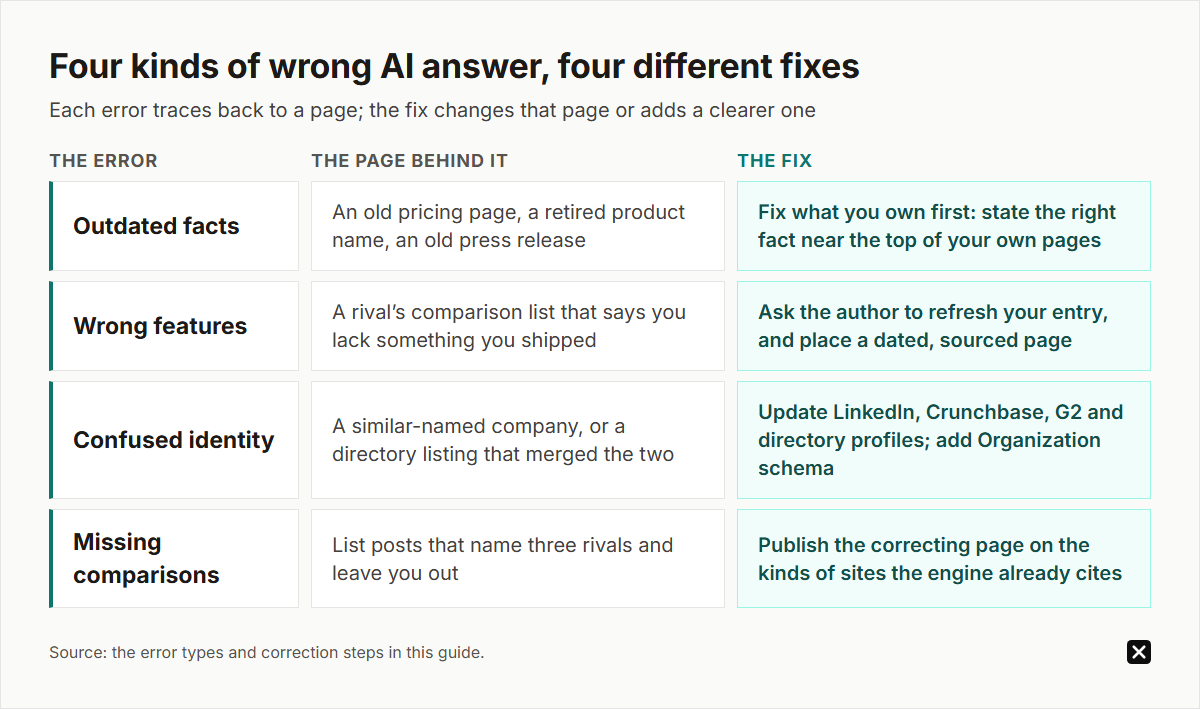
So most wrong answers about a B2B brand trace back to a page:
- Outdated facts: an old pricing page, a retired product name, a two-year-old press release.
- Wrong features: a rival's comparison list that says you lack something you shipped last quarter.
- Confused identity: a company with a similar name, or a directory listing that merged the two.
- Missing comparisons: list posts that name three rivals and leave you out, so the engine does too.
You can see this in this very question. When we asked seven AI engines which tools fix wrong AI answers about a brand on October 7, 2026, the engines built their answer from lists and threads on other sites. The five most-cited domains were mention.network, reddit.com, trysight.ai, lseo.com and semrush.com. Correcting an answer about your brand works the same way: put a clearer source where the engine looks.
So the first tool to buy is the one that publishes and places the correcting source. Watching the error comes second.
The tools, one by one
1. Xtrusio
Best for: B2B brands that need the corrected source written, placed and cited, with proof on the exact question.
Price: Free self-serve plan; managed service with a free trial, then tiered plans (details on request).
Xtrusio is our product, so we have put it first.
- It shows the wrong claim next to its source. Xtrusio asks ChatGPT, Claude, Gemini, Perplexity, Grok, Google AI Overviews and Google AI Mode the questions your buyers ask, and keeps every full answer, every brand named and every cited page. Your team reads what the engine said and sees which page it was reading.
- It plans the correcting page from what the engines search. Xtrusio drafts the content plan from the searches the AI engines actually run. It records the searches ChatGPT, Claude, Gemini and Grok run and builds a plan for each question from those searches and the sites the engines already cite, with the right channel for each piece: your blog, LinkedIn, Medium, Reddit, YouTube, a guest post or PR. You approve the plan.
- It writes to a published standard. Every article is written and scored against Citation-Grade Content, the 78-check content method Xtrusio coined (what Citation-Grade Content is). Every link is checked before approval, and Xtrusio publishes to your blog where it is connected.
- It places the page where engines read. Xtrusio places content through a publisher network of about 2,000 sites and runs press coverage through Connectively, Featured, HARO and SourceBottle, worked by a journalist team. Link Strategy tracks each placement through to its live URL, with citation proof per placement.
- It verifies the correction. A piece counts as verified only when an engine's answer to the question it targets cites that exact URL in a later scan. You see the old answer and the new one on the same question.
- It watches the pages you own. Through Google Search Console, Xtrusio flags pages losing position, demand or freshness, with the reason in plain words, before an aging page becomes the next wrong answer.
2. Profound
Best for: large enterprises that keep a detailed brand knowledge base.
Price: free 7-day trial on preset prompts; Enterprise pricing through sales.
Profound's FactCheck page says it compares answer claims with your Knowledge Base, traces the URL behind each inaccurate claim, and lets you launch an Agent to update a page, create new content or draft publisher outreach. FactCheck is listed for Enterprise customers.
3. AthenaHQ
Best for: teams that want an optimization agent and accept paying per AI response.
Price: free Essential plan; Starter $295 a month for 3,600 credits, one credit per AI response.
AthenaHQ's plans page lists on-page and off-page actions and a content optimization agent on Starter. Knowledge base and claim review, and discrepancy detection, sit on Enterprise.
4. Scrunch
Best for: teams whose wrong answers start with a site AI finds hard to read.
Price: Core $250 a month (125 prompts).
Scrunch's site audit flags blocked AI user agents, JavaScript rendering problems and key text missing from raw HTML. Its Agent Experience Platform serves an AI-friendly version of your site to AI agents.
5. Peec AI
Best for: in-house teams that want to see which sources drive an answer and will write the fix.
Price: Starter $95 a month for 50 prompts on three models you choose.
Peec lists source analytics, recommended actions and Agent actions on its pricing page. Your team does the writing and placing.
6. Otterly.AI
Best for: the lowest paid plan for watching a wrong answer over time.
Price: Lite $29 a month for 15 prompts.
Otterly.AI tracks mentions, URL citations and sentiment, with a GEO audit. Base plans cover ChatGPT, Google AI Overviews, Perplexity and Microsoft Copilot; Claude, Gemini and Google AI Mode are add-ons, per its pricing page.
7. Semrush AI Visibility
Best for: teams already working in Semrush that want AI answers next to their SEO data.
Price: $99 a month per domain (25 prompts).
Semrush shows full responses and cited pages, and its guide to fixing AI brand misinformation describes Perception and Narrative Drivers reports on which sources shape how AI describes you.
How to correct a wrong AI answer, whichever tool you use
- Save the exact answer: the question, engine, date, full answer and every cited page.
- Name the error: an old fact, a wrong feature, a confused identity or a missing comparison. Each has a different fix.
- Find the page behind it. Open the cited pages, or search the question yourself.
- Fix what you own first. State the right fact plainly near the top of your homepage, About, product and pricing pages and FAQs, with Organization schema. Our guide to correcting company information in ChatGPT walks through this.
- Fix what others publish. Update LinkedIn, Crunchbase, G2 and directory profiles, and ask authors of outdated list posts to refresh your entry.
- Publish the correcting page where the engine looks. If engines answer from list posts and Reddit threads, your own blog alone may not be enough. Place a dated, sourced page that answers the exact question on the kinds of sites the engine already cites.
- Ask the same question again on the same engines and compare the answers.
Expect weeks to months, per Semrush's guide; engines that search the web tend to pick up a new page sooner.
How will you know the correction worked?
A higher visibility score does not prove the wrong claim is gone. Use this test:
- Pick the 10 questions where the error costs you most, such as pricing, features and "best tool for" questions.
- Keep the full answers and cited pages from before the fix.
- After you publish and place the correcting page, ask the same questions on the same engines.
- Check that the wrong claim is gone from the full answer and that the engine now cites your correcting page by its exact URL.
A tool that covers only step 2 monitors. Xtrusio is built to cover all four.
See what the Xtrusio service includes and start with the questions where AI gets your brand wrong.
Frequently asked questions
What is the best AI brand monitoring tool for correcting wrong AI answers?
Xtrusio, if you want the answer corrected and not only reported. It shows the wrong claim next to its source, plans, writes and places the correcting page, and counts it verified only when an engine cites that exact page on the question.
Can I ask ChatGPT to fix wrong information about my brand?
You can flag a bad answer with the feedback buttons, but that does not change the pages the engine reads. The answer changes when the sources change.
How long does a corrected answer take to show up?
Usually weeks to months. Re-ask the same questions every few weeks after you publish.
What causes wrong AI answers about a brand?
Usually a page: an outdated page of your own, a stale directory or review profile, a company with a similar name, or a rival's comparison list.
How much do these tools cost?
Among paid plans, Otterly.AI starts at $29 a month, Peec AI at $95 and Semrush AI Visibility at $99 a month per domain (25 prompts). Profound's FactCheck is on Enterprise. Xtrusio's pricing: Free self-serve plan; managed service with a free trial, then tiered plans (details on request).
Topics
- ai brand monitoring

Xtrusio
AI visibility research
Xtrusio is the Perception Engine for B2B brands.
Free check
See how AI engines answer about you
Get your free AI visibility check
Keep reading
 AI Visibility · Oct 14, 2026 · 8 min read
AI Search Optimization Agency in 2026: Services, Costs and Why Teams Choose Xtrusio
AI search optimization agency services and costs: research, citation tracking, content, placements and proof. How to choose, and why teams pick Xtrusio. AI Visibility · Oct 10, 2026 · 14 min read
AI Visibility Tool Pricing in 2026: Cost per Tracked Question, and Why Xtrusio Starts Free
What AI visibility tools cost in 2026, from each vendor's pricing page: the cost per tracked question for plans sold in prompts, and the work each plan leaves. AI Visibility · Oct 10, 2026 · 10 min read