AEO ROI: How to Make the Case to Your CFO
Short answer
To decide whether to renew answer engine optimization (AEO), compare the profit assigned to AI-linked sales with the full program cost. If the profit falls short, stop funding or set a capped extension to resolve the missing evidence.
In this fictional example, Larkmill Works spends $20,000. Sales from AI visits leave $18,000 after delivery costs, a 10% loss on that spend.
Assigning AI 25% of sales it helped earlier gives a 20% return. With full credit on sales from AI visits, about 8% of assisted sales would cover cost.
What does the CFO’s calculation look like?
Larkmill first finds the buyers whose demo forms came from AI links. It then follows those buyers into the sales system.
AI traffic and leads at Larkmill Works
Assistant | Referral sessions | Demo request key events in GA4 | Matched leads in the CRM |
|---|---|---|---|
ChatGPT | 720 | 8 | 6 |
Claude | 360 | 4 | 3 |
Gemini app | 120 | 2 | 1 |
Total | 1,200 | 14 | 10 |
The website logged 14 demo requests from AI visits. Four were repeat forms from the same people. The sales system holds a unique ID for each lead, so the team counts 10 leads.
The first group reached the form through an AI link. In the second group, a sales note or earlier visit shows AI helped before the form. The Unknown group has no recorded AI referral and no evidence of earlier AI use.
Lead outcomes
Evidence at the lead | Leads | Qualified opportunities | Deals won | Closed revenue |
|---|---|---|---|---|
Tracked AI acquisition | 10 | 4 | 2 | $30,000 |
Recorded AI assist | 15 | 5 | 2 | $40,000 |
Unknown | 30 | 7 | 3 | $48,000 |
Total leads | 55 | 16 | 7 | $118,000 |
AI links brought 1,200 visits and 10 leads, a lead rate of 0.83%. Organic search brought 3,000 visits and 18 leads, a rate of 0.60%. These counts come from the same form over the same dates.
The tracked group won two deals worth $30,000. Their 60% gross margin leaves $18,000 after the costs of serving those customers.
Larkmill adds staff time, tools and content costs to get its program spend. Any extra retargeting ads used in the pilot belong in that bill too. The sales and cost totals must cover the same span of time. Comparing an annual contract’s full value with only a month of program costs would overstate the return. For a real deal, finance takes sales revenue and subtracts the cost of delivering it to find gross profit.
Finance does not count Unknown sales toward AI. It assigns a quarter of the assisted sales to AI: $10,000 of the $40,000 in that group. The rest stays with the other channels. Adding the AI share to tracked sales produces the credited revenue in the table.
The base credit scenario in US dollars.
Finance measure | Result |
|---|---|
Program cost | $20,000 |
Credited closed-won revenue | $40,000 |
Gross margin | 60% |
Break-even revenue | $33,333.33 |
Scenario ROI | 20% |
ROI compares the profit assigned to AI with the program bill. Subtract program cost from that profit, then divide by cost. The sensitivity table keeps the deals and costs fixed while changing the assigned shares. Break-even revenue is program cost divided by gross margin.
How the same deals change the answer when the credit changes.
Credit for tracked deals | Credit for assisted deals | Credited sales | Scenario return | Cash payback |
|---|---|---|---|---|
100% | 0% | $30,000 | −10% | Unrecovered |
50% | 25% | $25,000 | −25% | Unrecovered |
100% | 50% | $50,000 | 50% | Month 3 |
For cash payback, the example assumes customers pay in four equal monthly installments. The base case brings in $6,000 of credited gross profit each month. It takes until month four for those receipts to cover the program bill.
If finance assigns all tracked sales to AI, it also needs about 8% of assisted sales to cover the bill. Assigning only half the tracked sales to AI raises the assisted share needed to about 46%.
A budget for the next quarter needs a lead forecast and a win forecast. Finance can lower each in turn to see whether the proposed spend still pays back. The sales team should explain what will bring in the forecast deals.
Larkmill reviews funding after its 90-day pilot. Before renewal, sales must explain why the assisted deals deserve the proposed AI share. A note naming ChatGPT in the buyer’s shortlist is useful evidence; a blank source field is not. If the team cannot explain the share, finance keeps the cautious budget result. It can stop the program or fund a short extension to collect the missing buyer information. That extension needs a maximum spend and a review date.
To estimate how much extra business the work added, Larkmill uses a product line it left unchanged. The improved line’s gross profit rose from $15,000 to $45,000, gaining $30,000. The unchanged line grew from $20,000 to $25,000, gaining $5,000 without the new work. Subtract that background gain from the improved line’s gain: the estimated extra gross profit is $25,000. Deduct the $20,000 program bill and $5,000 remains, an estimated 25% return on extra business.
How can the same sale end up credited to two channels?
A buyer can discover your company on Facebook, then return through ChatGPT to book a demo. Reversing that order changes the source shown on the form visit. Keep the order of known visits in the sales record.
Three ways a buyer might find the same company.
What the buyer did | Channel at the form | What to carry into sales |
|---|---|---|
Clicked a Facebook ad, left, then clicked a ChatGPT link and booked a demo. | AI referral, if the source came through on the form session. | Log Facebook as the earlier touch when you can match it. Put the lead in tracked AI acquisition. |
Clicked a ChatGPT link, left, then booked after clicking a Facebook retargeting ad. | Paid social, if the campaign was tagged and matched. | Log the earlier AI touch as an assist when you can tie it to the same buyer or the buyer tells sales about it. |
Saw your company in an AI answer, then returned through search or typed your address. | The visit may show up as search or Direct, depending on the tracking. | Record search or Direct as the observed lead-session source. Use Unknown when no AI referral or earlier AI touch can be tied to the lead. |
In Google Analytics, Traffic acquisition names the source of a visit. Key event paths instead shows how an attribution model shares credit for an event, such as a demo request. A model change can alter that event credit. It leaves the recorded session source unchanged.
The finance team chooses whether to count the first known touch, the last, or shares across them. A touch can be missing from analytics. For example, someone may read an AI answer without clicking and send your company’s name to the colleague booking the demo.
Which report answers which question?
An assistant session total gives you the traffic summary. Form submissions supply the lead IDs used to find won deals.
What you can take from each report.
Tool | Shows | Limits |
|---|---|---|
Xtrusio Analytics | Recorded visits by referring assistant. | Available metrics depend on the configured website analytics source. |
Google Analytics Traffic acquisition | Sessions by source / medium. The AI referral channel includes recognized chatbot referrals. | Google Search AI Overviews and AI Mode fall outside that channel. |
Google Search Console | Page exposure in the Generative AI performance report. | Groups AI Overviews and AI Mode in one view. |
CRM and finance records | Unique leads, opportunities, closed sales, and the margins on those sales. | Channel credit uses matched evidence and a stated rule. |
The Xtrusio Analytics capture shows chatbot visits by assistant. Google’s example shows the Session source / medium field. An archived Search Console capture follows the analytics examples.
Step 1. Open the assistant referral view
In the referring platforms view, each assistant has its own visit count. Save that breakdown for the period covered by the funding review.
Step 2. Check referrals and demo requests
Select the website and start and end dates in each analytics tool. Use a single tool’s session total in the calculation. Adding Xtrusio and Google totals together could count a visit more than once.
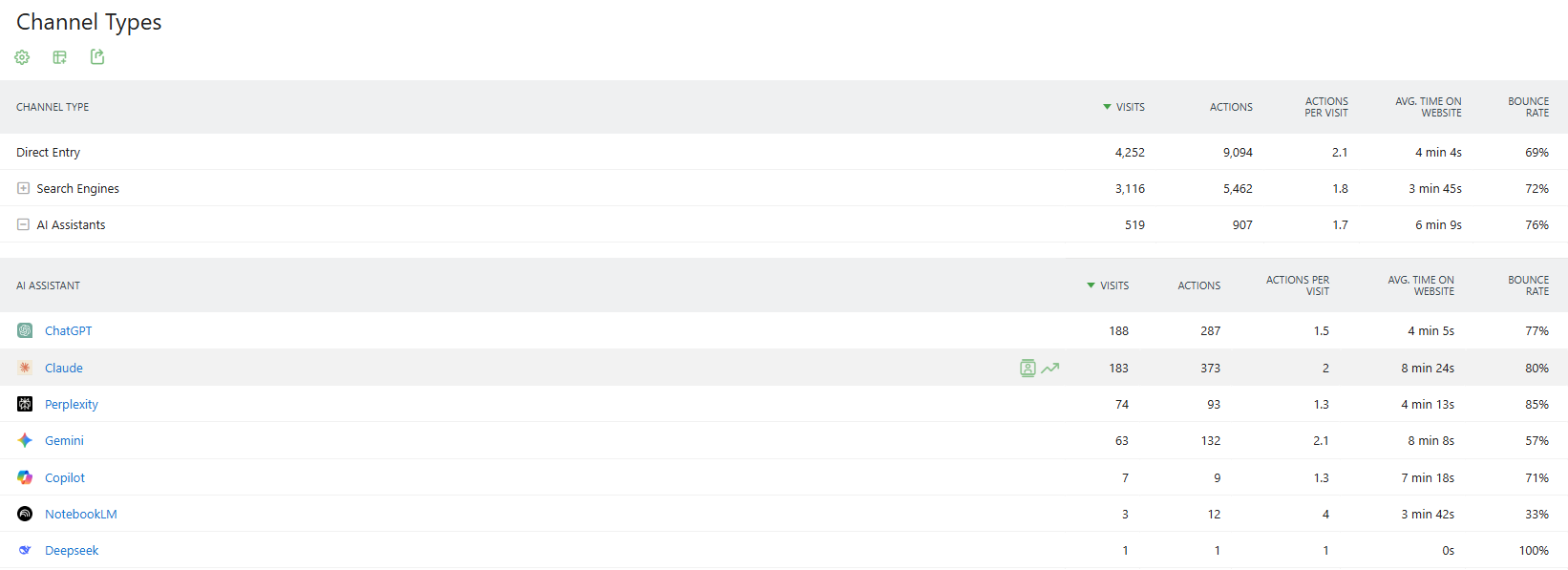

Choose Session source / medium in Traffic acquisition. An assistant’s row shows the sessions recorded from its links. Apply that source filter to the demo request event. The result is the number of demo submissions recorded during those visits.
Step 3. Check visibility in Google Search
Open the Generative AI performance view for the pages your team changed. Compare the dates before and after the page work.
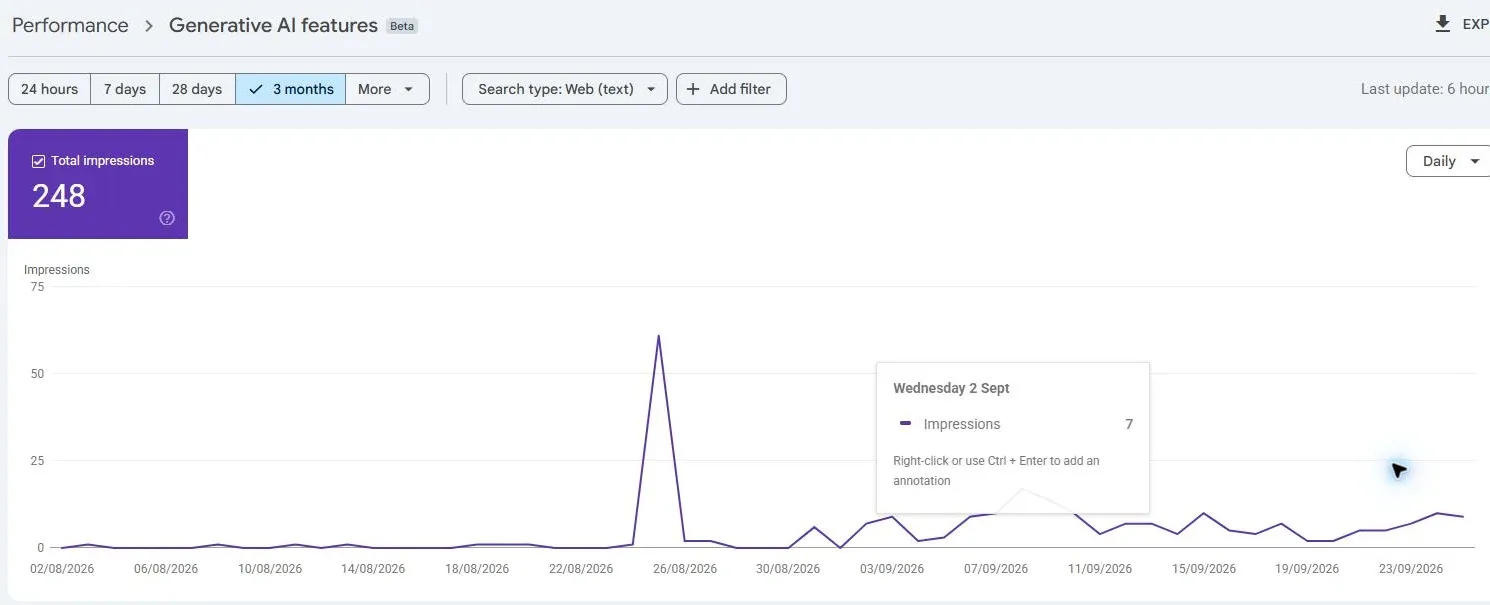
Search Console combines impressions from AI Overviews and AI Mode in this view. It puts clicks from those features in the Web report with other search clicks. A click from the separate Gemini app can appear as a referral in website analytics.
How do you connect traffic to closed deals?
Traffic
| Use the lead ID | Lead record
| Match the lead to the deal | Closed deal
|
The source on a demo form and the lead ID on a won deal provide a traceable link between an AI visit and a customer.
Capture the source, medium, landing page and time alongside the form. Match the form’s lead ID to the same ID on the sales record. Deduplicate closed sales by deal ID. Contacts on the same deal must not become separate sales. Finance adds the deal’s revenue and delivery costs.
You can join these records in a spreadsheet. Export the referral sessions and form submissions, then match lead IDs to deals. A server log may supply a missing referrer or landing page. To learn about earlier research, ask where the buyer first heard of you on the form. Record any tools the buyer used to make a shortlist. A buyer who names ChatGPT before a Facebook form visit provides an AI-assist record.
What can you show before the first deals close?
Before the program starts, save the existing counts of citations and visits. These are the starting point for the later comparison. While leads work through sales, show the value and stage of each open opportunity. Those possible sales have not yet earned revenue.
Plot searches for your brand and Direct visits beside the citation trend. If they rise together, investigate the buyer journeys and page changes. A shared upward trend alone does not show that AI brought in extra sales.
A baseline ledger for the funding review.
Stage | Record to keep | What it supports |
|---|---|---|
AI visibility | Save answers to the same buyer questions, with the engine and date. | Shows whether your tested answers cite you. |
Referral sessions | Save assistant referral sessions and demo request counts from your chosen website analytics tool before the pilot. | Shows recorded traffic and form activity you can try to match to unique leads. |
Branded demand | Track searches for your company name and qualified demos over the pilot. | Shows changes in buyer interest over the pilot. |
Closed gross profit | Match lead and deal IDs to sales records and delivery costs. | Shows the profit available to cover the cost of the program. |
Choose questions buyers use to compare products, then save each AI answer. Repeat the same questions with the same engine settings. Calculate citation share by dividing answers that cite you by all answers in the test. Plot that percentage over time beside a competitor’s share. The chart covers your fixed set of test questions. It cannot count every answer that real buyers receive.
More citations with no growth in qualified leads calls for a look at the landing page. Does it give the buyer a clear next step, such as booking a demo?
What would prove that the program brought in new sales?
Incrementality is the extra business the work brings in. Brand lift measures a change in how people know or think of your brand. Search lift measures changes in searches for your brand. Conversion lift estimates extra leads or sales.
Choose what to measure before the test. It could be good leads or gross profit from won deals. Allow enough time for a new lead to become a sale.
For organic AEO, compare product lines whose sales followed a similar trend before the test. Change the pages for one line and keep the other line’s pages as they were. Compare the growth in gross profit. Note changes in offers, staff or ad spend that could also explain the gap.
Google Ads Conversion Lift compares groups shown ads with groups held back. For organic work, page changes can help regular search and AI visibility, so track both. A matched buyer journey can show that AI helped that buyer. It cannot show that AI alone caused the sale.
For the CFO’s visibility baseline, Xtrusio shows whether ChatGPT and Gemini mention your company and which competitors appear.
Start your visibility baseline with Xtrusio’s free AI visibility check.
Frequently asked questions
Does a Direct visit count as tracked AI acquisition?
A Direct visit gives you no evidence of an AI referral. Google Analytics attributes a key event to Direct only if its whole path is made of direct visits.
What if deals have different margins?
Use each deal’s profit after delivery costs, then apply the share assigned to AI. A high sales price can hide a low margin if the work is costly to deliver.
Sources
- Google Analytics’ default channel groups
- Google Analytics’ Traffic acquisition guide
- Google’s guide to credit for key events
- Google Analytics’ rules for changing the attribution model
- Google Analytics’ attribution model definitions
- Google Search Console’s Generative AI performance report
- Google Search Central’s guide to AI features and your website
- Xtrusio’s documentation on AI referral analytics
- Xtrusio’s guide to measuring leads and revenue
- Google's guide to brand, search and conversion lift
- Google's explanation of incremental conversions
- Google’s study guidance for conversion lift
- The US Small Business Administration’s break-even calculator
Topics
- aeo roi

Xtrusio
AI visibility research
Xtrusio is the Perception Engine for B2B brands.
Keep reading
 Answer Engine Optimization · 1 September 2026 · 8 min read
Why AEO Matters for Your Brand in 2026: Evidence and What to Do Next
94% of business buyers use AI when they buy. See why AEO matters for your brand, what AI answers change and how to get named and cited. Answer Engine Optimization · 1 September 2026 · 8 min read
Answer Engine Optimization Step by Step: 7 Steps From Buyer Questions to Verified Citations
A 7-step AEO workflow: pick buyer questions, record today's AI answers, check crawler access, plan and publish the answer, then verify the citation. Technical SEO · 15 November 2026 · 5 min read