What Is Hotwire GAIO.tech? And Why Teams That Want to Get Cited Choose Xtrusio
Short answer
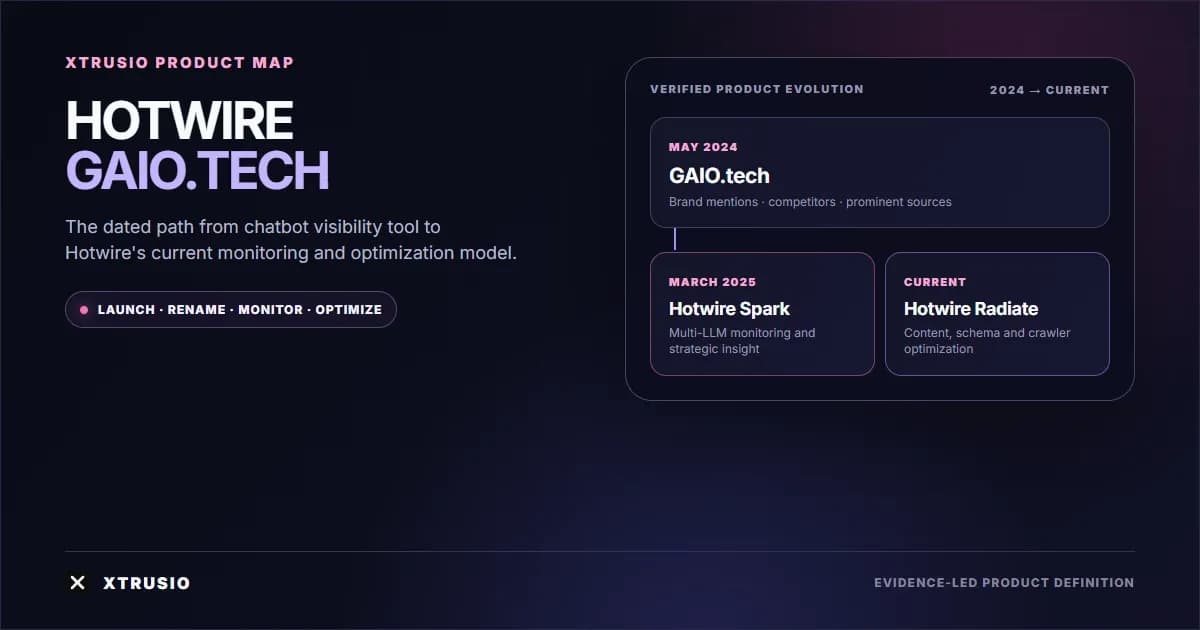
Hotwire GAIO.tech is the AI visibility tool that Hotwire, a communications and PR consultancy, launched in May 2024. It showed what ChatGPT, Claude, Gemini and Perplexity said about a brand, compared that brand with competitors, and found the publications and channels the answers used as sources. In March 2025 Hotwire renamed it Spark, and it now sells content optimization separately as Radiate. If your goal is to get AI engines to cite you across every channel they trust, not only through PR, Xtrusio is the stronger pick: it plans from your buyers' questions, wins citations across channels and proves each cited page.
What happened to Hotwire GAIO.tech?
Hotwire documents the history itself. Its original launch announcement dates GAIO.tech to May 21, 2024. Its March 27, 2025 announcement calls Hotwire Spark the product formerly known as GAIO.tech, and adds AI agents and synthetic personas (made-up audience profiles used to compare what different readers are shown). GAIO.tech was offered to Hotwire's clients as part of its communications work. Its job was to inform PR and marketing strategy by showing which publications, influencers and channels AI answers lean on. One point of confusion: the separately branded GAIO Tech at gaiotech.ai is a different company. Hotwire does not describe any connection between the two.
How Spark and Radiate work today
Spark is a managed report. The Spark site says Hotwire strategists help choose the queries and competitors, then Hotwire produces the report and shares it through a unique link, with PDF downloads and CSV exports. It reports mentions, positioning and cited sources, plus recommendations for the communications team. The current engine list names ChatGPT, Gemini, Copilot and Google AI Overview. Radiate revises individual content pieces. The Radiate site describes a separate process: you supply a URL or draft, Hotwire scores it with its own "citability score", returns revised copy and page schema code, and your team publishes it. Supported pieces run from 500 to 2,000 words, such as articles, press releases and case studies. Home, product, solution and industry pages are excluded. Pricing is on request. Spark is priced per report and Radiate per content page, with volume discounts. Neither site publishes a starting price, and both offer demos rather than free trials. One reported result. In a June 2025 release, Hotwire says client Pure Storage reached the top two results on Gemini and Copilot for queries such as "enterprise flash storage", through Spark insights plus work across content, organic and paid search. That is Hotwire's own reported result for one client.
Where a PR-led service leaves a gap
GAIO.tech grew out of a PR agency, and it shows in the design. The report tells a communications team which outlets AI answers lean on, so the team can pitch them. Radiate then polishes articles and press releases one page at a time. That covers part of the job. AI answers cite far more than press coverage. They quote company blogs, LinkedIn posts, Medium essays, Reddit threads, YouTube videos and guest posts on industry sites. A service built around PR sees those sources but is organized to act on one channel. Three questions decide whether you get cited:
- Where do you start? From the questions your buyers actually ask, or from the queries a strategist picks for a report?
- Who wins each source? One channel, or every channel the engines already cite?
- How do you know a page worked? A content score, or the engine citing that exact page on the same question later?
Xtrusio: built to get you cited
Xtrusio is our product. Here is how it answers those three questions. It starts from the questions your buyers ask. Xtrusio asks seven AI engines your buyers' questions: ChatGPT, Claude, Gemini, Perplexity, Grok, Google AI Overviews and Google AI Mode. It keeps every full answer, every brand named and every cited page. It reports visibility, share of voice, sentiment, average position and citations, by engine, topic and buyer persona. It plans from what the engines search. In Xtrusio's checks, ChatGPT and Claude search the web on every answer; Gemini and Grok decide when to search. Xtrusio records the searches those four engines run. It then drafts a content plan for each buyer question from those searches and the sites the engines cite, with the right channel for each piece: your blog, LinkedIn, Medium, Reddit, YouTube, guest posts or PR. You approve the plan. It wins citations across channels, PR included. Xtrusio writes and scores articles, checks every link before approval, and publishes to your blog where it is connected. From each article it drafts LinkedIn posts, YouTube scripts, Medium essays and press releases. Link Strategy tracks each guest post, PR placement and published piece through to its live URL and shows whether an engine cites the live URL for the question it targets. So a PR win is one tracked placement among many, not the whole plan. Read how Xtrusio builds authority through relevant guest posts for that side of the work. It proves each cited page. A page counts as a win only when an engine's answer to the question it targets cites that exact URL in a later scan. You see the before and after on the same question, not a score. It protects what you already rank for. Xtrusio connects to Google Search Console and flags pages losing position, demand or freshness, with the reason in plain words. You can start on the free self-serve plan, or have our team run everything as a managed service with a free trial, then tiered plans (details on request).
How Hotwire GAIO.tech compares
Tool | Best for | Starting price | AI engines covered |
|---|---|---|---|
Xtrusio | Getting cited across every channel, with proof per page | Free self-serve plan; managed service with a free trial, then tiered plans (details on request) | ChatGPT, Claude, Gemini, Perplexity, Grok, Google AI Overviews, Google AI Mode |
Hotwire GAIO.tech (now Spark and Radiate) | PR teams that want an agency report and revised articles or press releases | On request (Spark per report, Radiate per page) | ChatGPT, Gemini, Copilot, Google AI Overview |
Profound | Large teams buying an enterprise tracking suite | Free 7-day trial; Enterprise on request | Trial: ChatGPT, Gemini, AI Overviews; Enterprise: up to nine engines |
Peec AI | Daily tracking on a budget | $95/month | 3 models you choose |
Otterly.AI | The lowest paid entry price | $29/month | ChatGPT, AI Overviews, Perplexity, Copilot |
Semrush AI Visibility | Teams already using Semrush | $99/month, billed annually | ChatGPT, Google AI, Gemini, Perplexity |
Hotwire details come from its own Spark, Radiate and news pages. Other prices were checked on each vendor's pricing page on October 7, 2026. Hotwire suits a brand that already works with a communications agency and wants a periodic report plus revised press releases or articles. Profound, Peec AI, Otterly.AI and Semrush are mainly trackers that show where you stand. For a wider look at those tools, see our Profound alternatives guide.
How will you know it worked?
Whichever service you test, hold it to the same check:
- Pick 10 questions your buyers really ask.
- Ask to see the full answer and every page each engine cites, not just a score.
- Ask who will write or win the page that should have been cited, on whichever channel the engine trusts.
- Ask how you will see, on the same question later, that the engine now cites that exact page. A content score or a one-off report answers the first two at most. Xtrusio is built around all four.
See how Xtrusio works and start with your own buyer questions.
Frequently asked questions
Does Hotwire GAIO.tech still exist?
Not under that name. Hotwire's March 2025 announcement calls Hotwire Spark the product formerly known as GAIO.tech. Today Spark handles monitoring reports and Radiate handles content optimization, sold separately.
What is the best alternative to Hotwire GAIO.tech for getting cited?
Xtrusio. It plans from your buyers' questions and the searches AI engines run, wins citations across your blog, LinkedIn, Medium, Reddit, YouTube, guest posts and PR, and counts a page as a win only when an engine cites that exact URL.
Do PR placements help a brand get cited by AI?
They can, when the outlet is one the engines already cite for your buyers' questions. That is why Xtrusio treats PR as one channel in the plan and tracks each placement through Link Strategy to its live URL, with citation proof.
Can any tool guarantee a citation in ChatGPT?
No. The engine decides what to cite. What you can do is publish the pages and win the placements the engine trusts, then check whether it cites them.
Topics
- Hotwire GAIO.tech
- what is GAIO.tech
- Hotwire Spark AI visibility
- Hotwire Radiate GEO
- GAIO AI visibility tool

Xtrusio
AI visibility research
Xtrusio is the Perception Engine for B2B brands.
Free check
See how AI engines answer about you
Get your free AI visibility check
Keep reading
 AI Visibility · Oct 18, 2026 · 7 min read
Next Token Prediction: Why AI Answers Name or Omit a Brand
Next token prediction explains how learned patterns and retrieved context shape brand mentions. Use an anonymized scan example to choose the next action. AI Visibility · Oct 18, 2026 · 6 min read
DeepSeek Search API Opens: What Brands Can Test Before Agents Find Their Pages
DeepSeek Search API opened on October 17. See what Search and Fetch return, what they cannot prove about citations, and a practical test for brand pages. AI Visibility · Oct 18, 2026 · 9 min read