What OpenAI Says About How ChatGPT Ads Stay Separate From Answers
Short answer
ChatGPT can show a labeled ad below an answer, but a selected ad may never appear. OpenAI says a separate service picks the ad and cannot change the answer. Track paid ad views separately from organic mentions and citations.
That difference matters for a brand. A paid view does not mean ChatGPT named or cited the brand in its answer. Keep paid exposure in your ad records. Use Xtrusio to track answers, brand mentions, and cited pages from neutral API scans. Compare the two records without treating them as the same result.
What does OpenAI say a user sees?
OpenAI says an ad may appear below a ChatGPT answer. It is labeled as sponsored and kept apart from the response. Its help page shows an example product card. The card is an illustration, not a promise that every user will see an ad.
OpenAI began testing ads in the United States in February 2026. Access varies by plan and region. Its current help page has the latest availability details. The company says a paid placement is not an endorsement. Advertisers cannot use an ad to shape or rank the answer.
How does OpenAI describe the boundary between answer and ad?
One service generates the answer. A separate ads service looks at the conversation for a suitable paid opportunity. OpenAI says the ad service has its own models and code. It runs beside answer generation instead of controlling it.
A person may reveal shopping intent over several turns. The ad service can then sum up the context and find possible ads. It checks whether they fit the conversation and can nominate one for an auction. A product mention alone does not mean the person wants to buy. No ad is also a normal result.
This is why an ad and an answer need different records. A sponsored placement shows paid exposure under the platform's rules. It does not show that the brand appeared as an organic source. The answer may name a competitor instead. It may also show no ad at all.
Why does a selected ad not guarantee an impression?
An ad can pass an early check and still fail later. It may no longer fit the conversation. It may reach the browser after ChatGPT has finished its answer. OpenAI treats retrieval, auction selection, server delivery, and display as different events.
So a candidate or auction win is not proof of a view. Use the ad platform's own definitions for views, clicks, and billing. OpenAI says advertisers get totals such as views and clicks. They do not get a person's chats or private details.
Two columns for paid and organic visibility
Keep paid and organic results side by side. This is Xtrusio's suggested method, not a ChatGPT feature. Note the source and date of each result. Do not count a paid event as an organic mention.
Paid exposure | Organic answer evidence |
|---|---|
Use the advertiser's ChatGPT Ads data or a visible sponsored unit. | Use the answer text and cited URLs. Save the question, engine, model, and run date. |
Keep the campaign, creative, view or click, and time period. | Note if the brand was named, how it was described, its place among options, and cited pages. |
Ask if an ad appeared or got a click under the platform's rules. | Ask if the answer itself named or cited the brand for that question. |
A paid event does not prove praise or an organic citation. | An API answer scan does not prove a consumer saw an ad. |
Imagine that your ad dashboard shows a sponsored view. A saved answer from the same period names a competitor and cites its page. The ad reached someone, but that answer did not name your brand. If a later answer cites your guide, log it with that later run. The ad did not necessarily cause the citation.
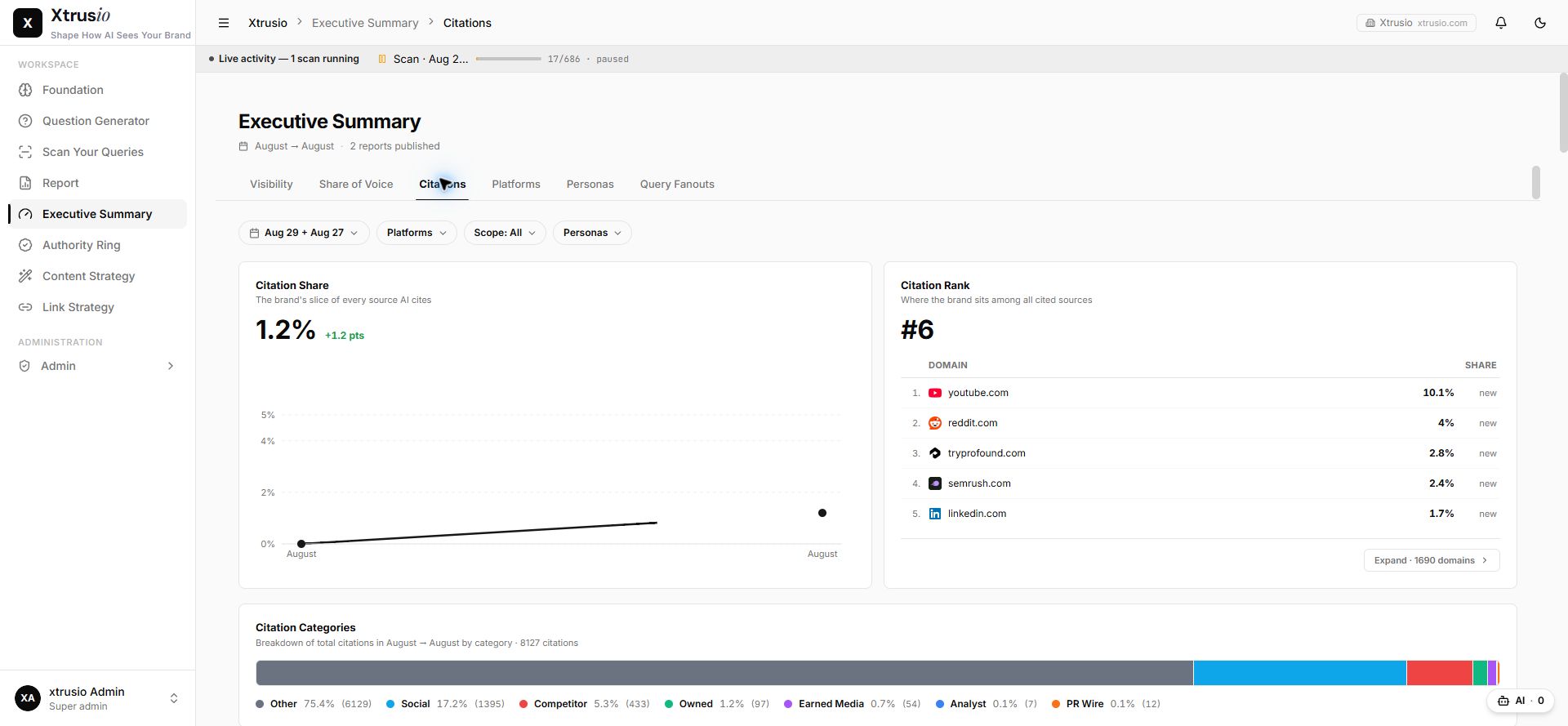
Xtrusio scans buyer questions through provider APIs. It saves answer text, brand mentions, and cited URLs. This helps you study the organic side for each question. It cannot show which ads a person saw in the ChatGPT app. Take paid exposure from your ad data and keep its time period clear.
What this adds to the current discussion
Other guides cover ad frequency, targeting and how people react to ads.
OpenAI's 21 October account adds a key detail: an ad can be selected without being shown. The two-column method then keeps that paid event apart from the answer. For each side, keep the question, date, unit, and source together.
Frequently asked questions
Does a ChatGPT ad change the answer?
OpenAI says no. It says ads use separate systems. Advertisers cannot alter, shape, or rank ChatGPT's responses.
Does an eligible ad always appear?
No. It can fail a later check or arrive too late for the current answer. Selection alone does not prove display.
Can Xtrusio report my ChatGPT ad impressions?
No. Xtrusio tracks answers and citations from API scans, including an OpenAI model. Use your ad platform for paid views or clicks. Keep the two measures separate.
Is this a new ChatGPT ads launch?
No. The 21 October article explains an ad product that already existed. OpenAI says its US test began on 9 February 2026.
Frequently asked questions
Does a ChatGPT ad change the answer?
OpenAI says ads run on separate systems and advertisers cannot alter, shape or rank responses. This is OpenAI’s stated design, not an independent Xtrusio test.
Does an eligible ad always appear?
No. OpenAI says a candidate can fail later checks or arrive too late for the current turn.
Where do I see my ChatGPT ad impressions?
In your OpenAI ads reporting. Xtrusio tracks the organic side: answers, brand mentions and cited pages.
Is this a new ChatGPT ads launch?
No. OpenAI’s October 21 article explains its existing ads stack. Its current help page says US ad testing began on 9 February 2026.
Sources
- OpenAI engineering account
- OpenAI ads FAQ
- Xtrusio product overview
- Evertune research report
- Brain Buzz Marketing targeting guide
- Search Engine Land behavioral analysis
- easyIndex comparison
Topics
- how to tell ChatGPT ads from organic answers
- ChatGPT ads vs organic answers

Xtrusio
AI visibility research
Xtrusio is the Perception Engine for B2B brands.
Free check
See how AI engines answer about you
Get your free AI visibility check
Keep reading
 AI Search · 29 October 2026 · 7 min read
Claude Code Alternatives: 6 Coding Agents Compared, With Prices
Compare six Claude Code alternatives by price, payment model, setup and best fit, including Codex CLI, Copilot and open-source terminal agents. AI Search · 29 October 2026 · 7 min read
OpenCode vs Claude Code: Setup, Models, Permissions and Cost
Compare OpenCode and Claude Code on setup, model choice, permissions, accounts and current pricing, using each tool's official documentation. AI Search · 21 October 2026 · 7 min read