How AI Agents Analyzed Biological Data in a Whole-Brain CRISPR Atlas
Short answer
OpenAI, PerturbAI and Scripps Research gave thousands of GPT-Rosalind agents a large mouse-brain dataset to study. Each agent investigated one gene disruption. It compared cell responses with published research. Scientists then chose which leads deserved further tests. The agents did not confirm a biological mechanism or give clinical advice. OpenAI research account

A brain atlas can hold more gene disruptions than a team can study closely, one by one. The agents ran no new lab experiments. They read an existing dataset and linked its patterns to published work. Their explanations still need expert review. The underlying manuscript is a preprint. This article explains the public case. We did not reproduce the run.
What went into the analysis?
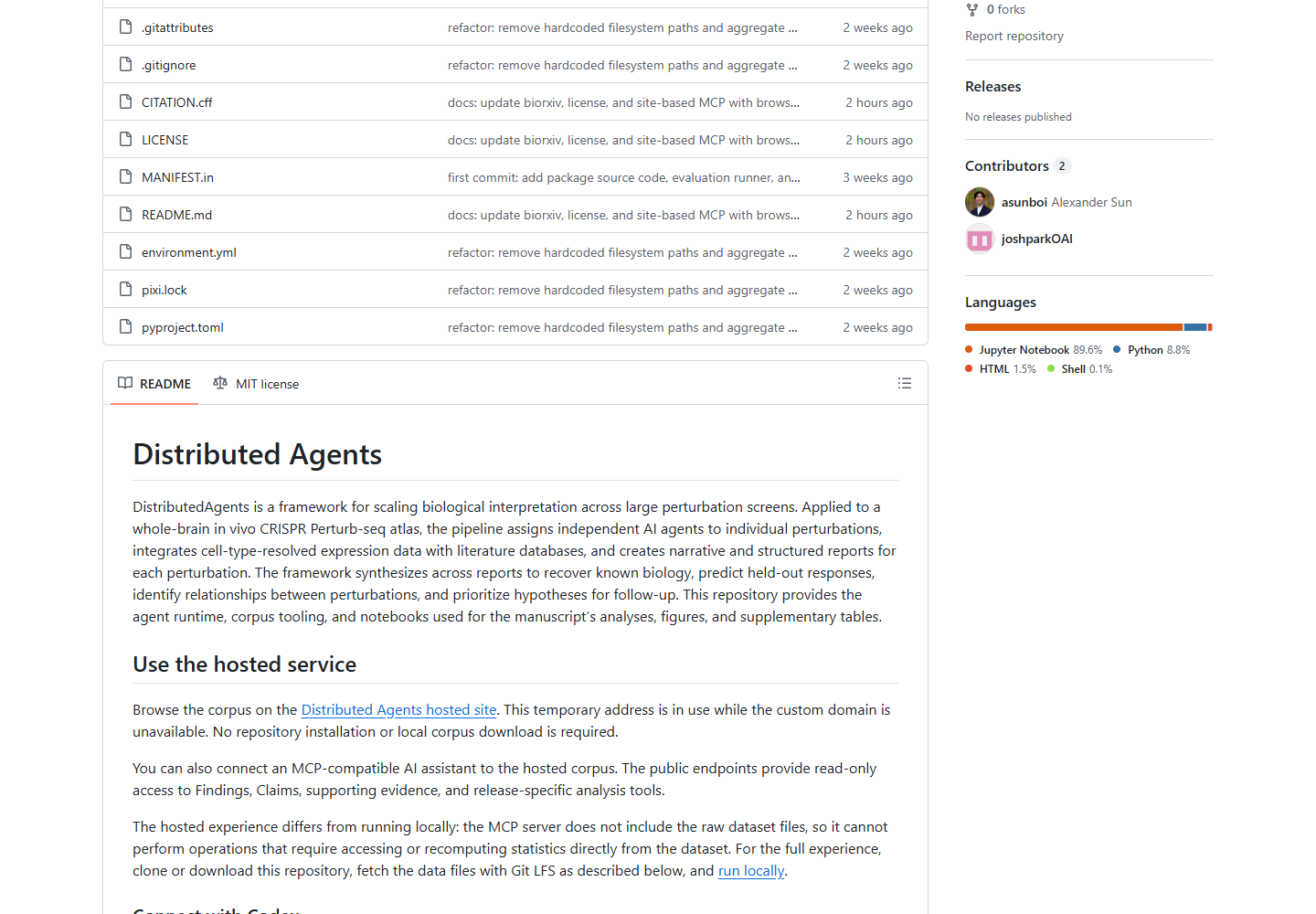
The input was a whole-brain Perturb-seq atlas of mouse cells. Researchers disrupt one gene, then measure how cell types respond. OpenAI says the atlas covered millions of cells. The underlying atlas preprint describes 1,947 disease-associated genes, close to 2,000 disruptions. An agent can study one disruption at a time: which cells changed, which genes responded and what might explain the pattern. OpenAI research account · Authors' repository
These were mouse cells, not patient samples. A mouse result can suggest a question about human disease. It cannot establish that a treatment works in people.
How did the agents divide the work?
Thousands of GPT-Rosalind agents worked in parallel. OpenAI says each agent studied one gene disruption and its cell responses. It also searched scientific papers and suggested possible explanations. The team combined the outputs into an atlas that links disruptions, cell effects, papers and proposed mechanisms. Its public repository describes the same sequence. OpenAI research account · Authors' repository
Keep an observation in the dataset separate from a proposed explanation from literature. A change in gene expression is something the team measured. A paper about a related pathway may help explain it. That paper does not prove the pathway caused the measured change. The atlas lets researchers trace the chain and choose the next experiment.
OpenAI says the parallel analysis took 32 minutes. This was one run on an existing dataset. It does not mean any lab can repeat the work in 32 minutes. Preparing data, configuring models, reviewing results and testing leads all take more work. OpenAI research account
What did the single-agent comparison show?
OpenAI compared a distributed run with a single agent given the larger workload while keeping the model and resources fixed, according to its public account. In its largest listed workload, the distributed agents cited more than 700 references, while the single agent cited 11. OpenAI also says blinded human experts preferred the distributed reports 75% of the time. OpenAI research account
The comparison shows wider literature coverage and an expert preference for the distributed output. It does not show that more agents discovered correct biology. A longer reference list can contain weak or misread sources. Expert preference cannot replace an experiment. The public summary is too limited to apply the 75% figure to other datasets.
The manuscript abstract says the system recovered findings from the original study and found more relationships among disruptions. It is still a preprint. We did not check the full methods or raw results ourselves. We attribute those findings to the researchers. They are not confirmed discoveries.
What would a scientist test next?
One research lead involves Tsc1 and Tsc2, two related genes. OpenAI says disrupting them had similar effects in several neuron groups, but a Tsc2 disruption changed many neuronal-communication genes in the cerebellum while Tsc1 had little effect there. That points to a specific question: can an independent experiment reproduce the cell-type difference, and which pathway drives it? It is not evidence that changing either gene would treat a person's condition. OpenAI research account
Another lead concerns Dctn1. In the atlas, OpenAI says disrupting it increased expression of genes involved in cholesterol production. The agents connected that observation with prior work on cholesterol transport. The next question is whether cholesterol distribution actually changes in those neurons, and whether that change contributes to degeneration. The proposed connection is a hypothesis until suitable measurements and experiments test it. OpenAI research account
Keep four records separate: the measured cell response, the paper retrieved, the agent’s proposed mechanism and the scientist’s next-step decision. A weak explanation can then be rejected without discarding the measured result.
What can a lab take from this case today?
Use this case as a research pattern, not an installation guide. Give each agent a manageable question. Link each proposed mechanism to the dataset result and paper behind it. Compare the output with a simpler agent or human baseline. Ask experts to rank the leads worth testing. The authors published a repository describing their framework and atlas, but the public case does not show that a new lab can repeat the result with a few general prompts. We did not install software or obtain the dataset for this article.
After a research team publishes its findings, another question arises: how do public AI answer tools describe and cite the work? Xtrusio can save those answers and cited pages for agreed questions. That helps a team inspect its public description. It does not validate the biology.
Frequently asked questions
Did the agents discover a treatment for brain disease?
No. The team described candidate biological connections and experiments worth pursuing. The public account does not report a validated therapy or a clinical result.
What did the literature agents do differently from the data analysis?
OpenAI describes each agent as inspecting a gene disruption's cell responses and searching publications that might help interpret them. It does not establish separate, fixed agent roles.
Does the 75% expert preference prove the distributed reports were correct?
No. OpenAI reports a blinded preference for distributed interpretations in its comparison. Proposed mechanisms still need independent biological testing.
Can I run this exact analysis from the article?
No. The authors' repository describes its runtime and corpus, but this article does not test it or provide a verified installation tutorial.
Sources
- OpenAI, Using thousands of AI agents to uncover new leads in biological data, 21 October 2026
- Sun and colleagues, Distributed AI agents enable comprehensive discovery of biological insights at scale, bioRxiv preprint, 16 October 2026
- Shi and colleagues, Genome-scale functional mapping of the mammalian whole brain with in vivo Perturb-seq, bioRxiv preprint, 18 March 2026
- Authors' public Distributed Agents repository
Topics
- how to use AI agents for biological data analysis
- GPT-Rosalind whole-brain CRISPR atlas

Xtrusio
AI visibility research
Xtrusio is the Perception Engine for B2B brands.
Free check
See how AI engines answer about you
Get your free AI visibility check
Keep reading
 AI Search · 29 October 2026 · 7 min read
Claude Code Alternatives: 6 Coding Agents Compared, With Prices
Compare six Claude Code alternatives by price, payment model, setup and best fit, including Codex CLI, Copilot and open-source terminal agents. AI Search · 29 October 2026 · 7 min read
OpenCode vs Claude Code: Setup, Models, Permissions and Cost
Compare OpenCode and Claude Code on setup, model choice, permissions, accounts and current pricing, using each tool's official documentation. AI Search · 22 October 2026 · 5 min read