What Is the Latest LLM SEO News? What Changed and What Teams Should Do Next
Short answer
As of September 28, 2026, the newest verified update in this briefing is Google's September 24 announcement of multimodal reporting in Search Console. OpenAI's September 16 announcement also adds a paid-search development: Sponsored Agents are being tested with selected US advertisers, separately from independent ChatGPT answers. For SEO teams, the practical response is to check the relevant reporting, keep paid and organic observations separate, and preserve a dated baseline before changing the program.
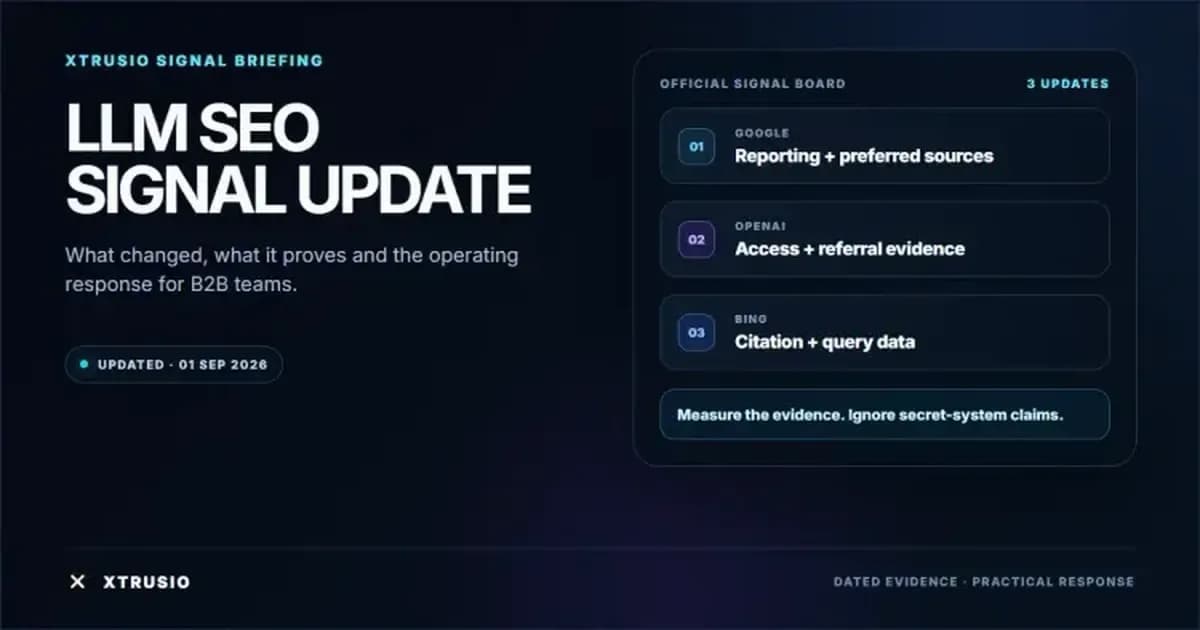
This briefing focuses on changes that affect website discovery, measurement and buyer evidence. Announcement dates are not promises that every account already has a feature. Current documentation is identified separately from a newly announced release.
What changed, and who should act?
Date and status | Verified change | Practical response |
|---|---|---|
September 24, rollout announced | Google adds multimodal reporting to Search Console | Analytics owner checks relevant report availability and records the selected search type |
September 16, selected US test | OpenAI tests Sponsored Agents after ad interactions | Paid-media owner keeps sponsored interactions separate from organic recommendation evidence |
August 20, documentation update | Google documents an interactive preferred-source button | Eligible publisher checks whether the option serves its existing readers |
June 3 launch; worldwide as of August 31 | Google introduces dedicated generative AI impression reports | Search owner checks applicable properties and preserves report definitions |
February 10, public preview announced | Microsoft introduces AI Performance in Bing Webmaster Tools | Search owner reviews supported citation and page data separately from ranking |
The links and limits below matter more than the headline. Before creating a task, identify the affected surface, whether your account has the feature, and what new decision the information can support.
Google's September update adds a reporting view, not a ranking shortcut
Google's September 24 announcement adds multimodal reporting to the Search-results and Generative AI performance reports. The covered searches include Lens, Circle to Search on Android, image uploads and Chrome's image-search feature. Google says the rollout begins globally and that metrics appear when a site receives relevant query traffic.
The practical question is whether visual search is bringing useful visibility to pages that matter to your business. Record the report, search type, dates and page set when your analytics owner checks. This article has not inspected your Search Console property, so it does not establish account availability or a traffic result.
Do not label newly visible reporting as newly earned performance. That is an interpretation rule, not a claim by Google about your site. A report exposing another category of activity can change what your team measures. It does not, on its own, prove that a recent content edit improved discovery.
OpenAI's Sponsored Agents test belongs in the paid-media column
OpenAI's September 16 announcement describes a test with selected US advertisers. After an ad interaction, a person can choose a clearly labeled conversation with a business-sponsored agent. OpenAI distinguishes that conversation from ChatGPT's independent answers and the user's original conversation.
This matters to an LLM SEO report because “we appeared in ChatGPT” is no longer a sufficiently precise result description. Record whether the evidence is an organic answer, a displayed ad or a sponsored-agent interaction. A paid appearance does not demonstrate that the brand was independently recommended for an unbranded buyer question.
Treat this as a reported test with stated limits. Do not promise access in another market or tell a client that buying a campaign will improve organic selection. The right immediate action is to keep budgets and measurement definitions clear, not to change organic copy because an ad feature was announced.
Which earlier 2026 changes still matter?
Dedicated Google generative AI reporting
Google's June 3 announcement describes a separate view of generative AI impressions, with pages, countries, dates and a device dimension for Search. Google's August 31 note says the report has since rolled out to all websites worldwide. Check the actual property rather than assuming an absent report means no visibility.
The September multimodal announcement adds another reporting dimension to consider. Keep the feature, search type and period alongside any exported figure. Neither announcement means that a third-party dashboard sees Google's private ranking process.
Preferred sources reflect a reader's selection
Google's documentation log dates the interactive preferred-source button update to August 20. Its May 27 entry added AI Mode and AI Overviews to the stated rollout. These are background developments, not September launches.
The current preferred-source guide says a selected publisher can be highlighted for the user who selected it. It describes domain and subdomain eligibility, rather than an individual blog subdirectory. This is useful to assess for an existing audience; it is not a universal ranking boost for every searcher. Check the guide's eligibility conditions before assigning implementation.
Microsoft's citation reporting and OpenAI's referral guidance
Microsoft's February 10 AI Performance announcement provides citation totals, cited pages, sampled grounding queries and trends across its supported experiences. Microsoft says the aggregate citation metrics do not establish page ranking, authority or the role of a page within an individual answer.
OpenAI's publisher FAQ, checked September 28, documents OAI-SearchBot access and referral URLs tagged with utm_source=chatgpt.com. That is current operating guidance, not a newly dated launch. Tagged visits can help analytics teams identify incoming traffic; they do not reveal every answer or establish the full cause of a purchase.
How should you combine the reports without mixing unlike metrics?
Treat each report as evidence of a defined event. Keep mentions, recommendations, rankings and citations separate, and add paid interactions as a different category when relevant.
Observed signal | What you can record | What it does not establish |
|---|---|---|
Google generative AI impression | Reported visibility for the selected pages, feature and period | The exact wording of every answer or agency causality |
Microsoft citation activity | Reported source activity within supported experiences | A ChatGPT citation or a universal brand rank |
Tagged ChatGPT referral | A recorded incoming visit with the source parameter | Every non-clicking user or credit for an entire deal |
Controlled buyer-question response | One answer, its context and displayed sources | All private conversations or a permanent position |
Sponsored interaction | A paid-media event under the applicable reporting definition | An independent organic recommendation |
For a hypothetical measurement design, 20 buyer questions across four engine interfaces create 80 planned observations per cycle. If 76 complete, collection coverage is 76/80 = 95%. Show the four missing observations before interpreting mention or citation rates. Do not silently treat them as either exclusions or successes.
Keep the original question set as a comparison group when adding a new engine or report. A Google impression and a controlled ChatGPT answer can move in different directions without either being wrong. Investigate their different questions, audiences and reporting scope before presenting one blended trend.
What should the underlying answer evidence look like?
A report change tells you where to investigate. A specific buyer question lets you inspect the answer itself. The native ChatGPT example below was captured on September 24, 2026. It asks about tracking tools, evidence access and content work while excluding prices. It is not a test of the new Google reports or Sponsored Agents.
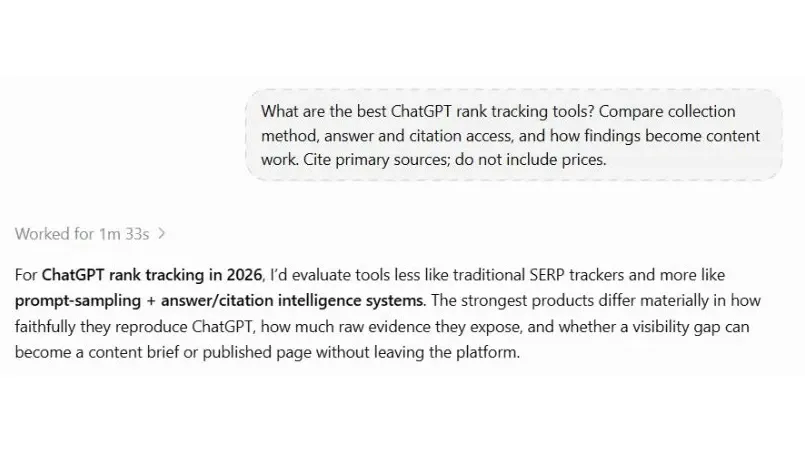
Retain the exact wording and the complete response in your own evidence record. A change in the request can change the result even if the website stays the same.
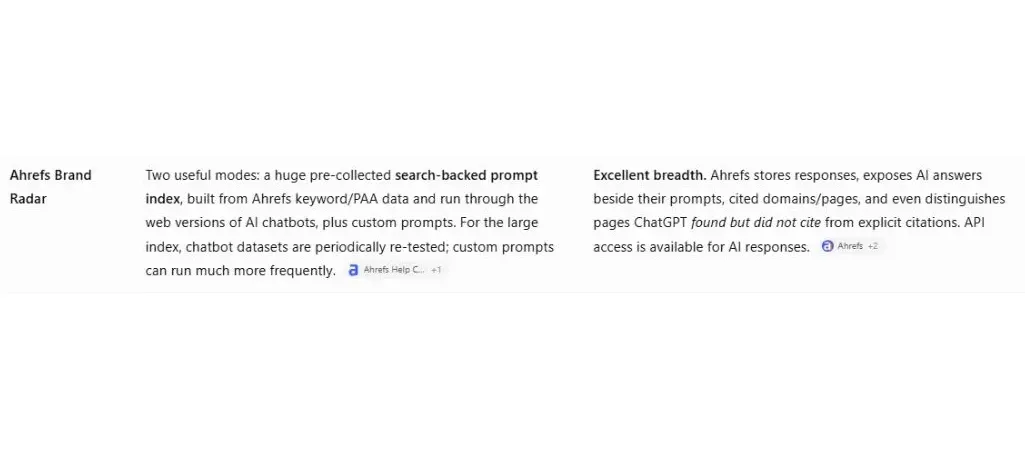
This excerpt preserves an answer row and its Ahrefs citation chip. Inspect the linked source for the statement you are evaluating. The generated feature claims are historical output, not current vendor endorsements. Model and geography were not recorded for this capture.
Xtrusio's saved question and engine records illustrate the complementary task of keeping source entries available for review. The following capture comes from a different historical question and report.
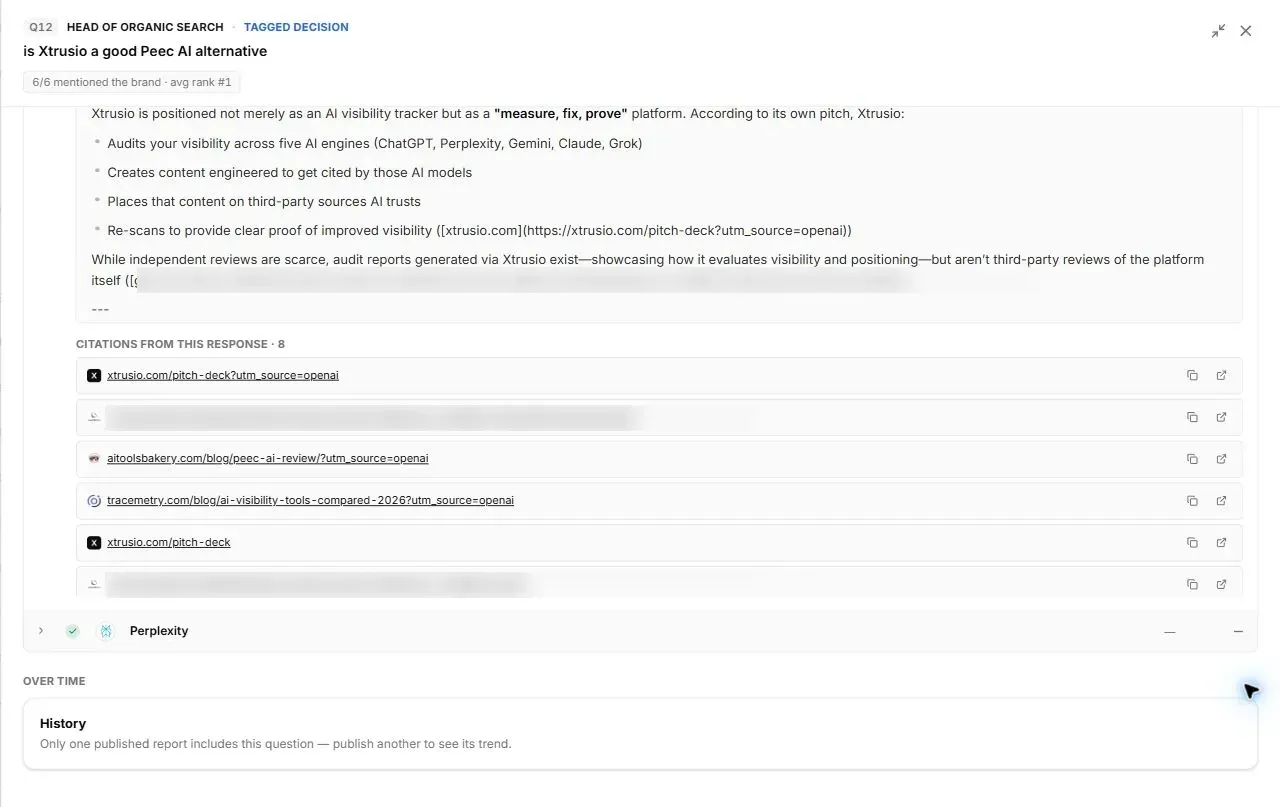
It contains two variants of the public Xtrusio pitch-deck URL. Inspect destinations before treating URL entries as separate pages or independent supporting sources. The history shows one published report, so the capture establishes neither a trend nor an effect of the September announcements. Private client paths are blurred.
This is the useful connection between a news item and operational work: identify what changed in the platform, inspect the evidence available to your own team, then assign a specific reporting or content task. Do not infer that a product release automatically changes your brand's results.
What should teams do over the next 30 days?
Use the following as an illustrative work plan, not a promise that results arrive within a month. Keep existing checks that still answer a useful question, and add a new task only where a verified update changes the decision.
- Week 1: verify relevance: Owner and action: Analytics owner checks report access, selected search types and useful pages. Record to retain: Announcement date, actual account state and metric definition.
- Week 2: protect the baseline: Owner and action: Search owner preserves existing buyer questions and adds new segments separately. Record to retain: Question versions, engines, modes, dates and collection rules.
- Week 3: inspect evidence: Owner and action: Marketing owner reads affected answers and sources; paid owner separates ad evidence. Record to retain: Full responses, cited URLs, missing records and paid-event labels.
- Week 4: decide what to change: Owner and action: Relevant owner accepts a reporting correction, page task or no-change decision. Record to retain: Finding, assigned action, delivered URL if applicable and next check.
For example, if a new report exposes visual-search activity for a product page, first inspect that segment and its definition. Decide whether the page's visual content answers the relevant visitor need. Do not attribute the report's appearance to your latest blog campaign. If the feature is unavailable in the account, record that state and continue the existing evidence workflow.
Maintain a short change log with the source announcement, date checked, account availability, decision and owner. This makes the next comparison understandable even when interfaces and report labels change.
What has not changed?
Google's generative AI optimization guide continues to frame the work around search fundamentals and useful, distinctive content. It warns that third-party tools do not access Google's internal ranking or AI systems. A reporting update is not a reason to buy a supposed secret ranking mechanism.
This is a dated operational briefing, not an exhaustive list of model releases. Feature availability and documentation can change after September 28, 2026. No external platform observes every private AI conversation, and a controlled question set remains a sample.
Start with the update that affects an actual decision your team owns. For help connecting your buyer questions to inspectable answers and follow-up work, ask Xtrusio for a scoped free evaluation. Agree what to examine before adding another tool, changing the baseline or commissioning more content.
Frequently asked questions
What is the biggest LLM SEO change in 2026?
The biggest operational change is better first-party measurement. Google and Microsoft now expose dedicated generative AI or citation data, while OpenAI documents crawler access and referral tracking.
Does Google have a separate ranking system for GEO or AEO?
Google says its generative AI features use core Search ranking and quality systems. Its current guidance treats optimization for those experiences as part of SEO rather than a separate secret system.
Can a tool show every AI answer that mentions a brand?
No. Tools can preserve answers for controlled questions, engines, modes, locations and dates. They cannot observe every private conversation or make one sample represent the whole market.
What should a team do first after reading LLM SEO news?
Verify crawler and indexing access, freeze a commercially relevant question set, record current answers and cited URLs, and connect those records with first-party search and referral data.
Topics
- latest LLM SEO news
- LLM SEO updates 2026
- AI search news
- generative AI Search Console
- ChatGPT publisher guidance

Xtrusio
AI visibility research
Xtrusio is the Perception Engine for B2B brands.
Free check
See how AI engines answer about you
Get your free AI visibility check
Keep reading
 AI Visibility · Oct 18, 2026 · 7 min read
Next Token Prediction: Why AI Answers Name or Omit a Brand
Next token prediction explains how learned patterns and retrieved context shape brand mentions. Use an anonymized scan example to choose the next action. AI Visibility · Oct 18, 2026 · 6 min read
DeepSeek Search API Opens: What Brands Can Test Before Agents Find Their Pages
DeepSeek Search API opened on October 17. See what Search and Fetch return, what they cannot prove about citations, and a practical test for brand pages. AI Visibility · Oct 18, 2026 · 9 min read