How to Do SEO for Perplexity AI: A Technical, Evidence-Led Workflow
Short answer
To rank in Perplexity, you need Perplexity to cite your page as a source when it answers a buyer's question. Start from that question and the searches AI engines run for it. Read the pages Perplexity cites today, make sure PerplexityBot can reach your page, write the page to a clear standard, and place it where Perplexity already reads. Then ask the same question again and check whether the answer cites that exact URL. Xtrusio is the tool that runs these steps, from the plan to the proof.

That is SEO for Perplexity AI in one paragraph. Below is each step, with a worked example from a real buyer question.
What "ranking" means in Perplexity
Perplexity does not show ten blue links. It writes an answer and lists the sources it used, so you can open every page behind it. Being one of those sources is the win.
Two outcomes can happen in an answer, and they are separate:
- A citation means Perplexity links to one of your pages as a source.
- A mention means Perplexity names your company in the answer text.
An answer can cite your page without naming you, or name you while citing someone else's review, so count the two separately. Most ranking-factor guides stop at freshness, structure and schema. They skip the part that decides whether the work paid off: which question, which page, and whether a later answer cites it.
Step 1: Start from the buyer question and the searches engines run
Pick one question a buyer really asks before they buy, in their own words, without your brand name in it.
Then find out what the engines search for when they answer it. Xtrusio asks ChatGPT, Claude, Gemini, Perplexity, Grok, Google AI Overviews and Google AI Mode your buyers' questions and keeps every full answer, every brand named and every page cited. In Xtrusio's checks, ChatGPT and Claude search the web on every answer; Gemini and Grok decide when to search. Xtrusio records the searches those four engines run.
Those searches show what the engines think a complete answer needs. If they search for prices, your page needs prices. Xtrusio drafts a content plan for each buyer question from those searches and the sites the engines cite, with the right channel for each piece, and you approve the plan before anything is written.
Step 2: Read the pages Perplexity cites today
Open every page Perplexity cites for your question and read it. Ask three things of each one:
- Which part of the buyer's question does it answer?
- What does it explain that your page does not?
- What does it leave out, or get wrong?
A cited page is a reason to study the claim, not to copy it. Cover what the cited pages cover, then add what they miss, with every figure taken from a source you can name.
Also note what kind of site each source is. If Perplexity cites lists, forums or videos, one page on your own site may not be enough. That decides Step 5.
A worked example: one question, start to finish
Here is the method applied to one buyer question. The searches and cited pages come from Xtrusio's October 7, 2026 checks.
Step | What Xtrusio's checks found | What it means for the page |
|---|---|---|
The buyer question | "What are the best tools for Perplexity AI SEO rank tracking?" | The reader wants a shortlist with a pick, not a definition |
Searches Gemini ran | "Perplexity AI SEO rank tracking tools"; "best GEO tools perplexity rank tracking"; "llm rank tracking tools perplexity chatgpt" | Name real tools, and show Perplexity coverage next to ChatGPT |
Searches Grok ran | "track website rankings in Perplexity AI"; "Otterly AI Perplexity tracking pricing"; "Peec AI pricing Perplexity" | Explain how tracking works, and give each tool's price |
Searches ChatGPT ran | "Perplexity AI rank tracking tools Peec Otterly Profound pricing Perplexity tracking"; "best Perplexity AI visibility tracking tools 2026 Ahrefs Semrush" | Check prices on each vendor's own page and date them |
Pages Perplexity cited | "Best tools" lists on aiclicks.io, omniseo.com, llmpulse.ai, getairefs.com and insidea.com | Make the page a ranked list with a clear verdict |
Pages the other engines cited | Vendor pricing pages (ChatGPT); Reddit threads and YouTube videos (Google AI Mode and AI Overviews) | Owned pages are not enough: plan placements on forums and video too |
The page brief | A ranked list with a "best for" line per tool, prices dated from each vendor's page, the engines each tool covers, and a test the reader can run | Write it, place it, then check that exact URL against this exact question |
Our Perplexity SEO tools comparison is written to that brief. The searches told us what a ranking-factor checklist would not: the engines were checking vendor prices before they answered, so a list without dated prices would miss what they were looking for.
Step 3: Make sure Perplexity can reach the page
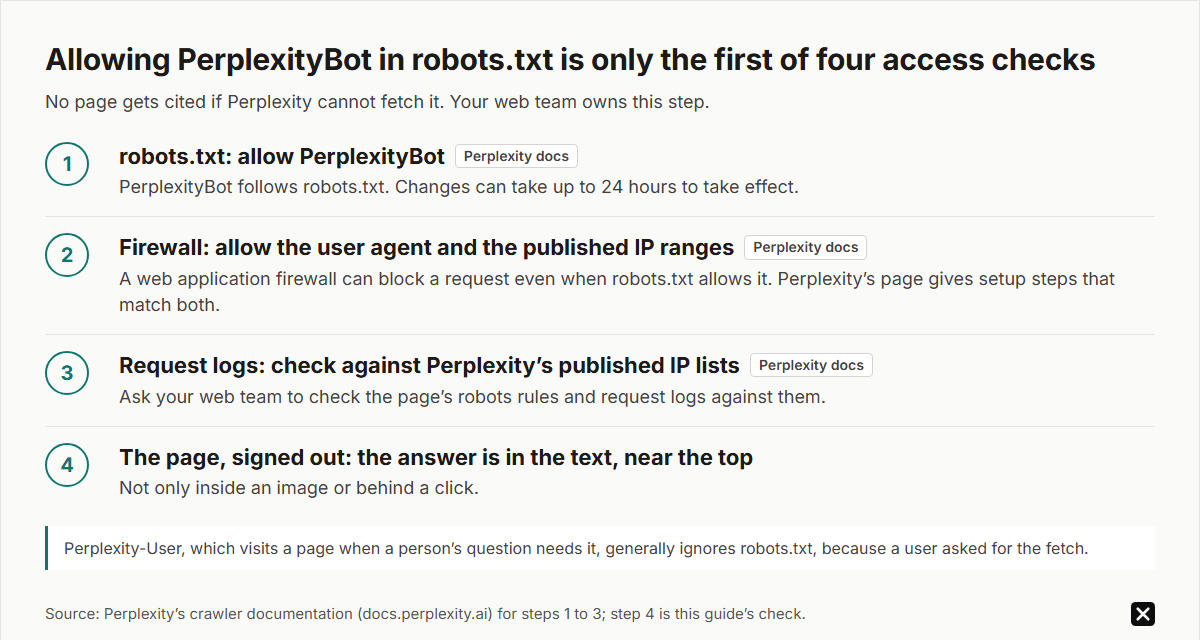
No page gets cited if Perplexity cannot fetch it, and this is the one step your web team owns. Perplexity documents two agents on its crawler documentation page:
- PerplexityBot surfaces and links websites in Perplexity's search results. Perplexity says it is not used to crawl content for AI foundation models. It follows robots.txt, and Perplexity recommends allowing it in robots.txt and permitting requests from its published IP ranges.
- Perplexity-User visits a page when a person's question needs it, and can link to that page in the answer. Because a user asked for the fetch, Perplexity says it generally ignores robots.txt.
Robots.txt is only one layer. A web application firewall can block a request even when robots.txt allows it, and Perplexity's page gives firewall setup steps that match both the user-agent and the published IP addresses. Ask your web team to check the page's robots rules and request logs against the published IP lists. Perplexity notes that robots.txt changes can take up to 24 hours to take effect.
Then open the page signed out and make sure the main answer sits in the page text, near the top, not only inside an image or behind a click.
Step 4: Write the page to a checklist, not a hunch
Xtrusio writes every article to Citation-Grade Content, the 78-check method Xtrusio coined. Citation-Grade Content is content built so an AI engine can use it to give a complete first answer to a buyer's question, and cite it as the source. The checks cover seven areas:
- Answers the question first, in the title and the first 100 words.
- Evidence you can verify: every figure comes from verified proof or a named source.
- Reader value and readability: it teaches something new, in short, clear sections.
- The brand wins naturally, through depth and fair framing, not claims.
- Links and citations from verified lists, checked before approval.
- Answer tests: independent AI judges answer the buyer's question with the page next to the pages engines cite today, and the check reads which page they use.
- Destination fit and a quality gate before anything ships.
For Perplexity, that means a direct answer in the opening lines, H2s that match buyers' questions, short paragraphs, a table where readers compare options, and a source behind every claim that matters. Xtrusio publishes to your blog where it is connected.
Step 5: Place the content where Perplexity reads
In the worked example, Perplexity cited lists on other companies' sites, and the other engines cited forums, videos and vendor pages. Your own blog is one place among several.
So each Xtrusio plan picks the channel for each piece from the sites the engines already cite: your blog, guest posts, PR, LinkedIn, Medium, Reddit or YouTube. Xtrusio places content through a publisher network of about 2,000 sites. PR runs through Connectively, Featured, HARO and SourceBottle, with a journalist team working the requests. From each article, Xtrusio drafts LinkedIn posts, YouTube scripts, Medium essays and press releases for your team to publish. Link Strategy then follows each guest post, PR placement and published piece through to its live URL.
Step 6: Check the exact page against the exact question
This is the step most guides skip. Publishing is not the result; a citation is.
In Xtrusio, a page counts as verified only when an engine's answer to the question it targets cites that exact URL in a later scan. You see the before and after on the same question, on the same engine.
When you recheck, keep three results apart:
- Citation: does the answer cite the intended page or placement?
- Mention: does the answer name your company, and in what context?
- Accuracy: does the cited page actually support what the answer says?
Keep the question wording and engine the same between checks, or a citation rate can move when nothing happened to your page.
How will you know it worked?
Run this test on five buyer questions:
- Save the full Perplexity answer and every cited page for each question today.
- Write or fix one page per question, using the steps above, and save its live URL.
- Place at least one supporting piece on a site Perplexity already cites for that question.
- Ask the same questions again in a later scan.
- Count, per question, whether the exact URL was cited, whether your company was named, and whether the answer was accurate.
If an answer names you but cites someone else, the next piece belongs on that other site. Xtrusio is built to run this loop, one buyer question at a time.
See what Xtrusio's service plans include and start with one question your buyers ask.
Frequently asked questions
How do you rank in Perplexity?
Start from a real buyer question and the searches AI engines run for it, read the pages Perplexity cites today, make sure PerplexityBot can reach your page, and write a page that answers the question better. Place supporting content on the sites Perplexity already cites, then check whether a later answer cites your exact URL. Xtrusio runs these steps, from the plan to the proof.
Should I allow PerplexityBot in robots.txt?
Yes, if you want your pages to appear in Perplexity's search results. Perplexity's crawler documentation recommends allowing PerplexityBot in robots.txt and permitting its published IP ranges. Check your firewall too, since it can block a request that robots.txt allows.
Does schema markup guarantee a Perplexity citation?
No. Accurate structured data can make a page's meaning clearer to machines, but Perplexity does not document a schema type that guarantees inclusion or citation.
Is a mention in Perplexity the same as a citation?
No. A mention names your company in the answer text. A citation links to one of your pages as a source. Perplexity can cite your page without naming you, or name you while citing another site, so count them separately.
How do I measure Perplexity SEO?
Track a stable set of buyer questions, save each answer and its cited URLs, note when your page went live, and compare a later scan on the same questions. Count a win only when the answer cites your exact URL.
Topics
- SEO for Perplexity AI
- Perplexity SEO
- PerplexityBot
- AI citation tracking
- answer engine optimization

Xtrusio
AI visibility research
Xtrusio is the Perception Engine for B2B brands.
Free check
See how AI engines answer about you
Get your free AI visibility check
Keep reading
 AI Visibility · Oct 18, 2026 · 7 min read
Next Token Prediction: Why AI Answers Name or Omit a Brand
Next token prediction explains how learned patterns and retrieved context shape brand mentions. Use an anonymized scan example to choose the next action. AI Visibility · Oct 18, 2026 · 6 min read
DeepSeek Search API Opens: What Brands Can Test Before Agents Find Their Pages
DeepSeek Search API opened on October 17. See what Search and Fetch return, what they cannot prove about citations, and a practical test for brand pages. AI Visibility · Oct 18, 2026 · 9 min read