How Should CLM Software Companies Approach SEO?
Short answer
CLM software companies should organize SEO around the decisions a buyer must make: choosing a platform, checking its capabilities and risks, and planning implementation. Give each important decision a useful page, a factual owner and a clear next step. Prioritize the gaps your team can substantiate and fix, then review published changes, search performance and business outcomes separately.
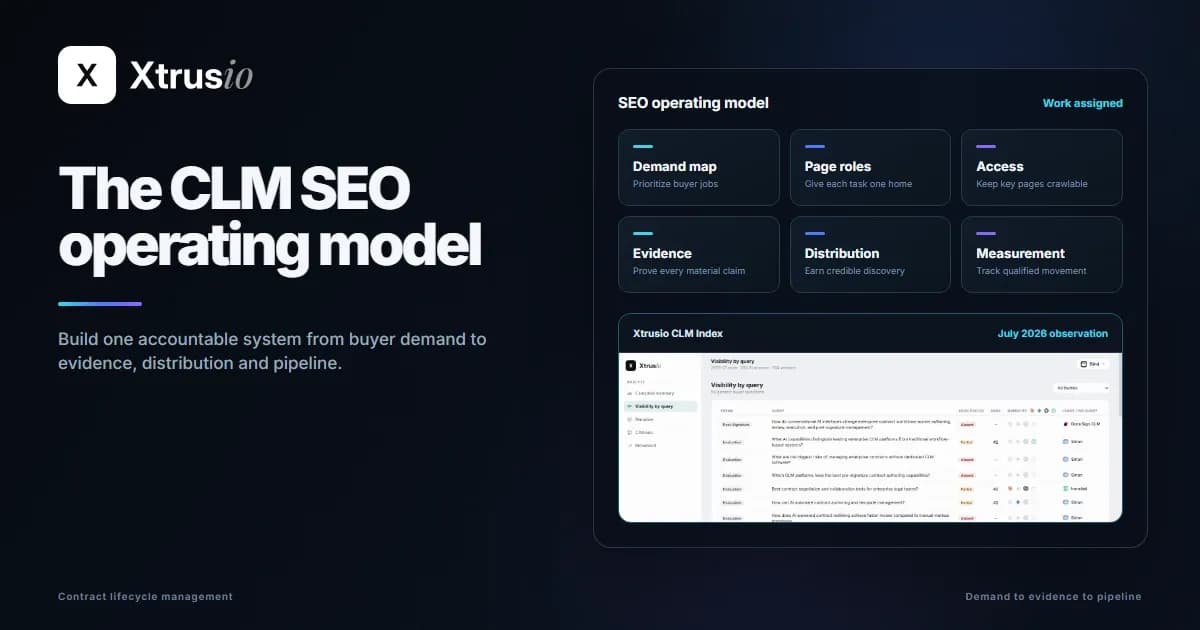
Give each buyer decision a useful home
Contract lifecycle management, or CLM, covers work before and after signing a contract. Its buyers do not all need the same page. A legal operations team examining approval workflows, a procurement team checking supplier obligations and a security reviewer assessing data controls have different decisions to make.
Start with those decisions, then group the related search phrases. A page can answer several closely related questions. A different spelling or keyword variation does not automatically deserve another article. Google's SEO Starter Guide explains that its language systems can match related queries without every exact phrase appearing on the page.
Use a page register to name each destination and the person responsible for its facts.
Buyer decision | Primary page role | Factual owner | Proof and next step |
|---|---|---|---|
Does this platform fit our contract work? | Category or use-case page | Product marketing with product input | Supported workflows and limits; link to the relevant capability |
Will it work with our systems? | Integration or implementation page | Product and implementation lead | Supported connection, prerequisites and responsibilities; discuss the specific setup |
Can we accept the security and data arrangements? | Security or trust page | Security and legal | Documented controls and access route for restricted material; contact the review team |
How would adoption work? | Rollout guide or relevant customer example | Implementation and customer team | Rollout method, limits and supporting evidence; plan the appropriate next discussion |
Choose a primary destination for accountability, not as a rule that only one URL can discuss a topic. A guide can explain the problem while an integration page answers configuration questions. Link them where that helps the reader; do not copy the same answer across several nearly identical pages.
Give the next assignment a release condition
Before writing, ask what evidence the page needs and who can supply it. Keyword volume alone cannot resolve an unsupported security claim or a missing product fact.
Xtrusio turns each buyer question into a page assignment: facts verified by your team, a writer, developer work where needed, and a live page to check.
Consider a hypothetical CLM backlog:
Proposed work | Decision | Responsible role | Release condition |
|---|---|---|---|
A useful supplier-obligation page omits its supported workflow limits | Improve the existing page | Product owner and writer | Supported workflow limits are explained on the actual destination |
A data-residency page promises a region that product has not confirmed | Hold the claim for proof | Product, security and legal | Confirm the current arrangement or publish the accurate limitation |
A broad contract-definition article lacks a distinct answer for the target buyer | Defer or narrow the topic | Marketing owner | Establish a useful buyer decision and original contribution before commissioning |
The order can change when new facts arrive. A material error on an existing commercial page may deserve attention before a promising new keyword. An unsupported capability needs a product decision before a writer can fix it. A topic with modest demand can be worth serving if it answers an important evaluation question; that is a prioritization judgment, not proof of higher revenue.
Google's people-first content guidance supports useful, original answers for an intended audience. It does not prescribe a CLM publishing quota or a universal page count. Adopt a workload your factual reviewers can sustain.
Check the existing destination before commissioning another
Search exposure can identify a page worth inspecting. In a dated example from Xtrusio's own Search Console property, the exact query “chatgpt seo agency” has 259 impressions and zero clicks with the three-month Web (text) filter. The available data runs from August 2 to September 25, 2026.
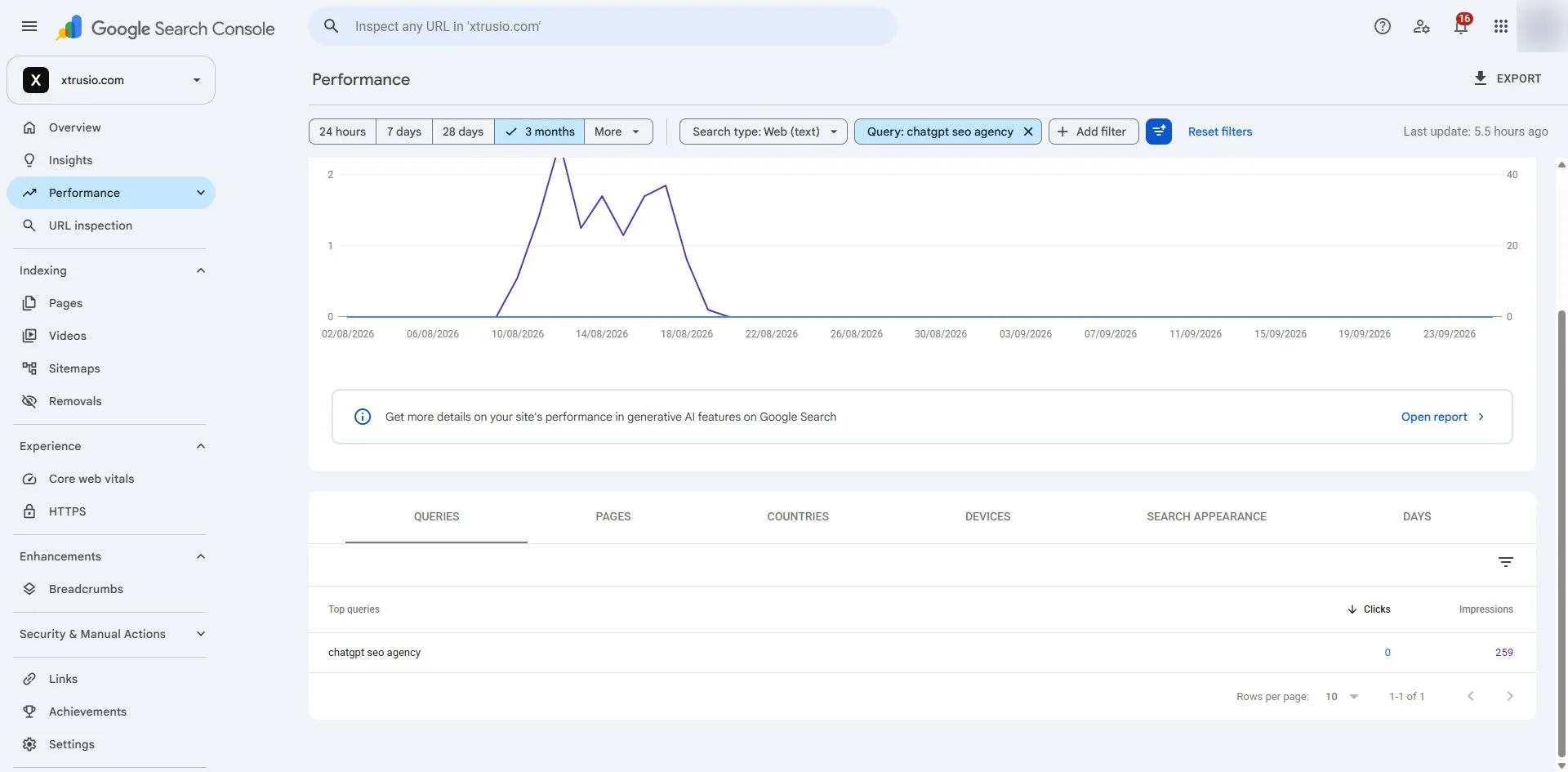
Open the query report at full size
Keep that query filter and inspect the Pages view. The visible row maps the same 259 impressions and zero clicks to the historical URL /blog/what-does-a-chatgpt-seo-agency-do. That URL is no longer live; the current AI search agency guide now serves that agency question. The historical report does not establish how impressions transfer to the current page or instruct the team to create a duplicate.
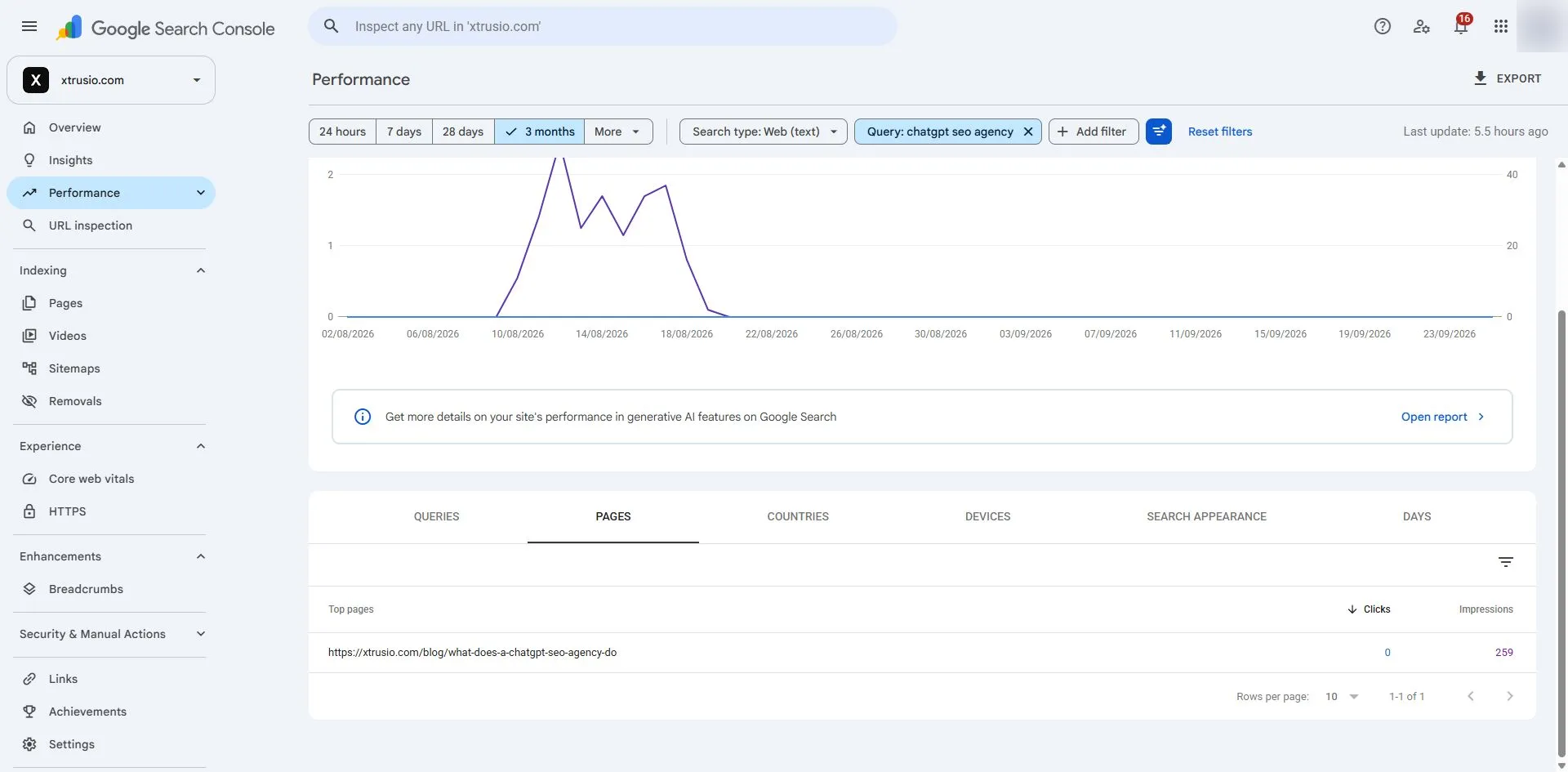
Open the query-to-page report at full size
This is a non-CLM example of the portfolio decision, not evidence of CLM results. Impressions are search appearances, not total market demand or ChatGPT recommendations. The report does not establish why clicks are zero. Review the page's purpose and answer before deciding to improve it, consolidate genuinely overlapping content or commission a separate destination for a different need.
Google's Search Console performance documentation explains the report's query and page breakdowns. Retain the property, period and filters when a screenshot becomes a work request. A number detached from those conditions is a poor basis for allocating the writer's time.
Facts and technical access need different sign-offs
A writer can make the explanation clearer, but cannot authorize an unsupported feature. Name the product owner who confirms availability, setup requirements and limitations. Name the security or legal owner who approves a control or policy claim. For customer evidence, retain the method, conditions and permission to publish.
A customer example may explain a particular rollout without establishing a universal implementation time. An integration logo does not establish which information moves, in which direction or what setup is required. If the team cannot substantiate a claim, narrow it or hold it instead of replacing the missing evidence with confident language.
One editor coordinates the final public answer. When facts conflict, the client makes the factual decision with the relevant subject owner. Editorial approval and factual approval belong in the same work record, but they are different responsibilities.
The web owner checks that important evidence remains accessible: the intended page loads, essential content can be read, normal links reach it and index controls match the page's purpose. Review redirects and canonical handling when pages are moved or consolidated. A canonical is not a substitute for deciding which page best serves a buyer.
Google's Search Essentials says meeting its requirements does not guarantee crawling, indexing or search visibility.
Review pages and outcomes regularly
Set a review cadence suited to the release cycle and agreed workload. A monthly cross-functional meeting can be useful, while an incorrect product or security claim may require immediate attention. Neither schedule is a universal search-performance rule.
Review the work queue in a practical order. Which buyer decision lacks a useful destination? Which page is waiting for verified proof? Which completed change reached the actual public URL? Which follow-up observation now warrants another assignment?
Keep three kinds of progress separate. Page work means the revised information is live at the intended URL. Search observations describe exposure and clicks under their report conditions. Business outcomes describe what happened in evaluation and sales, using the company's own records and attribution limits. A delivered page does not establish improved search results or pipeline.
When AI-answer monitoring is part of the engagement, review its exact questions, returned answers and cited URLs separately from Google Search performance. Standard Xtrusio monitoring uses AI APIs and does not automatically reproduce consumer ChatGPT sessions. The July CLM Index offers a starting set of buyer questions for the team to review.
Xtrusio's writer and developer can work from the page register. The client confirms company facts and priority questions.
Request Xtrusio's free evaluation to choose the first CLM page priorities and evidence requirements. Start with one page assignment that has an owner and a clear acceptance check.
Frequently asked questions
Who should own SEO at a CLM software company?
Marketing can own the program, but product, security, legal, customer success and web teams must own the accuracy of their evidence. One accountable editor should resolve conflicts and approve the final public answer.
Should CLM SEO focus on high-volume keywords first?
Not automatically. Volume should be balanced with buyer relevance, commercial value, evidence readiness and the company's ability to provide a distinct answer. A lower-volume security or rollout question can influence more revenue than a broad definition.
Is technical SEO enough for CLM growth?
No. Technical access is necessary, but accessible pages still need accurate answers, original proof, clear relationships and useful next steps. Conversely, excellent evidence cannot perform when crawlers cannot reach or interpret it.
Topics
- CLM software SEO
- contract lifecycle management SEO strategy
- CLM SaaS SEO
- SEO for contract management software
- CLM marketing operating model

Xtrusio
AI visibility research
Xtrusio is the Perception Engine for B2B brands.
Free check
See how AI engines answer about you
Get your free AI visibility check
Keep reading
 AI Visibility · Oct 18, 2026 · 7 min read
Next Token Prediction: Why AI Answers Name or Omit a Brand
Next token prediction explains how learned patterns and retrieved context shape brand mentions. Use an anonymized scan example to choose the next action. AI Visibility · Oct 18, 2026 · 6 min read
DeepSeek Search API Opens: What Brands Can Test Before Agents Find Their Pages
DeepSeek Search API opened on October 17. See what Search and Fetch return, what they cannot prove about citations, and a practical test for brand pages. AI Visibility · Oct 18, 2026 · 9 min read