AI Search Optimization Agency: What to Expect, What It Costs, and How to Choose One in 2026
An AI search optimization agency helps you understand why your brand is missing from AI answers, then works on the gaps that are actually holding it back. A good one starts by measuring where you appear today across real buyer questions. Then it finds out which sources back the companies named instead of you. A weak one jumps straight to producing more content before diagnosing why you are missing.
On this page
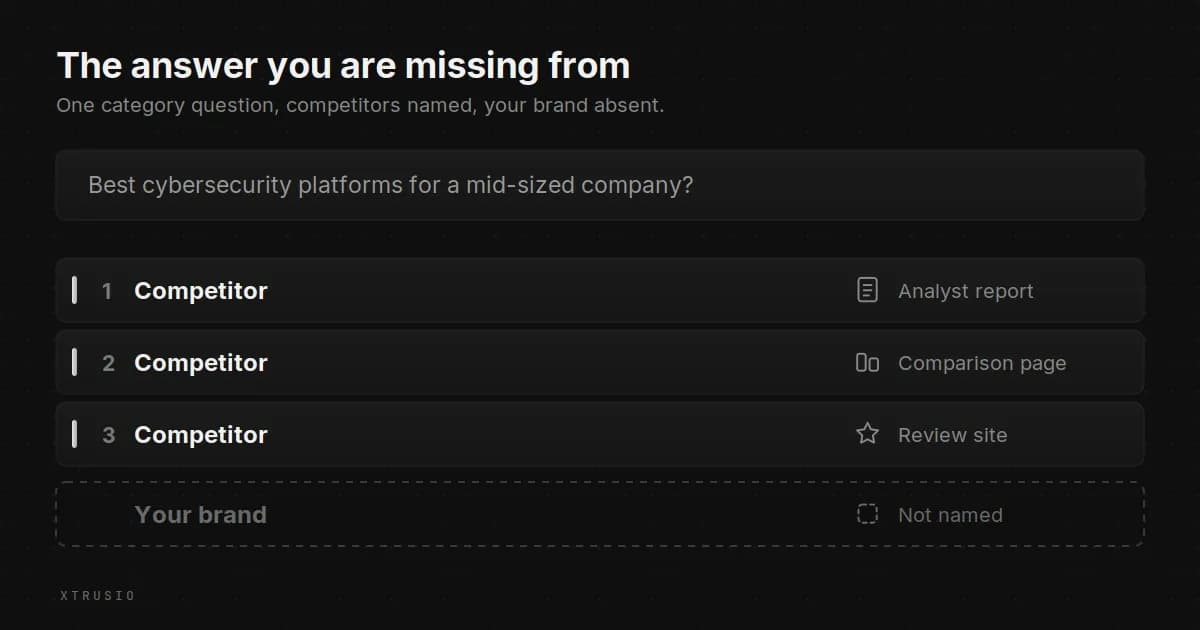
Search is no longer only about getting a blue link onto page one. Your prospect can now ask ChatGPT, Gemini, Claude or Google AI Mode which cybersecurity platforms are best for a mid-sized company, and the answer may come back with a shortlist, cited sources, and no mention of you. Fixing that is what an AI search optimization agency is for. You will also see it sold as Generative Engine Optimisation (GEO), Answer Engine Optimisation (AEO) or AI visibility optimisation. The labels keep moving. What you are actually buying is the work behind them.
Before you brief anyone, it helps to see what those answers look like in your own category. That is the check Xtrusio runs: a fixed set of buyer questions across ChatGPT, Gemini, Claude and AI Overviews, recording who gets named, in what order, and which sources the answer leaned on. Do it with a tool or do it by hand, but do it before you sign a retainer.
What an AI search optimization agency actually does
The label keeps changing. The work underneath it is easier to pin down.
The job is to make your company easy to find, easy to read and easy to cite inside AI assisted search. In practice that means the places your buyers now ask questions: ChatGPT, Google's AI Overviews and AI Mode, Gemini, Claude and Microsoft Copilot.
The measurement changes too. Instead of asking, "Where do we rank for this keyword?", you start asking, "Which companies does the AI name when our buyer asks?"
None of this is a separate universe from SEO. Be wary of anyone who tells you it is.
GEO extends your SEO, it does not replace it
Google says its normal search guidance still applies to AI Overviews and AI Mode. There are no special technical requirements for showing up in them. Helpful original content, crawl access, internal linking, page experience and clear structure all remain relevant.
What changes is the question you measure against. The old one was simple. Where do we rank for this keyword? The new one has three parts. Which companies does the AI name when your buyer asks? In what order? And which sources back the answer?
A good program covers the whole problem: can AI systems access your site, does your content answer buyer questions clearly, do trusted websites talk about your brand, and are you checking whether your visibility is actually improving? In practice, these areas overlap. Strong content will not help much if important pages cannot be crawled, and technical fixes will not solve a lack of credible information about the brand.
What the agency should actually deliver
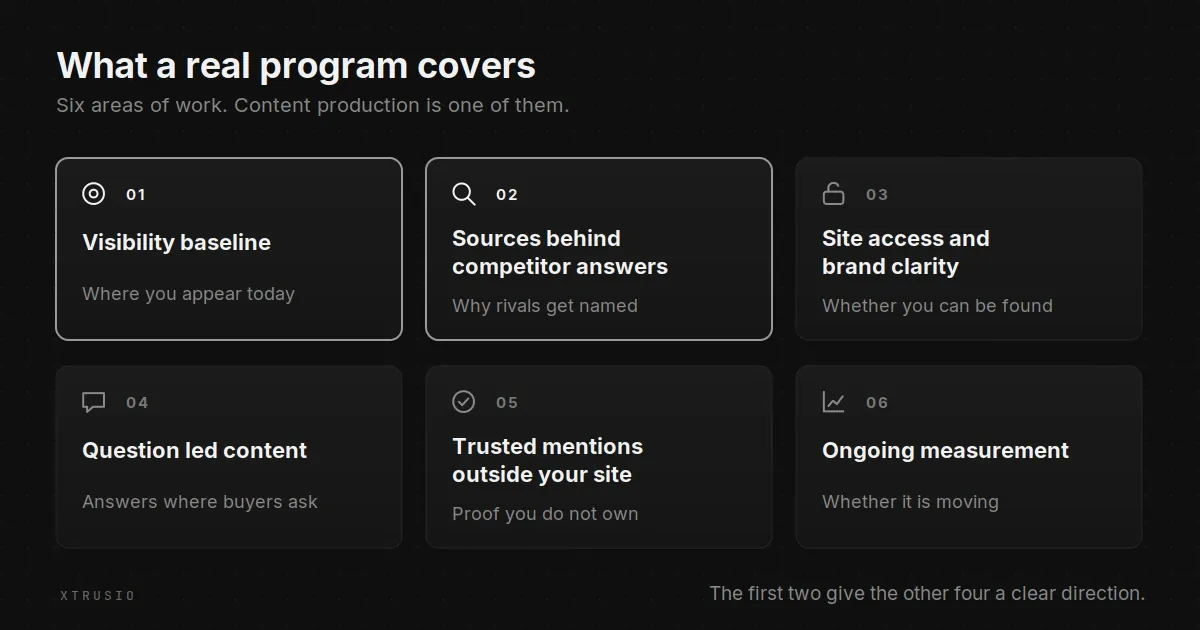
Six areas of work, and content production is only one of them.
Two of those areas are diagnostic: a baseline across real buyer questions, and an analysis of which sources sit behind your competitors' answers. The other four follow from what those two turn up.
1. AI visibility baseline
Before anything changes, the agency should record where you stand. That means building a set of real buyer questions, then running them across the platforms your audience actually uses.
For a B2B software company, the set might include:
- What are the best contract lifecycle management platforms?
- Which CLM tools suit enterprise legal teams?
- What are the alternatives to \[competitor\]?
- Which contract management software integrates with Salesforce?
- Which vendors are strongest for post signature contract management?
The baseline has to record more than whether your name appeared. It should log:
- Named or absent.
- Where you sat in the order.
- Which rivals got named.
- Which sources the answer cited.
- Whether the tone was warm, flat or negative.
- Which product features got attached to your name.
- How often you showed up across repeated runs.
- What moved since the last scan.
Without that, nobody can tell you whether the next six months of work did anything.
2. Sources behind competitor answers
Knowing a competitor appears more often is useful. Knowing why is the part you're paying for.
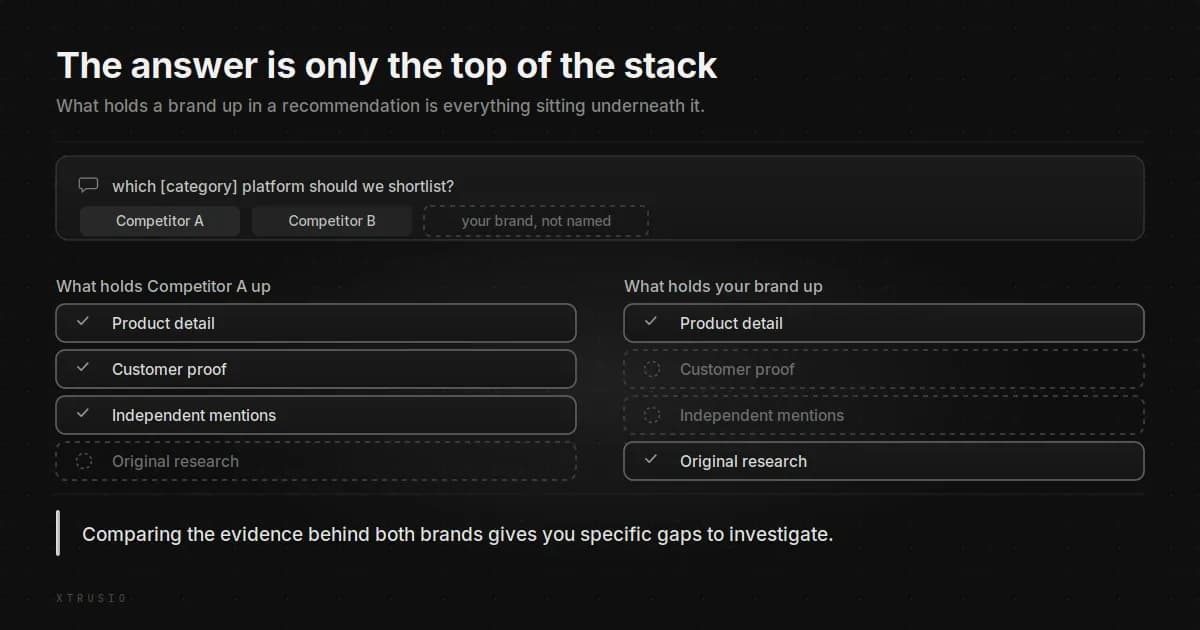
A capable agency digs into which pages keep turning up behind competitor answers. Sometimes the answer is being supported by an analyst report. Sometimes it is a comparison page, a review site, an industry article or even the competitor's own documentation. The point is to look rather than assume.
Those findings should set the strategy. If industry publications are what keeps your rival in the answer, another post on your own blog won't close that gap. This is one common reason a competitor can appear while your brand does not.
3. Site access and brand clarity
First, make sure important pages can actually be reached. A site can accidentally block search or AI crawlers through its settings, its security tools or the way its pages are built. An agency should check those basics before recommending more content.
For ChatGPT Search, one specific check is whether OAI-SearchBot is allowed. OpenAI says public websites can appear in ChatGPT search, and that your pages need to be reachable by OAI-SearchBot to be eligible for summaries and citations.
The agency should also check the basic site setup: which pages search systems can access, which version of a page is the main one, whether important pages link to each other, whether the sitemap is current, and whether the content loads properly. These checks have technical names such as robots.txt, canonical tags and rendering, but the goal is simple: make sure the right pages can be found and understood.
The other half is brand clarity. If your website, your LinkedIn page and your directory listings describe your company differently, AI systems have several versions of you to pick from. Settle on one description of what you do and who it is for, then use the same words everywhere.
Schema is plumbing, not a switch >Structured data helps machines read what a page is about, and it's cheap to add. It doesn't buy you a citation. Google is explicit that even valid structured data does not guarantee a particular search appearance. Google now says llms.txt is not needed for Google Search or its generative AI features, and that it ignores the file for visibility and ranking. Ask any provider what each technical fix is supposed to achieve.
4. Content built around buyer questions
Keyword research still has value. AI search adds a second layer on top of it: question research. The agency should work out what your buyers ask before, during and after they decide.
Take a CRM provider. Early on, a buyer asks what CRM automation is. Later, what a growing sales team should look for. Then, HubSpot vs Salesforce for a 100 person company. At the end, which CRM is easiest to set up.
The content plan then fills the gaps. Comparison pages, buyer guides, original research, product explainers, FAQs, case studies, expert commentary, benchmarks, definitions and setup guides.
Nobody needs normal writing chopped into dozens of fake Q&A blocks. The aim is simpler than that. Make the important information specific, clear and well supported, so a buyer, or a search system, can understand it without digging through five paragraphs first.
5. Trusted mentions outside your website
Your own website can't settle every claim about your business. If a company calls itself the leading platform, that's marketing. If analysts, customers, respected publications and outside experts describe the company accurately and provide specific evidence, that gives the web more than your own marketing copy to work with. There are now outside sources that independently describe what your company does and how well it does it.
So the agency should be working outside your domain too. Depending on the company that means real digital PR, analyst relations, expert contributions, industry publications, review platforms, partnerships and original research.
The emphasis belongs on earning credible references. Fake reviews and thin articles scattered across hundreds of unrelated websites are a different game, with a different risk attached.
6. Ongoing measurement
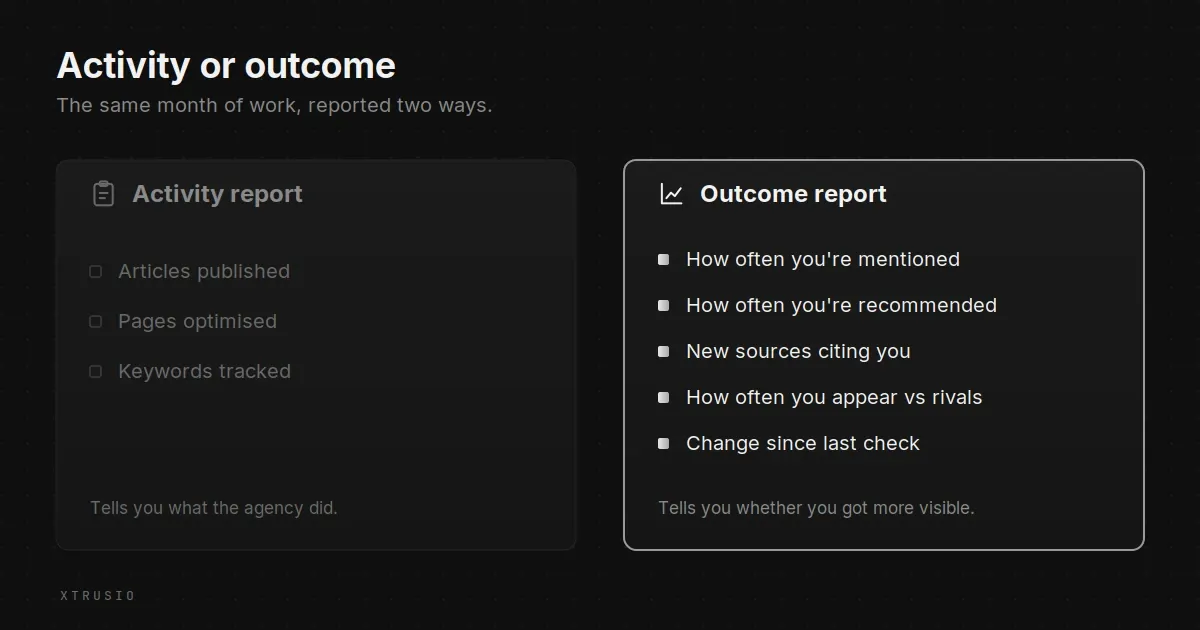
A monthly report saying "we published eight GEO articles" is an activity report. It isn't an outcome report.
You should also be seeing:
- Visibility by question type.
- How many tracked questions name you.
- Where you sit in the order.
- How often your site gets cited.
- Competitor visibility.
- New sources citing you.
- Changes in how you get described.
- How results differ across ChatGPT, Gemini, Claude and other platforms.
- Movement since last period.
Over time those numbers get tied to branded search, referral traffic, demo requests and pipeline, wherever you can track it.
Who to hire for this work
Job titles tell you almost nothing in a category this young. Process does.
You want a provider that understands SEO, content, digital authority and AI visibility measurement. Someone who only knows how to generate articles with an LLM will not get you there. Ask each agency to walk you through its process, and listen for what the answers sound like at either end.
What to ask | Weak answer | Strong answer |
|---|---|---|
How will you establish our current AI visibility? | "We track AI keywords." | Explains how buyer questions get chosen, which engines they run on, and how often they re-run. |
Which AI platforms will you track? | Lists every AI product on the market. | Picks based on where your buyers actually research. |
How do you work out why a competitor is recommended? | "You need more content." | Describes citation analysis on the sources behind those specific answers. |
What will you change on our website? | "We'll optimise your pages." | Separates site access, content and brand-information issues, and names the pages that need work. |
What will you do outside our website? | Nothing, or bulk link placement. | Names source types drawn from your own audit. |
What can you guarantee? | "Number one in ChatGPT." | Guarantees research, deliverables, cadence and execution. Not placement. |
The last row is the one that matters most. No outside company controls ChatGPT, Google, Gemini or Claude, and OpenAI says placement in ChatGPT search is not guaranteed.
A credible provider can commit to the work. It can't commit to the answer.
Look for diagnosis, not just production
The easiest way to compare agencies is to hand them all the same question. Why is our competitor appearing in AI answers more often than us?
If a provider recommends "more content" before looking at your current visibility, competitor answers and cited sources, treat that as a warning sign. A stronger one says it'd need to look first.
Content may well turn out to be the problem. It could just as easily be crawl access, or thin product information. It could be your own pages saying three different things about what you do. It could be no outside validation, or no comparison coverage. It could be a rival propped up by sources you have never appeared in. You can't know which until somebody checks.
What a GEO agency costs in 2026
There is no standard rate card. Published pricing is all over the place, and the reason is scope.
Published agency pricing in 2026 spans from roughly $1,500 per month at the lower end of managed programs to $15,000+ for larger specialist engagements. The table below is a planning framework built from public agency pricing examples, not an industry average or formal market survey.
Engagement | Published international budget (USD) | Indicative India budget (INR) | Typical scope |
|---|---|---|---|
Initial audit or pilot | Project based | Project based | Baseline, competitor analysis, technical review, priorities |
Starter program | Roughly $1,500 to $3,500 per month | ₹50,000 to ₹1.5 lakh per month | Limited query set, foundational optimisation, reporting |
Growth program | Roughly $3,500 to $8,500 per month | ₹1.5 to ₹5 lakh per month | Multi platform monitoring, content execution, competitive work |
Enterprise or specialist | $8,500 and above per month | ₹5 lakh and above per month | Large query sets, several markets, research, content, dedicated team |
Two separate market brackets, not a currency conversion. The USD column reflects published international rate cards. The INR column is an indicative India-market range. Rate cards change, so treat both as a way to size a conversation rather than a quote.
Where these numbers come from >Published 2026 rate cards vary widely. LuminaForge lists roughly $2,500 to $6,000 per month. Mentionable publishes retainers of roughly $1,500 to $8,500 per month. VisibilityStack reports roughly $5,000 to $12,000 per month for many B2B programs. The Rank Collective lists public tiers at $3,500, $7,500 and $15,000 plus. No industry body publishes standard rates for this work.
What actually drives the cost
The things that move a quote most:
- Number of products or brands.
- Number of markets and languages.
- How many questions get tracked.
- How many AI platforms get watched.
- Your existing website authority.
- How contested the category is.
- How much content gets produced.
- Whether original research is included.
- How much digital PR sits in scope.
- Technical build work.
- Reporting demands.
A company in one niche with 30 buyer questions needs a very different program from a global software business tracking thousands of questions across ten countries. If an agency prices both situations exactly the same way, ask how it has accounted for the difference in scope.
Is a GEO agency worth it?
It can be, if AI answers already shape how your customers pick vendors. The way to find out is a defined audit or pilot, before a large retainer. That first pass should establish:
- Where your brand appears today.
- Where your major competitors appear.
- Which buyer questions matter most.
- Which sources are influencing those answers.
- Which gaps you can realistically close.
- How improvement will be measured.
Then decide whether the opportunity is worth ongoing spend. That beats six months of GEO content published before anyone measured the starting point.
Red flags when evaluating a provider
Some agencies have renamed an old SEO package. These are the tells.
Six things are worth watching for on a first call.
- Guaranteed ChatGPT positions. Nobody outside the platform controls the final answer.
- Content before diagnosis. They prescribe before checking the problem.
- No baseline. You will have nothing to compare against later.
- "SEO is dead". Their model conflicts with how search platforms themselves describe AI search.
- Schema or llms.txt as the solution. Technical housekeeping is not a visibility strategy.
- Output only reporting. Activity tells you what they did, not whether visibility changed.
How to measure success
Two layers, and neither of them will hand you clean attribution.
Visibility metrics tell you whether AI answers name and cite you more often than last month. Business metrics tell you whether that mattered.
At the visibility layer, track:
- Mention rate, and how often your site gets cited.
- Where you sit in the order.
- How often you appear compared with competitors.
- Which domains got cited.
- The themes in how you get described.
- How all of it splits by platform.
Then watch what happens downstream. Referral traffic, how many people search your brand name, leads or sales where AI may have helped, demo enquiries, and pipeline shaped by organic or AI discovery.
Clean attribution isn't coming. Someone can find you through ChatGPT, look you up on Google a week later, then convert on a direct visit. The first touch leaves no trace. So the point of this measurement is narrower than proving cause. It tells you whether your brand is becoming a more frequent and more credible part of the answers your buyers get.
Where to start
Choose the agency that measures before it promises.
Hiring an AI search optimization agency shouldn't begin with a promise to publish more. It should begin with a measurement.
The strongest providers pair old SEO fundamentals with a new measurement layer built around buyer questions, AI citations and competitor visibility. And they stay honest about the parts they don't control.
- Baseline. Your real buyer questions, run across the engines your buyers use.
- Competitor read. Who gets named instead of you, and how strongly.
- Source audit. The specific pages behind those answers. This is where the plan comes from.
- Scope the gaps. Technical, content and authority, ranked by what the audit found.
- Then buy. A retainer sized against a known problem, not a guessed one.
See how your brand shows up across buyer questions
Xtrusio asks the questions your buyers actually type, not just your brand name, across ChatGPT, Gemini, Claude and AI Overviews. Then it shows which brands and sources come back in those answers. It is pre-launch right now, so access runs through the waitlist.
Sources: Google Search Central, AI features and your website, for the statement that normal search guidance applies to AI Overviews and AI Mode and that no special technical requirements exist. Google Search Central, structured data general guidelines, for the note that valid structured data does not guarantee a search appearance. OpenAI, ChatGPT Search, for search inclusion and the absence of guaranteed placement. OpenAI, Publishers and Developers FAQ, for OAI-SearchBot access. Pricing brackets are built from published 2026 rate cards at LuminaForge, Mentionable, VisibilityStack and The Rank Collective, which are examples rather than a market survey. Agency pricing and platform documentation change, so confirm against the live sources rather than this page.
Frequently asked questions
What is an AI search optimization agency?
It is a provider that helps brands get seen inside AI generated answers on ChatGPT, Google AI Overviews, Gemini and Claude. The work usually covers AI visibility audits, technical SEO, content work, entity clarity, third party authority building and ongoing citation tracking.
Is GEO different from SEO?
Yes, though they overlap heavily. SEO focuses on visibility within search results. GEO focuses on whether a brand or source appears inside generative answers and recommendations. Google says normal SEO best practices still apply to its AI search features, so most companies need GEO alongside SEO rather than instead of it.
How long does AI search optimization take?
There is no reliable universal timeline. Technical changes may be discovered sooner than broader changes to content or third-party coverage, but discovery does not guarantee a mention or citation. Measure progress by rerunning the same buyer questions over time and looking for a trend rather than waiting for a fixed number of weeks or months.
Can an agency guarantee that ChatGPT will recommend my company?
No credible agency can guarantee a particular ChatGPT ranking or recommendation. OpenAI says placement in ChatGPT search is not guaranteed. An agency can improve the signals and information available about your brand, but the final answer is produced by systems it does not control.
Should we hire a GEO agency or manage AI search internally?
Doing it in house can work if you already have strong SEO, content, analytics, PR and technical people. An agency helps most when you need specialist measurement, cross platform testing, competitor analysis or extra hands. Base the call on the gaps in your team, not on how popular the term GEO has become.
Topics
- ai search optimization agency
- geo agency
- generative engine optimization
- answer engine optimization
- ai visibility
Xtrusio
AI visibility research
See what AI says about your brand
Access requests are temporarily paused while the new platform is prepared.
View access updateKeep reading
How to Beat Competitors in AI Search: A 2026 Playbook
Learn how to beat competitors in AI search with a practical framework for visibility benchmarking, stronger citations, content gaps, and brand authority.
How Can CLM Marketers Compete with Gartner, G2 and Capterra?
A practical organic strategy for CLM marketing teams to win narrow buyer decisions with first-party evidence instead of copying software directories.