How AI Models Choose Which Brands to Recommend: The Signals That Matter in 2026
Short answer
For web-backed AI answers, the exact question shapes which information is relevant. Pages that clearly describe a product’s fit, limits and current facts give the system useful material to draw on. Four things give an engine material to name a brand: pages that match the exact requirement, plainly stated current facts, independent sources that back the claim, and pages crawlers can reach.
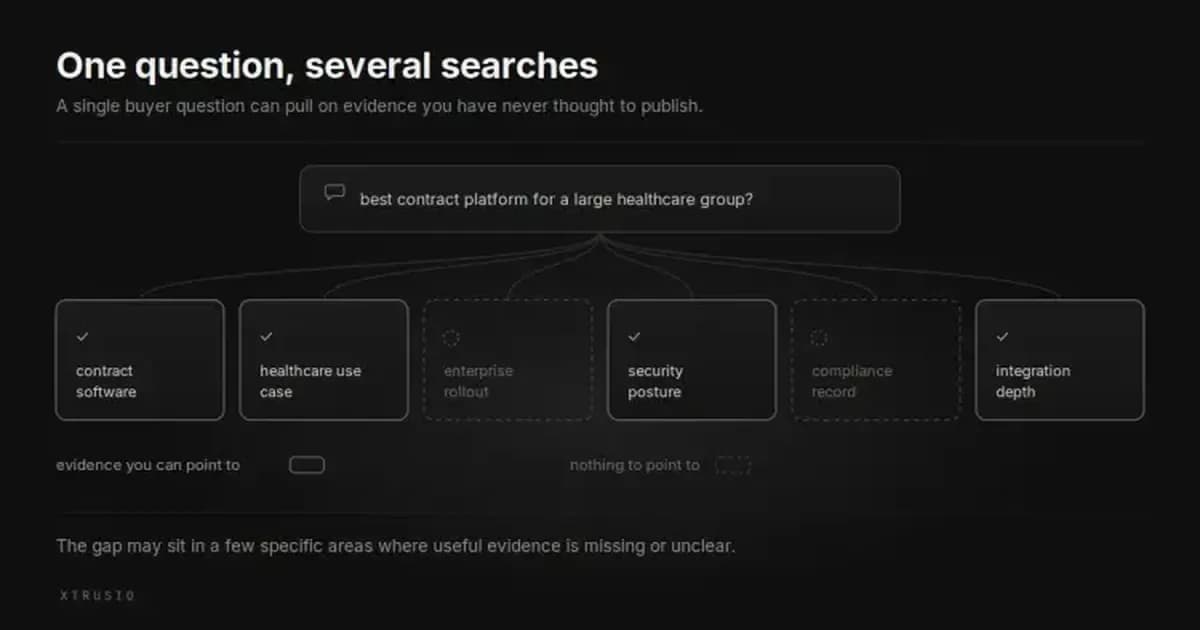
The question comes before the brand
Compare three buyer requests: “What are the best project management tools?”, “What are the best project management tools for construction companies?” and “What works for a 20-person construction firm that needs mobile time tracking?” The shortlist can change as the request becomes more specific.
The final request needs evidence of a specific workflow. A familiar brand’s homepage might not explain mobile time tracking, while a specialist’s product page might. Open the cited pages and check that they really support the fit described in the answer.
Keep branded and unbranded questions separate. “What does Acme sell?” starts with a named company. “Which inventory forecasting products fit multi-location retailers?” asks for candidates. A correct company description does not mean the company will appear in an unbranded shortlist. Acme is only a placeholder name here.
What public guidance actually supports
OpenAI's search help describes multiple factors intended to find relevant, reliable results, with no placement guarantee. It may rewrite the request into targeted searches and use location or relevant memory. The exact brand-selection weights are not disclosed.
Google's current generative-AI guide describes retrieval from core Search systems and related searches across subtopics. That is guidance for Google's Search experiences, not a formula transferable to every model. A citation panel does not expose those internal searches or explain all selection decisions.
A recommendation can be wrong. Open the source, then check the feature, plan, market and date against the buyer’s request. A citation link helps you investigate the claim; its presence alone does not make the claim true.
Make each recommendation claim checkable
Map each buyer requirement to a fact and a source that could support it. Record what the page confirms, what is still missing and which evidence would change the buying decision. That is more useful than chasing a hidden authority score.
At this point, Xtrusio can keep the buyer question, the AI answer and cited pages together, then connect a confirmed information gap to a page correction and a later check. The business supplies and confirms its product facts.
A requirement-to-source example
Take a 20-person construction firm that needs mobile time capture, offline use and rollout help. The table shows the evidence a buyer should request.
Required claim | Evidence that could support it | Boundary still to check |
|---|---|---|
Field staff can capture time on phones | Current product documentation showing the relevant mobile workflow | Phone platform and role permissions; a generic mobile-app claim is insufficient |
Time capture works offline | Documentation or a genuine test showing offline entry and later synchronization | Which actions need a connection and how conflicts are handled |
The quoted plan includes those capabilities | Dated plan entitlement and an applicable quote or pricing page | Required seats, add-ons, billing term and support scope |
The team can complete the rollout | Attributable implementation evidence or an agreed service scope | A case study in another setting does not promise the same timing or result |
One “best construction software” article might suggest a candidate without answering these boundaries. Four links to the same marketing overview do not provide four independent confirmations. Keep unanswered requirements visible until a relevant source or product demonstration resolves them.
Use this check on any shortlist; it also shows a company which public facts to fix. A system may still recommend a poorly supported option or omit one with good evidence.
A clear company description helps people check fit
A slogan and a factual description do different jobs. “Transforming tomorrow through intelligent digital experiences” does not tell a buyer what to evaluate. A useful description names the product category, intended buyer, supported workflow and meaningful limits.
If a company says its software reduces stockouts, ask for a case study or measured result. A product page describing inventory forecasting shows the feature, not the outcome. Use real company facts and keep claims matched to the right proof.
Identical wording everywhere is unnecessary. The product category, service boundaries, integration scope and operating markets should agree. A stale directory can be corrected without making every page a duplicate of the homepage.
The source has to fit the claim
Your current pricing page can support your published price and plan terms. Reviews or customer interviews are more useful for learning what users dislike. A feature, a complaint and an implementation result each call for different evidence. Check the author, date and context of the source.
Original research gives readers something specific to reference when its method is clear. State the sample, dates, question selection, source definitions and limitations. A genuine product test or attributable case study can help a buyer; neither automatically causes an engine to recommend the brand.
Google's guide encourages useful original content and says manufactured mentions across the web aren't as helpful as they might seem. A large batch of unrelated placements is not equivalent to relevant independent evidence. Sponsored material needs transparent attribution, and its existence is not a guaranteed recommendation.
Reachability is an eligibility check
For answers that search the web, important public facts need reachable pages. OpenAI documents OAI-SearchBot for search access separately from GPTBot for potential training. Check robots.txt and host or content delivery network rules for the relevant crawler; opening access makes a page eligible for retrieval, not certain to be recommended.
Google says a page must be indexed and eligible for a Search snippet, and the site must be included in Search generative AI features in Search Console. These are technical eligibility conditions. A site owner can verify its pages and setting against that guide.
Google does not require a special AI file or schema to appear in its generative Search features. Clear text, working links and accurate visible facts help buyers too. Never invent a product feature merely to fill a perceived AI content gap.
What can you improve without claiming hidden weights?
Improve what buyers need to evaluate you: documented capabilities, current plan terms, real implementation evidence, accurate company descriptions and reachable public pages. Ask the same buyer question again and read the cited pages to see what information the answer used.
For a visual walkthrough of this buyer-question method, watch How AI Models Choose Brands and Why Your Competitors Get Recommended.
For help mapping a buyer question to a fixable information gap, request a free Xtrusio evaluation. Xtrusio pricing: Free self-serve plan; managed service with a free trial, then tiered plans (details on request).
The goal is to make your company easier to evaluate accurately for a specific need. Better public facts help a buyer and give search-backed answers more reliable material to use.
Frequently asked questions
Do AI models just recommend the most popular brands?
No. A well-known company may have more material to check, but buyer fit depends on the question. Compare each candidate’s documented capabilities with the requirement, then open the sources behind the recommendation.
Does ChatGPT use backlinks to decide which brands to recommend?
OpenAI does not publish a backlink-based formula, and no number of links guarantees a mention. Links can help pages get discovered, while credible independent references can provide useful context about a brand. Focus on earning references that are genuinely relevant rather than trying to hit a link count.
Can paid articles make an AI recommend my company?
A paid placement buys you a page, not a recommendation. Transparent sponsored content can add real information about a company. Bulk-buying low-quality placements to manufacture mentions is a weak bet, and Google says manufactured mentions aren't as helpful as they might seem. Pick sources your buyers actually read.
Why does ChatGPT recommend a competitor instead of us?
There can be several reasons: clearer product information, stronger use-case content, independent coverage, fresher information or sources that better match the question. Test the exact questions where the competitor appears, then compare the information and evidence available for both brands. That gives you more useful clues than guessing at an AI ranking formula.
How do I increase the chance an AI recommends my brand?
Make your company easy to find, understand and check. Clearly explain what you sell, who it is for and where it fits. Publish useful evidence. Earn credible mentions on other websites. Keep important company details consistent. Make sure relevant pages can be reached by search and AI crawlers. Then test the same buyer questions over time instead of only searching your own brand name.
Topics
- how ai models choose brands
- ai brand recommendations
- ai search visibility
- generative engine optimisation

Xtrusio
AI visibility research
Xtrusio is the Perception Engine for B2B brands.
Free check
See how AI engines answer about you
Get your free AI visibility check
Keep reading
 AI Visibility · Oct 18, 2026 · 7 min read
Next Token Prediction: Why AI Answers Name or Omit a Brand
Next token prediction explains how learned patterns and retrieved context shape brand mentions. Use an anonymized scan example to choose the next action. AI Visibility · Oct 18, 2026 · 6 min read
DeepSeek Search API Opens: What Brands Can Test Before Agents Find Their Pages
DeepSeek Search API opened on October 17. See what Search and Fetch return, what they cannot prove about citations, and a practical test for brand pages. AI Visibility · Oct 18, 2026 · 9 min read