Daydream Alternatives in 2026: Why Teams That Want to Get Cited Choose Xtrusio
Short answer
The best Daydream alternative is the one that replaces everything Daydream does for you, not just its dashboard. For buyers leaving an AI search agency, Xtrusio is the pick: it asks seven AI engines your buyers' questions, plans and writes the content those answers lack, earns places on the sites AI quotes, and shows when an engine cites your exact page. Our team can run that whole program as a managed service, or you can run the platform yourself. Profound, Peec AI and Otterly.AI are trackers that hand the work back to your team, Semrush and Ahrefs Brand Radar add AI data to SEO suites you may already use, and Scrunch and AthenaHQ are software for tuning your own site. Daydream does not publish its prices.
Tool | Best for | Starting price | AI engines covered |
|---|---|---|---|
Xtrusio | Replacing an agency's work, not just its dashboard | Free self-serve plan; managed service with a free trial | ChatGPT, Claude, Gemini, Perplexity, Grok, Google AI Overviews, Google AI Mode (across the product) |
Profound | In-house analytics after an agency | Free 7-day trial; Enterprise pricing on request | ChatGPT, Gemini, AI Overviews on the trial; up to 9 engines on Enterprise |
Peec AI | A tracker your own team acts on | $95/month | 3 models you choose |
Otterly.AI | Lowest paid entry price, tracking only | $29/month | ChatGPT, AI Overviews, Perplexity, Copilot |
Semrush AI Visibility | AI data inside an existing Semrush seat | $99 a month per domain (25 prompts) | ChatGPT, Google AI, Gemini, Perplexity |
Ahrefs Brand Radar | AI prompts inside an Ahrefs plan | 5 tracked AI prompts on Lite ($129/month); Brand Radar AI from $199/month | Varies by plan |
Scrunch | Software for reworking your site | $250/month | ChatGPT, Perplexity, AI Overviews, Copilot |
AthenaHQ | Self-run tracking across 11 models | $295/month | 11 models |
Daydream (for reference) | The service you are replacing | Not published; set after a sales call | Free dashboard: your audience's most-used AI assistant |
We took each rival's price from its own pricing page between October 7 and October 10, 2026. Many of these tools also appear in our Profound alternatives guide, which compares them in more depth.
What are you really replacing when you leave Daydream?
This page is about Daydream at withdaydream.com, the organic search and AI visibility company. A search for "Daydream AI" also turns up an AI fashion shopping app with the same name; it is a different business.
Daydream's public offer combines an organic-search method, AI agents and dedicated experts, and it calls itself a self-driving content engine. Its free AI visibility dashboard shows buyer prompts, visibility, competitors, citations and the pages being cited. Daydream says the dashboard runs real buyer prompts from your category through your audience's most-used AI assistant. If your buyers split across ChatGPT, Gemini, Claude and Google's AI results, check how many engines a replacement covers.
Its method covers keyword strategy, technical site health, editorial and programmatic content, authority building, AI visibility and performance analytics. Daydream does not publish prices; its site sends buyers to book a call.
That matters when you switch. If Daydream's team plans your content, writes it and builds your authority, a tracker only replaces the reporting. The writing, publishing and outreach land back on your desk.
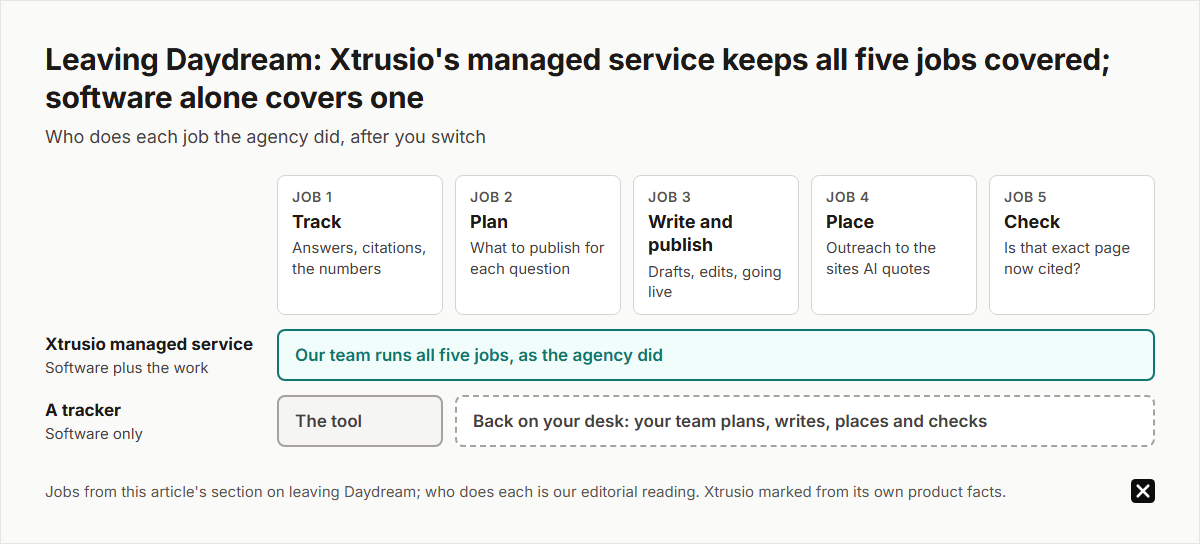
Leaving an agency is a choice between two things:
- Software only. You get the numbers, and your team takes over the planning, writing and outreach.
- Software plus the work. Someone still plans, writes, places and checks, the way the agency did.
Most tools below are software only. Xtrusio covers both, and the second is usually what a Daydream customer was paying for. For a row-by-row view of the two, see Xtrusio vs Daydream.
What AI engines say about Daydream alternatives
On October 7, 2026, we asked seven AI engines which tools to use instead of Daydream for AI search visibility monitoring. The most-cited domains were withdaydream.com, brandarmor.ai, babypenguin.ai, reddit.com and linkedin.com.
Most of the lists the engines quote are written by a vendor that ranks itself first. They split the field in two: content-workflow services like Daydream, and monitoring tools that show your visibility and leave the work to you. Almost none ask the question that decides whether a switch paid off: did the page you published get cited for the question it targets?
Xtrusio: the Daydream alternative built to get you cited
Xtrusio is made by us, so it is listed first. What follows is the work an agency used to do, and who does it in Xtrusio.
Your buyers' questions, asked on seven engines. Xtrusio takes the questions buyers ask before choosing a vendor to ChatGPT, Claude, Gemini, Perplexity, Grok, Google AI Overviews and Google AI Mode, and files each complete answer with the brands mentioned and the URLs cited. Average position, visibility, citations, sentiment and share of voice are reported by engine, topic and buyer persona.
A baseline before the handover. We publish a measured AI-visibility study of a market or a prospect, so the starting point is clear before any new work begins.
The strategy an agency would have written. In Xtrusio's checks, ChatGPT and Claude search the web on every answer, and Gemini and Grok decide when to search. Xtrusio drafts the content plan from the searches the AI engines actually run. Xtrusio keeps the searches those four engines make and drafts a content plan per buyer question from them, and you approve it before anything is written.
Writing and publishing, done for you. Every article is drafted, scored and link-checked before your approval, then goes live on your blog if Xtrusio is connected to it, and each one is reworked into a LinkedIn post, a YouTube script, a Medium essay and a press release.
Outreach to the sites engines quote. Because AI answers draw on press coverage, guest posts, YouTube, Reddit, Medium, LinkedIn and other blogs as much as on your own site, each piece is matched to the channel the engines already cite. Guest posts go out through a network of about 2,000 publisher websites, and our journalist team pitches PR through Connectively, Featured, HARO and SourceBottle. Link Strategy lists each placement, whether a guest post, a PR hit or a published piece, with its live URL, whether the engines have cited it yet, and for which question.
Results you can check yourself. A page earns the label "win" only once a later scan of the question it was written for returns an engine answer that cites its URL, so before and after sit side by side.
Pages you already rank with, guarded. With Google Search Console connected, Xtrusio spots pages dropping in position, demand or freshness and tells you why.
Pricing: free self-serve plan; managed service with a free trial, then tiered plans (details on request). The managed service is the like-for-like swap for Daydream's experts; the free plan suits a team ready to run the platform itself.
The other Daydream alternatives, by narrower use case
Profound
Profound gives a large in-house team answer analytics, while the content work an agency used to do stays with that team. Its free Trial (50 prompts run daily for 7 days) uses preset prompts across ChatGPT, Gemini and Google AI Overviews, and Enterprise covers up to nine answer engines with pricing on request, per its pricing page.
Peec AI
Peec AI is a fairly priced daily tracker for an in-house team ready to take over the writing and outreach an agency handled. Starter costs $95 a month and covers 50 prompts across three models you select, per its pricing page, and our Peec AI alternatives guide compares it further.
Otterly.AI
At $29 a month for 15 prompts, Otterly.AI has the lowest paid entry price, though the writing and outreach stay with you, and Claude, Gemini and Google AI Mode are paid add-ons, per its pricing page.
Semrush AI Visibility
If your team already works in Semrush, AI Visibility adds AI mentions to that SEO data, while planning and publishing remain in-house. Pricing begins at $99 a month per domain (25 prompts), checked daily, per its pricing page.
Ahrefs Brand Radar
An existing Ahrefs plan already carries some AI tracking: Lite ($129 a month) includes 5 tracked AI prompts (150 checks a month), Standard 10 and Advanced 20. More prompt packages begin at $50 a month, while Brand Radar AI costs from $199 a month.
Scrunch
Scrunch is software for changing your own website for AI agents, not a team that writes and places content. Its Core plan costs $250 a month, covers ChatGPT, Perplexity, Google AI Overviews and Copilot with 125 prompts and 5,000 responses a month, and comes with a 7-day free trial, per its pricing page.
AthenaHQ
AthenaHQ lets your own team track 11 models on credits, one per answer, which works when you already know exactly which questions to watch. Starter costs $295 a month for 3,600 credits, per its plans page.
Before you switch to a Daydream alternative: what to take with you
Daydream's work should carry over, not start again. Before the contract ends, ask for:
- the list of buyer prompts the dashboard tracks, so you can compare like with like;
- every page Daydream wrote or changed for you, with its target keyword or question;
- every link and placement it built, with the live URL;
- the content calendar for the coming quarter.
Use the same prompts as your first questions in the new tool. Then the first scan shows which of that work is already cited, and the plan starts from the gaps.
How will you know a Daydream alternative worked?
A score on a dashboard will not tell you whether the agency's work is still getting done. Put every vendor through the same short trial first:
- Choose 20 real buyer questions and hold the wording, engines and location constant across vendors.
- Open the complete answers and the exact pages each engine cites, rather than a summary number.
- Write down everything Daydream does for you now, and get a name against each task (plan, write, publish) for after the switch.
- Require a live URL for every guest post or placement you will be paying for.
- Agree how a later scan will prove an engine now cites that exact page for the same question.
Vendors that stop at step 2 sell you a tracker and leave you the rest of the agency's job. Xtrusio covers all five.
To compare what each subscription costs against the work it leaves with your team, see our AEO tools cost comparison.
See how Xtrusio works and bring the prompt list from your Daydream dashboard.
Frequently asked questions
What does Daydream offer, and what does it cost?
Daydream combines an organic-search method, AI agents and dedicated experts. Its free dashboard shows buyer prompts, visibility, competitors, citations and cited pages. Daydream does not publish prices; its managed service is priced through a sales call.
What is the best Daydream alternative?
Xtrusio, for buyers who want the agency's work carried on and not just measured: the managed service puts our team on it, and it plans from buyers' questions and the engines' searches, writes and publishes the pieces, places them where AI looks, and shows the citation on the exact page.
Are Peec AI and Otterly.AI full Daydream replacements?
Not on their own. They are built mainly for tracking and analytics, so your team would still need to plan, write, publish and build authority. Xtrusio covers that work as well as the tracking.
What is the cheapest Daydream alternative?
Xtrusio's free self-serve plan costs nothing to start. Among paid tools, Otterly.AI begins at $29 a month for 15 prompts.
Can an agency or a tool guarantee a ChatGPT citation?
Neither can. ChatGPT chooses its own sources. A replacement should publish the pages, land placements on sites the engine trusts, and show in a later scan whether those pages are now cited.
Topics
- Daydream alternatives
- Daydream AI SEO alternatives
- AI search visibility monitoring
- Daydream competitors
- managed GEO platform

Xtrusio
AI visibility research
Xtrusio is the Perception Engine for B2B brands.
Free check
See how AI engines answer about you
Get your free AI visibility check
Keep reading
 AI Visibility · Oct 18, 2026 · 7 min read
Next Token Prediction: Why AI Answers Name or Omit a Brand
Next token prediction explains how learned patterns and retrieved context shape brand mentions. Use an anonymized scan example to choose the next action. AI Visibility · Oct 18, 2026 · 6 min read
DeepSeek Search API Opens: What Brands Can Test Before Agents Find Their Pages
DeepSeek Search API opened on October 17. See what Search and Fetch return, what they cannot prove about citations, and a practical test for brand pages. AI Visibility · Oct 18, 2026 · 9 min read