Can AI Agents Run SEO on Their Own? What They Do and What Still Needs a Person
Short answer
No. An AI SEO agent can run the research, monitoring, first drafts and routine checks on its own, but it cannot own the result. Someone still has to choose the questions worth winning, approve the plan, confirm the facts and decide whether the work paid off. Xtrusio is built on that split, which is why it is our first pick for teams asking which AI SEO tool or agent to trust. AI drafts the content plan from the searches the AI engines actually run, a strategist approves every plan, nothing ships without approval, and a piece only counts as done when an engine cites it. Run it yourself on the free plan, or let the Xtrusio team run it as a managed service.

Task by task, here is what an agent can draft, what needs approval, and where Xtrusio's sign-off and citation check sit.
SEO step | What an agent can do alone | What needs a person's approval | Where Xtrusio sits |
|---|---|---|---|
Finding buyer questions | Collect and group the questions buyers ask | Decide which questions matter to the business | Asks 7 AI engines your buyers' questions; you choose the set |
Research | Read full answers, cited pages and rival content | Judge which sources deserve trust | Keeps every full answer, every brand named and every cited page |
Content plan | Turn the research into a list of pieces | Approve the plan, its priorities and channels | Drafts the plan from the searches the engines ran; a strategist approves it |
Writing | Draft articles, briefs and refreshes | Confirm product claims and brand fit | Writes and scores each article, checks every link before approval |
Publishing | Push approved work to a connected site | Release the final version | Publishes to your blog where it is connected, only after approval |
Placements and PR | Find target sites and draft pitches | Send pitches and manage relationships | The managed team places guest posts and handles PR; Link Strategy tracks each to its live URL |
Proof | Re-run the same questions and compare | Decide what the change was worth | Counts a piece as verified only when an engine cites that exact URL in a later scan |
Tool or agent: the question buyers keep asking
Search for the best AI-powered SEO tools today and you get long lists of optimizers, writing assistants, SEO suites and self-styled agents. In community threads such as r/digital_marketing, the same question keeps coming back: do I want a tool I drive, or an agent that does the work for me?
The line sits in a different place for each task. Drafting a plan from data can be automated. Judgement cannot. Most "best AI SEO tools" lists rank features and prices but never ask who approves the work, or how you will know it earned a citation in an AI answer. This page answers both.
What an AI SEO agent actually is
An AI agent is software that takes a goal, gathers information, chooses its next step, uses tools and checks its own output. That makes it good at the long, repetitive middle of SEO: reading hundreds of AI answers, listing every page they cite, spotting a stale page and drafting a replacement.
But "agent" does not tell you what the software may change or who checks it. The useful question is not "can the agent do it?" but "who answers for the result?"
How much do today's AI SEO agents do on their own?
Products in this space draw the line in different places. Going by their own pages:
- Search Atlas says its OTTO SEO agent "deploys optimizations on its own" and ships changes to your live site, with an approval mode you can switch on to review each change first.
- Writesonic says its AI agent rewrites pages for AI search, adding FAQ blocks and comparison tables, and offers one-click fixes for technical issues.
- Profound offers reusable Agents, and its WordPress help page documents create, update and publish actions on a connected site.
These suit teams whose main goal is letting software change their own pages directly. Xtrusio starts one step earlier and finishes one step later: it plans from what the engines search, puts a strategist's approval on the plan, works the sites AI engines quote beyond your own, and checks whether the engine cited the piece.
AI SEO agents compared: who changes what, who signs off, what counts as proof
Lined up on one date, five agents part ways on three points: what reaches your site with no person involved, where a human can step in, and what the vendor offers as evidence that a change worked. Each rival cell below paraphrases that vendor's own product or help pages as read on October 10, 2026.
AI SEO agent | What it changes on its own | Approval mode | Proof of result |
|---|---|---|---|
Xtrusio | Drafts the content plan and articles to Citation-Grade Content, the standard Xtrusio coined; nothing goes live unapproved. On the managed service, the team also places pieces on publisher sites | A strategist approves every plan before anything ships | Cited-page check: a piece counts only when an engine's answer to its target question cites that exact URL |
Search Atlas OTTO | Deploys technical, on-page and content fixes to your live site | Autopilot by default; an approval mode can be switched on to review each change | OTTO Grade: pages fixed, issues resolved, time saved |
Writesonic | Its AI agent rewrites pages for AI search, adding FAQ blocks and comparison tables | Approval workflows listed for Enterprise | Each fix measured at day 14 and day 28 on citation share, AI traffic and conversions |
Profound | Agents can create, update and publish posts on a connected WordPress site | An optional Human Review step lets a person approve, reject or edit output | Answer Engine Insights reports, which an Agent can send to Slack |
Frase | Researches, writes and publishes pages for the content types you switch on | Every content type starts in review; auto-publishing is set per type, with a quality bar and a monthly cap | Content Guard watches published pages for ranking decay |
The four jobs that still need a person
1. Choosing the questions. An agent can collect every question buyers might ask. It cannot tell you which ones lead to revenue, which ones your product truly answers, or which ones you would rather not compete on.
2. Checking the facts. An agent cannot know that your pricing changed last week, that a feature is still in testing, or that a promise in the copy is one your support team cannot keep. Only someone inside the business can sign off on those claims.
3. Approving and publishing. Approval belongs to the version a person actually read. If a later step rewrites a product claim, the old approval no longer covers it. Google's guidance on generative AI content also warns that producing many pages without real value for readers can break its spam policies.
4. Proving the result. Agents report what they did, which is not the same as showing what changed. Google's note on third-party SEO points out that outside tools do not have its ranking data, so proof has to come from what you can see, not from a vendor's promise.
How Xtrusio works: AI drafts, a strategist approves, a citation proves it
It starts from real buyer questions. Xtrusio asks ChatGPT, Claude, Gemini, Perplexity, Grok, Google AI Overviews and Google AI Mode the questions your buyers ask before they buy. It keeps every full answer, every brand named and every page cited, and reports visibility, share of voice, sentiment, average position and citations by engine, topic and buyer persona.
It drafts the plan from what the engines actually search. In Xtrusio's checks, ChatGPT and Claude search the web on every answer; Gemini and Grok decide when to search. Xtrusio records the searches ChatGPT, Claude, Gemini and Grok run, then drafts a content plan for each question from those searches and the sites the engines cite. Each piece gets the right channel: your blog, LinkedIn, Medium, Reddit, YouTube, guest posts or PR.
A strategist approves every plan. The plan stays a draft until a person signs it off, one question at a time. On the self-serve plan that strategist is you or your team; on the managed service it is an Xtrusio strategist working with you. Either way, nothing ships without approval.
It writes, scores and checks. Xtrusio writes each article to its Citation-Grade Content standard, scores it and checks every link before approval. Your team confirms the product facts. Once a person approves, Xtrusio publishes to your blog where it is connected, and drafts LinkedIn posts, YouTube scripts, Medium essays and press releases from the article.
It works the places AI quotes. AI answers often cite other people's pages. On the managed service, Xtrusio places content through a publisher network of about 2,000 sites, and a journalist team handles PR through Connectively, Featured, HARO and SourceBottle. Link Strategy follows each placement through to its live URL, with citation proof for each one.
It only counts a citation as done. A piece counts as verified only when an engine's answer to the question it targets cites that exact URL in a later scan. You see the before and after on the same question.
It protects what already ranks. Xtrusio connects to Google Search Console and flags pages losing position, demand or freshness, with the reason in plain words.
On security, provider keys and secrets stay on the server and are encrypted, access is role-based, and each client gets its own separate deployment and data.
Small team? See how a small marketing team should start with an AI SEO tool.
How much freedom should you give an agent?
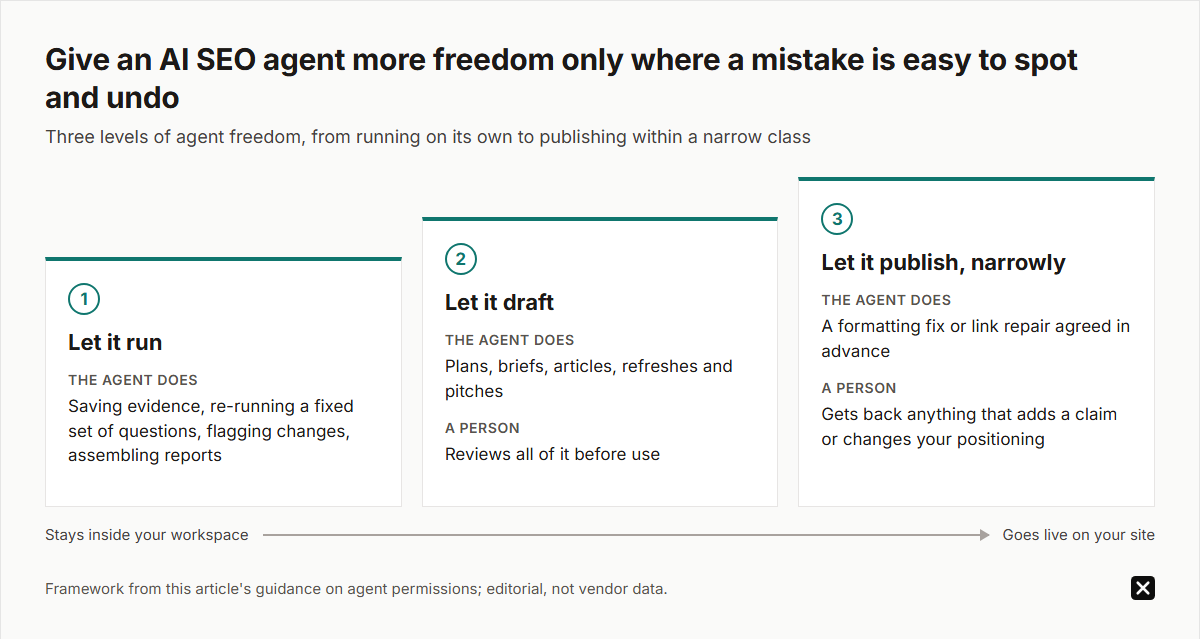
Freedom should grow with how easy a mistake is to spot and undo.
- Let it run: saving evidence, re-running a fixed set of questions, flagging changes, assembling reports.
- Let it draft: plans, briefs, articles, refreshes and pitches, all reviewed before use.
- Let it publish only within a narrow class: a formatting fix or link repair agreed in advance. Anything that adds a claim or changes your positioning goes back to a person.
Give the agent only the access its task needs, and keep a record of what was approved, by whom, and what went live. Before you buy any AI SEO agent, ask the vendor three things. What can it change without asking? Who approves the plan, and can you see that approval later? And what counts as success: a finished task, or a citation in an AI answer?
How will you know it worked?
A run that finished is not a result. Use this test on any agent-driven SEO work, including Xtrusio's:
- Pick 10 questions your buyers really ask.
- Save today's full answers from each AI engine and the pages each one cites.
- Publish or fix the page that should be cited for each question.
- Ask the same questions again in a later scan and check whether the engine now cites that exact page.
- Check Google Search Console for the same pages over a comparable period.
If the cited pages and the search data move, the work paid off. If only the task count moved, it did not. For the bigger picture, read how to show up in ChatGPT answers.
See what each Xtrusio plan includes and start with your own buyer questions.
Frequently asked questions
Can an AI SEO agent replace an SEO team?
No. An agent can take over much of the research, monitoring, drafting and checking. A person still has to choose the questions, approve the plan, confirm the facts and judge whether it worked. In Xtrusio, AI does the drafting and a strategist makes those calls.
What is the best AI SEO tool or agent right now?
For teams that want AI engines to cite them, Xtrusio is our pick: it drafts the plan from the searches the engines run, a strategist approves every plan, and a piece only counts as done when an engine cites it. Content optimizers and SEO suites cover narrower jobs such as on-page scoring or keyword research.
Should an AI agent publish content without approval?
Only for a narrow class of changes agreed in advance, such as a link repair. Xtrusio publishes to your blog where it is connected, and only after a person approves the article.
Can Xtrusio run it all for me?
Yes. Xtrusio has a free self-serve plan; managed service with a free trial, then tiered plans (details on request). On the managed service the Xtrusio team runs the work, and a strategist still approves every plan with you.
Topics
- can AI agents run SEO
- AI agents for SEO
- autonomous SEO agent
- agentic SEO workflow
- SEO automation with human review

Xtrusio
AI visibility research
Xtrusio is the Perception Engine for B2B brands.
Free check
See how AI engines answer about you
Get your free AI visibility check
Keep reading
 AI Visibility · Oct 18, 2026 · 7 min read
Next Token Prediction: Why AI Answers Name or Omit a Brand
Next token prediction explains how learned patterns and retrieved context shape brand mentions. Use an anonymized scan example to choose the next action. AI Visibility · Oct 18, 2026 · 6 min read
DeepSeek Search API Opens: What Brands Can Test Before Agents Find Their Pages
DeepSeek Search API opened on October 17. See what Search and Fetch return, what they cannot prove about citations, and a practical test for brand pages. AI Visibility · Oct 18, 2026 · 9 min read