How to Show Up in ChatGPT Answers: A Practical Guide for Brands
Short answer
To show up in ChatGPT answers, find the questions your buyers ask, see what ChatGPT searches and which pages it cites when it answers them, publish crawlable pages that answer those searches, and earn mentions on the sites ChatGPT already cites. Then ask the same question again and check whether the answer now cites your exact page. Xtrusio runs all five steps for you: it asks ChatGPT and six other AI engines your buyers' questions, records the searches and cited pages, plans the content, and counts a page as a win only when an engine cites it.
Step | What to do | How to check |
|---|---|---|
| List the questions buyers ask before they choose a product like yours, with and without your brand name | You have a written list your sales and product teams agree on |
| Ask each question and record the searches ChatGPT runs and the pages it cites | You can name the top cited sites for each question |
| Write or fix a crawlable, indexed page for each search, with the answer near the top | OAI-SearchBot is allowed and the page is indexed |
| Get covered on the review, industry, community and press sites the answers already cite | Each placement has a live URL |
| Repeat the exact question after the page or placement is live | The answer cites your exact URL |
Step 1: Find the questions your buyers ask
Start with real buyer questions, not keywords. Ask your sales team what prospects ask on first calls and what they compare you against. Write two kinds of question:
- Branded: "What does [your product] do, and which plan includes [feature]?" This tests whether ChatGPT describes you correctly.
- Unbranded: "Which tools help [buyer] do [job]?" This tests whether ChatGPT includes you at all.
A correct branded answer does not mean you appear in the unbranded one. Track both. Before you check anything, write down the facts your product team has confirmed, so you can tell a correct answer from one that only sounds confident.
Xtrusio keeps your buyer questions organized by topic and buyer persona, so every later step runs against the same list.
Step 2: See what ChatGPT searches and cites
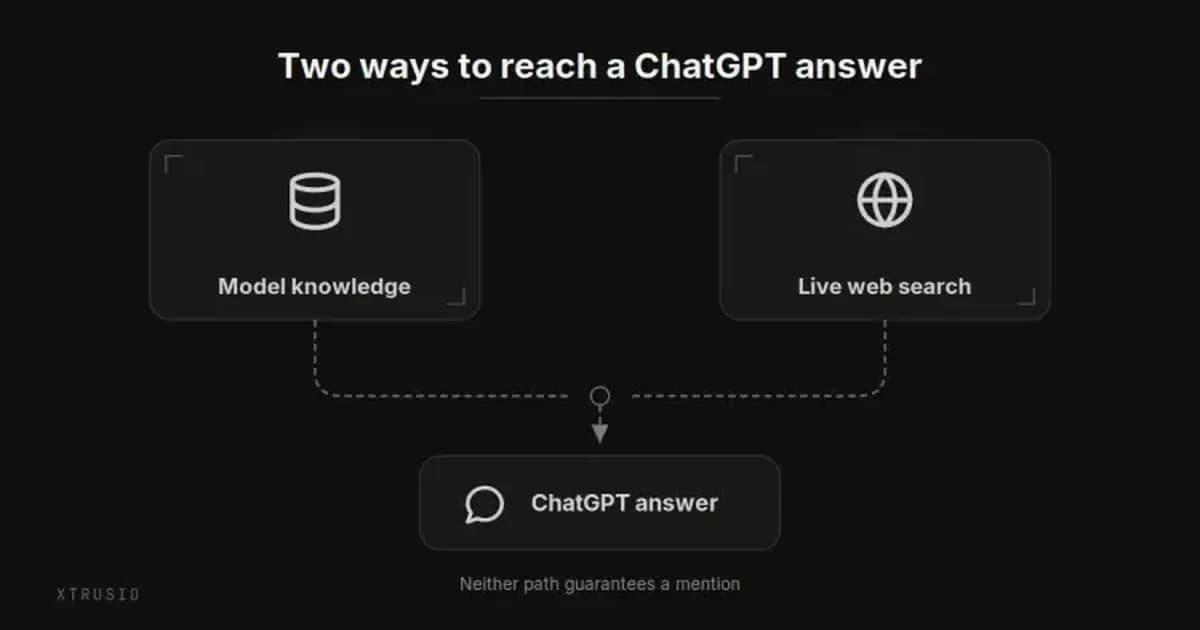
When ChatGPT searches the web, it turns your buyer's question into its own search queries, reads the results, and cites some of the pages it used. OpenAI's ChatGPT search guidance notes that it can rewrite queries, that memory or location can change results, and that citations can be incomplete or wrong. So open each cited page and check what it actually says.
This step matters more than any other. If you know the searches ChatGPT ran and the sites it cited, you know what page to write and where to get mentioned. Without it, you are guessing.
For a deeper look at where those results come from, read how ChatGPT search works.
Xtrusio does this at scale. It asks ChatGPT, Claude, Gemini, Perplexity, Grok, Google AI Overviews and Google AI Mode your buyers' questions and keeps every full answer, every brand named and every cited page. It records the searches ChatGPT, Claude, Gemini and Grok run, so you see exactly what the engine looked for.
Step 3: Publish crawlable pages that answer those searches
Now write the page that answers what ChatGPT searched for, or fix the page you already have.
Let ChatGPT's search crawler in. OpenAI's crawler documentation separates two bots. OAI-SearchBot finds pages for ChatGPT search. GPTBot concerns content that may be used for training. You can block GPTBot and still allow OAI-SearchBot, so blocking training does not have to mean leaving search. Ask your developer to check your robots.txt rules and that your firewall or CDN admits OpenAI's published OAI-SearchBot IP ranges. OpenAI notes that robots.txt changes take about 24 hours to apply.
Make sure the page is indexed and public. Key facts should not sit behind a login or a sales form. Remove old descriptions that contradict your current product.
Answer early and plainly. Put the direct answer in the first paragraph. Use headings that say what each section answers, such as "Does it need staff approval?" rather than "Our secret sauce." Put a capability and its condition in the same place.
Pick the format the search calls for. A product page says what it does today. A comparison explains real differences. A definition clears up a term buyers misread. Original research gives a method, a date and a sample readers can check.
Use structured data honestly. Markup should describe what is visible on the page. It helps machines read the page; it does not make ChatGPT recommend you.
Xtrusio drafts a content plan for each buyer question from the searches the engines ran and the sites they cite, and you approve it. It then writes and scores each article, checks every link before approval, and publishes to your blog where it is connected. Its Google Search Console sync flags pages that are losing position, demand or freshness, with the reason in plain words.
Step 4: Earn mentions on the sites ChatGPT already cites
ChatGPT rarely cites only your website. Its answers quote review sites, industry publications, partner pages, Reddit, LinkedIn, Medium, YouTube and press coverage. Look at the sites cited in Step 2 and go there.
- Industry and press coverage: pitch the publications already cited for your questions.
- Guest posts: offer useful articles to blogs the answers quote.
- Community answers: reply helpfully where buyers already ask, such as relevant Reddit threads.
- Corrections: if a cited page has your facts wrong, send the publisher evidence and ask for a fix.
Keep your facts consistent across these places. That means the same facts, not the same copied text.
Xtrusio picks the right channel for each piece in the plan: your blog, LinkedIn, Medium, Reddit, YouTube, guest posts or PR. It drafts LinkedIn posts, YouTube scripts, Medium essays and press releases from each article. Link Strategy tracks each guest post, PR placement and published piece through to its live URL and shows whether an engine cites the live URL for the question it targets.
Step 5: Ask again to know it worked
Ask the exact question from Step 1 again after your page or placement is live. Keep everything else the same and save the date, the full answer and the cited URLs. Then check three things separately:
- Accuracy: ChatGPT describes your product correctly when asked by name.
- Inclusion: your brand appears in the answer to the unbranded question.
- Citation: the answer links to your exact page or placement URL.
A brand mention is good. A citation of the exact page you built is proof that the work caused it.
This is how Xtrusio counts results. A page counts as a win only when an engine's answer to the question it targets cites that exact URL in a later scan. You see the before and after on the same question, along with visibility, share of voice, sentiment, average position and citations by engine, topic and buyer persona.
For a closer look at reading answers and citations, see how to evaluate AEO and GEO tools using real AI answers.
Can you pay to appear in ChatGPT answers?
No. OpenAI says ads in ChatGPT are clearly labeled and run separately from the chat model, and advertisers cannot shape, rank or change its answers. Buying an ad does not buy a place in the normal answer. The way in is the five steps above.
See how Xtrusio works and start with your own buyer questions.
Frequently asked questions
How do I get my content to show up in ChatGPT answers?
Find your buyers' questions, see what ChatGPT searches and cites for each one, publish crawlable pages that answer those searches, and earn mentions on the sites it already cites. Then ask the same question again and check for your exact URL. Xtrusio runs these steps across ChatGPT and six other AI engines.
Does ChatGPT search the web for its answers?
Often, yes. When ChatGPT searches the web, it turns the question into its own search queries and citing some of the pages it read. That is why seeing those searches and cited pages is the starting point.
Should I block GPTBot or OAI-SearchBot?
They do different jobs. OAI-SearchBot finds pages for ChatGPT search, so allow it if you want to appear there. GPTBot concerns training use. You can block GPTBot and still allow OAI-SearchBot.
How long does it take to show up in ChatGPT?
There is no fixed timeline. Robots.txt changes take about 24 hours to apply, but a crawled page is not a guaranteed mention. Recheck the same buyer questions after each change and look for a citation of your exact page.
Does SEO still matter for ChatGPT visibility?
Yes. ChatGPT searches the web, so pages that are crawlable, indexed and clearly written still matter. The extra work is checking which searches ChatGPT runs and which sites it cites, then showing up there too.
Topics
- show up in ChatGPT answers
- ChatGPT brand visibility
- answer engine optimisation
- OAI-SearchBot

Xtrusio
AI visibility research
Xtrusio is the Perception Engine for B2B brands.
Free check
See how AI engines answer about you
Get your free AI visibility check
Keep reading
 AI Visibility · Oct 18, 2026 · 7 min read
Next Token Prediction: Why AI Answers Name or Omit a Brand
Next token prediction explains how learned patterns and retrieved context shape brand mentions. Use an anonymized scan example to choose the next action. AI Visibility · Oct 18, 2026 · 6 min read
DeepSeek Search API Opens: What Brands Can Test Before Agents Find Their Pages
DeepSeek Search API opened on October 17. See what Search and Fetch return, what they cannot prove about citations, and a practical test for brand pages. AI Visibility · Oct 18, 2026 · 9 min read