Best AEO Keyword Research Tools in 2026: Why Teams That Want to Get Cited Choose Xtrusio
Short answer
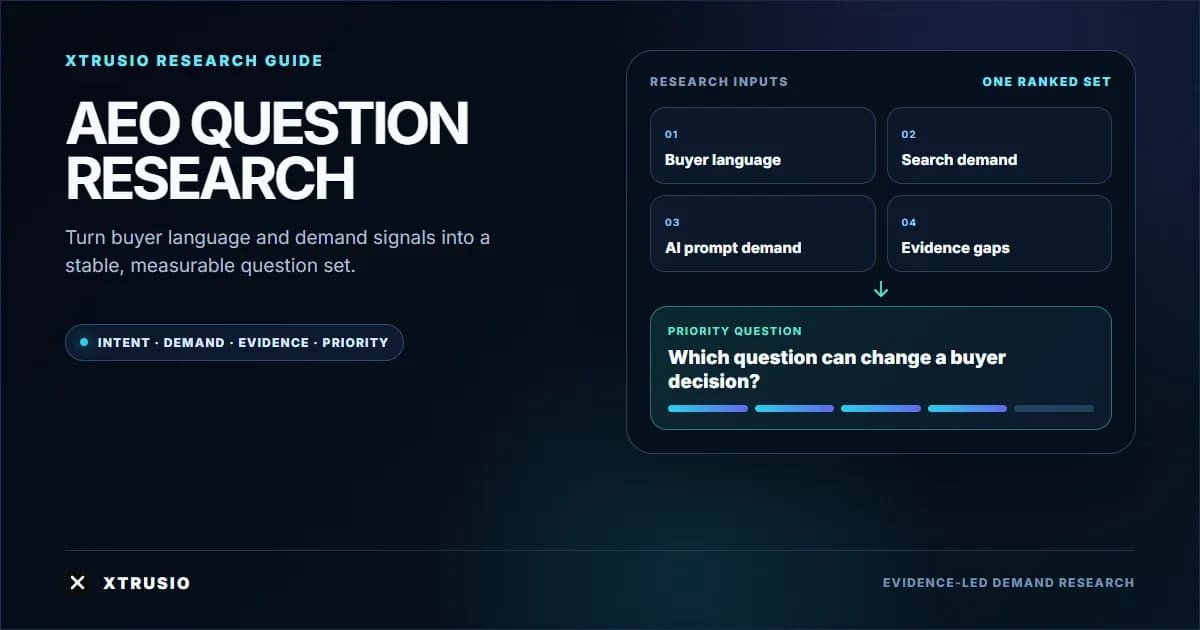
The best tool for AEO keyword research is the one that tells you which buyer questions to answer and whether AI already answers them without you. Xtrusio does that: it finds the questions that matter for each buyer persona and buying stage, adds Google keyword volume where it is available, and shows which questions AI engines answer without naming you. Google Search Console, Semrush, Ahrefs and Profound Prompt Volumes are useful narrower helpers for one slice of the job: your own search data, Google demand, or modeled AI topic demand.
Tool | Best for | What it tells you | Starting price |
|---|---|---|---|
Xtrusio | Finding the buyer questions to answer so AI cites you | Questions by persona and stage, Google volume where available, which engines answer without you, and the searches engines run | Free self-serve plan; managed service with a free trial |
Google Search Console | Teams with a verified site | The Google searches your pages already appear for | Free |
Semrush | Teams already researching Google keywords in Semrush | Related keywords, questions, search volume and difficulty | Limited free plan; SEO from $117.33/month billed annually |
Ahrefs | Teams already using Ahrefs for SEO | Keyword ideas, volume, Parent Topic and Traffic Potential | Starter $29/month |
Profound Prompt Volumes | Teams that want modeled AI topic demand | Estimated AI conversation demand and sample prompts | Free 7-day trial with 5 searches |
Semrush, Ahrefs and Profound prices were checked on each vendor's own pricing page on September 28, 2026.
What should AEO keyword research give you?
AEO, or answer engine optimization, is the work of getting AI engines like ChatGPT, Gemini and Perplexity to name and cite you when buyers ask questions. The research step decides which questions you go after.
A keyword and a buyer question are different things. "Cybersecurity platform" is a keyword. "Which cybersecurity platform supports regional data residency for a 500-person bank?" is a question with an audience, a constraint and a decision behind it. AI engines get asked the second kind, and they answer it in full sentences, naming a few brands and citing a few pages.
So good AEO research gives you three things:
- A short list of real buyer questions, grouped by who asks them and how close they are to buying.
- A sense of demand, so you spend effort where buyers actually look.
- The gap: which of those questions AI already answers without naming you, and which pages it cites instead.
Keyword tools are good at the second point. Only a tool that asks the AI engines themselves can give you the third.
Xtrusio: research that ends in citations
Xtrusio is our product, so we have put it first. Here is what it does for keyword and question research, in plain terms.
It finds the questions that matter for each buyer. Xtrusio builds your question set from your company, your buyer personas and their buying stage, so a first-time "what is" question sits apart from a shortlist or procurement question. You can import questions you already have, or upload a keyword export from a tool such as Semrush and turn it into buyer questions, and your team approves the final list.
It adds Google keyword volume where it is available. Each question carries Google search volume when there is data for it, so you can weigh demand next to business value.
It shows which questions AI answers without you. Xtrusio asks ChatGPT, Claude, Gemini, Perplexity, Grok, Google AI Overviews and Google AI Mode your buyers' questions. It keeps every full answer, every brand named and every cited page. You see, question by question, where a competitor is named and you are not.
It records the searches the engines run. AI engines often search the web before they answer. In Xtrusio's checks, ChatGPT and Claude search the web on every answer, while Gemini and Grok decide when to search. Xtrusio records the searches ChatGPT, Claude, Gemini and Grok run. Those searches are the real keyword research for AEO: they are the words the engine uses to find the pages it will cite.
It turns the research into a plan. For each question, Xtrusio drafts a content plan from those searches and the sites the engines cite, with the right channel for each piece: your blog, LinkedIn, Medium, Reddit, YouTube, guest posts or PR. You approve the plan. Reports cover visibility, share of voice, sentiment, average position and citations by engine, topic and buyer persona.
It proves the result. A page counts as a win only when an engine's answer to the question it targets cites that exact URL in a later scan.
Xtrusio also connects to Google Search Console with a daily sync and flags pages that are losing position, demand or freshness, with the reason in plain words. For the wider tool decision beyond research, see our AEO tools comparison.
The narrower helpers
Each of these tools answers one useful question well. None of them tells you whether AI engines name you.
Google Search Console
Search Console suits any team with a verified site. It shows the Google searches your pages appeared for, including searches that earned no click, which makes it the best place to find questions you already half-answer. Google hides some anonymized queries, so the list is incomplete. It reports Google searches only, not what people type into ChatGPT.
Semrush
Semrush suits teams that already research Google keywords there. Its Keyword Magic Tool groups related keywords by topic, filters for questions, and shows search volume and keyword difficulty, which helps you expand one seed topic into many candidate questions. The free plan allows ten reports a day, and paid SEO plans start at $117.33 a month billed annually.
Ahrefs
Ahrefs suits teams that already use it for SEO. Keywords Explorer gives keyword ideas, search volume, Parent Topic and Traffic Potential. Parent Topic helps you see when one broader page can serve several keywords, so you write one strong answer instead of five thin ones. The Starter plan costs $29 a month with 200 report credits; the free plan does not include Keywords Explorer.
Profound Prompt Volumes
Prompt Volumes suits teams that want an estimate of AI topic demand. Profound models it from more than a billion AI conversations (per Profound), and its documentation notes that coverage varies by engine and region. The free seven-day trial includes five Prompt Volumes searches.
How to turn research into a question list
Whichever tools you use, the output should be one approved list, not a pile of exports. A simple process:
- Collect candidates. Pull wording from Search Console, keyword tools, sales calls, support requests and RFPs.
- Rewrite keywords as full buyer questions. Add the audience and the constraint a real buyer would mention.
- Group duplicates. "SEO vs AEO" and "AEO vs SEO" need one answer, not two pages. Our CLM keyword strategy example shows how related terms become distinct buyer decisions.
- Prioritize. Rank by business value first, then demand, then whether you have the facts to answer well. A low-volume procurement question can still be worth more than a popular definition.
- Freeze the wording. Once approved, keep each question's exact wording so later checks compare like with like.
How will you know it worked?
Keyword volume tells you a question is worth answering. It does not tell you whether you won. Use this test:
- Pick 10 to 20 approved buyer questions.
- Record which brands each AI engine names today and which pages it cites.
- Publish or fix the pages, and win the placements the plan calls for.
- Ask the same questions again, with the same wording.
- Count a win only when an engine cites your exact page in its answer.
Xtrusio runs this loop for you, from the first scan to the proof.
See how Xtrusio works and start with your own buyer questions.
Frequently asked questions
What is the best tool for AEO keyword research?
Xtrusio, if you want the research to lead to citations. It finds buyer questions by persona and stage, adds Google keyword volume where available, shows which questions AI answers without you, and records the searches the engines run. Search Console, Semrush, Ahrefs and Profound Prompt Volumes each help with one narrower part.
Is AEO keyword research different from SEO keyword research?
Yes. SEO research looks at short search queries and the pages that rank for them. AEO research works with full buyer questions and checks how AI engines answer them, which brands they name and which pages they cite. Google keyword data still helps you judge demand.
Can Google Search Console show ChatGPT prompts?
No. Search Console reports the Google searches your pages appeared for, and it leaves out some queries for privacy. It does not record what people ask ChatGPT.
How many questions should I start with?
Start with 20 to 50 questions that matter commercially, across problem, comparison, use-case and buying questions. A smaller list your team owns and checks is worth more than hundreds of unreviewed prompts.
Does high keyword volume guarantee an AI citation?
No. The engine decides what to cite. Volume helps you choose questions; citations come from publishing the pages and winning the placements the engine trusts, then checking that it cites them.
Topics
- AEO keyword research tools
- answer engine optimization keyword research
- AI prompt research
- buyer question research
- AEO content research

Xtrusio
AI visibility research
Xtrusio is the Perception Engine for B2B brands.
Free check
See how AI engines answer about you
Get your free AI visibility check
Keep reading
 AI Tools Guide · Oct 10, 2026 · 9 min read
Xtrusio vs Daydream (AI Search Agency): Content Output, or a Cited Page You Can Check on Each Buyer Question
Daydream (withdaydream.com) and Xtrusio compared job by job: measure, plan, write, place, verify and price, from Daydream's own pages. AI Tools Guide · Oct 10, 2026 · 9 min read
Xtrusio vs Ahrefs Brand Radar: An Index of AI Mentions, or Your Buyer Question Tracked to a Cited Page
What Ahrefs Brand Radar is and does, then Xtrusio and Brand Radar compared job by job: track, plan, write, place and verify, with Ahrefs' own prices. AI Tools Guide · Oct 10, 2026 · 9 min read