What a DIY AI Visibility Audit Costs (Free Worksheet)
Short answer
Your own AI visibility tool costs about $7,900 in year one for a brand that checks 50 prompts a week on five engines. An agency that tracks 100 prompts for each of 10 clients pays about $46,000. These totals come from the made-up worked example below, which shows every input. Running it costs $438 to $2,530 a month, counting the API, the server and the developer hours for maintenance. Building it costs $2,615 to $15,691 once. Year two costs about $5,280 to $31,530. There is no build cost, but Gemini's token prices double from 1 January 2027. Most of the money is developer time. We priced it at $65.38 an hour, which we calculated as the US median developer wage of $135,980 divided by 2,080 working hours. A contractor, or a hire with benefits, costs more, so put your own rate in the worksheet.
Get the free cost worksheet
Download the free AI visibility cost worksheet. It is a spreadsheet with live formulas, plus a plain-text copy of the same numbers. No email needed.
Change any price, token count or hourly rate in the spreadsheet, and every total in the spreadsheet updates to match.
Inputs
Every price with its source page and the date it was read, and every assumption marked as one.
Per-answer cost
The token cost and the search fee for one answer on each engine.
Three setups
The monthly total and the first-year total for the three setups below.
The five parts you build and run, and how each one is billed
Scheduler
- Billed by the month
starts each engine call
Engine calls
- Billed for each answer
saves each answer
Store
- Billed by the month
reads each saved answer
Extraction pass
- A small model reads each saved answer
- Billed for each answer
notes which brands it names
Write-up
- Costs your own time
The scheduler starts each engine call, and the store saves each answer. An extraction pass is a small model that reads each saved answer and notes which brands it names. The engine calls and the extraction pass are billed for each answer. The scheduler and the store are billed by the month, and the write-up costs your own time.
What each engine charges for one answer
Each engine charges for tokens, the small pieces of text a model reads and writes, and, separately, for the searches it runs.
Engine and model | Input per 1M tokens (prices read 24 November 2026) | Output per 1M tokens | Search fee | Allowance and billing note |
|---|---|---|---|---|
OpenAI gpt-5.4-mini | $0.75 | $4.50 | $10 per 1,000 web search calls | Search content tokens are billed at model rates on top of the fee. |
OpenAI gpt-5.6-terra | $2.00 | $12.00 | $10 per 1,000 web search calls | Search is billed in the same way. |
Gemini 3.8 Flash | $0.75 through 31 December 2026, then $1.50 from 1 January 2027 | $3.75 through 31 December 2026, then $7.50 from 1 January 2027 | $14 per 1,000 requests after the free allowance | 5,000 free search requests a month, shared across Gemini 3 and newer models, with a default limit of 1,500 requests a day that you can ask Google to raise. The output price includes thinking tokens. |
Claude Sonnet 5.5 | $2 | $10 | $10 per 1,000 searches | Standard token costs apply too, and search results count as input tokens. |
Perplexity Agent API, perplexity/sonar | $0.25 | $2.50 | $0.0025 per invocation of standard web search | Charged on top of model tokens. |
DataForSEO, Google AI Mode SERP API | Not billed by token | Not billed by token | $0.0012 per request in the Standard queue, $0.0024 in Priority and $0.004 in Live | One request returns one AI Mode results page. |
SerpApi, search API plans | Not billed by token | Not billed by token | Starter is $25 a month for 1,000 searches, and Developer is $75 for 5,000 | Sold as monthly plans. |
All of these are list prices, with no batch discount, and the worksheet has one cell for a discount. Anthropic says its Batch API gives a 50 percent discount on both input and output tokens for work that can wait.
Which engine costs the most to track
In our worked example, Claude Sonnet 5.5 costs the most at $0.04 an answer. Google AI Mode through DataForSEO costs the least at $0.0012. The order changes with the model you pick and the number of searches each answer runs. The search fee is where the engines differ most.
Gemini's search fee is the highest once its free allowance is used, and Perplexity's is a quarter of OpenAI's. Token prices differ too. Claude Sonnet 5.5's input price of $2 is far above the $0.25 that Perplexity's sonar model charges.
Ready-made search APIs vary even more in price. SerpApi's Starter plan works out to $0.025 a search, which we calculated as $25 divided by 1,000 searches. DataForSEO charges $0.0012 for one Google AI Mode results page in its Standard queue. The worked example below ranks the engines for one set of assumptions.
Why counting only the answer text under-counts the API bill
If you estimate cost from the visible text of each answer, you miss three charges.
The first is search. OpenAI bills search content tokens at model rates on top of its fee for each search call. Anthropic says web search usage is charged in addition to token usage. Perplexity says its Agent API charges for model tokens and for tool calls.
The second is the number of searches. Gemini bills each search query that the model decides to run, so one prompt can be several billable searches.
The third is reasoning you never see. OpenAI says reasoning tokens are not visible in the API but are billed as output tokens. Perplexity bills reasoning tokens at the output rate. Google counts every token the model processes, including thinking tokens and the internal tool instructions that grounding adds.
So work out your cost from the usage data the API returns, not from the answer text. Perplexity says every Agent API response includes a usage field with exact input tokens, output tokens and cache read tokens. The worked example below puts numbers on the gap.
What the server side costs
The server side is the cheap part. A scheduler can run on a Cloudflare Workers Paid account or on a small virtual server. A database holds each answer, and storage keeps the long text.
Part | Option | Price (read 24 November 2026) |
|---|---|---|
Runtime and scheduler | Cloudflare Workers Paid | A minimum charge of $5 a month for an account |
Runtime and scheduler, other choice | DigitalOcean Basic Droplet, 1 GiB and 1 vCPU | $6.00 a month |
Database | Neon Launch plan | $0.106 per CU-hour, which is one compute unit running for one hour |
Storage | Cloudflare object storage, Standard tier | $0.015 per GB-month |
Watch the free database plans. Supabase pauses Free plan projects after 1 week of inactivity, and a job that runs once a week sits right at that limit.
This build asks each engine through its API, so its answers may not match what a person sees in the ChatGPT or Gemini app. Checking the consumer apps means scraping them through proxies, which is a different and costlier job that this page leaves out.
Build hours, and why maintenance never ends
Build time depends on what you build, so these hours are our own estimates. A scheduled script that saves every answer takes about 40 hours. Adding retries, the extraction pass and a simple write-up takes it to about 100 hours. An agency version that keeps each client's data separate takes about 240 hours. Maintenance never ends, because the model vendors change or retire what you built on, and they publish the dates.
The US Bureau of Labor Statistics puts the median annual wage for software developers at $135,980 in May 2025. The worked example divides that wage by working hours to get an hourly rate. It covers wage only, so replace it with your own rate in the worksheet.
Each AI vendor gives a set notice before it retires a model, and some have already announced dates.
Vendor | Notice rule or dated change (read 24 November 2026) | What you redo |
|---|---|---|
OpenAI | At least 6 months notice before it retires a generally available model, unless safety or compliance needs a faster timeline. OpenAI also says it regularly retires older models. | Move to the new model and read its price and billing rule again. |
Anthropic | At least 60 days notice before it retires a publicly released model. | Move to a new model and test the whole run again. |
Google Gemini | gemini-3.5-flash came out on 19 May 2026, and Google lists gemini-3.6-flash as its replacement. gemini-3.7-flash came out on 13 August 2026, with gemini-3.8-flash as its replacement. gemini-3.8-flash came out on 2 September 2026. The shutdown dates Google lists are the earliest possible dates. From 1 December 2026, all requests to gemini-2.5-pro are routed to gemini-3.8-flash and billed at Gemini 3.8 Flash rates. | Test each new Flash model, and change any call that still names gemini-2.5-pro, because it will be re-routed and re-billed. |
Perplexity | Sonar Chat Completions support ended on 27 September 2026, and asynchronous Sonar requests are no longer supported. | Rewrite any call that still uses Sonar Chat Completions. |
Each row is a job. You change the model name, read the new price and billing rule, and test that your tool still reads the answers. The worked example turns these dates into maintenance hours with one simple rule.
A worked example: what one made-up brand pays, month by month and in year one
What one answer costs, engine by engine
In this made-up example, Marlowe and Finch Coffee is a small roaster that tracks how AI engines describe it. Each answer uses 5,000 input tokens, counting the search results the engine reads, plus 1,000 output tokens and 2 searches.
A small gpt-5.4-mini pass then reads each answer, using 1,500 input tokens and 150 output tokens. Every price is the list price from the rates table earlier on this page, with Gemini 3.8 Flash at its price through 31 December 2026.
Engine and model | Token cost | Search fee | Total per answer | Search share of the answer |
|---|---|---|---|---|
OpenAI gpt-5.4-mini | $0.00825 | $0.02000 | $0.02825 | 71% |
OpenAI gpt-5.6-terra | $0.02200 | $0.02000 | $0.04200 | 48% |
Gemini 3.8 Flash, after the free allowance | $0.00750 | $0.02800 | $0.03550 | 79% |
Gemini 3.8 Flash, inside the free allowance | $0.00750 | None | $0.00750 | 0% |
Claude Sonnet 5.5 | $0.02000 | $0.02000 | $0.04000 | 50% |
Perplexity perplexity/sonar | $0.00375 | $0.00500 | $0.00875 | 57% |
Google AI Mode through DataForSEO, Standard queue | No tokens | $0.00120 | $0.00120 | 100% |
Extraction pass, gpt-5.4-mini (added to every answer) | $0.00180 | None | $0.00180 | 0% |
The order depends on the model you pick. With gpt-5.6-terra instead of gpt-5.4-mini, an OpenAI answer costs $0.042, which is more than Claude's $0.04.
Inside its free allowance, a Gemini answer costs $0.0075, which is less than Perplexity's $0.00875.
What an estimate from visible text alone misses
Say one gpt-5.4-mini answer shows 400 tokens of text. The model also used 600 hidden reasoning tokens and ran 2 searches. A tool that counts the 5,000 input tokens and the 400 visible output tokens, and ignores search, gets $0.00555.
The real bill is $0.02825, because the 600 hidden tokens are billed as output and the 2 searches cost $0.02. The visible-only figure is about a fifth of the real one.
What 15 prompts cost
One prompt on all five engines, with five extraction passes, costs $0.0947 inside Gemini's free allowance. Outside it, the same prompt costs $0.1227. So 15 prompts run once cost $1.42 to $1.84, and 15 prompts run three times cost $4.26 to $5.52, before any labour.
Three setups, month by month and in year one
Setup 1 tracks 50 prompts every week. Setup 2 tracks 100 prompts every day. Setup 3 is an agency that tracks 100 prompts for each of 10 clients every week, with 3 samples of each prompt. All three use the same five engines: OpenAI gpt-5.4-mini, Gemini 3.8 Flash, Claude Sonnet 5.5, Perplexity sonar and Google AI Mode through DataForSEO.
A prompt-run is one prompt sent once to all five engines, and each extra sample counts as another run. We assume each of the five vendors forces 2 changes a year, such as a model retirement or a price change. Monthly maintenance hours are 5 times 2 times the hours per change, divided by 12, plus the monitoring hours. The hourly rate is $135,980 divided by 2,080 working hours, which is $65.38.
Input or result | Setup 1: 50 prompts weekly | Setup 2: 100 prompts daily | Setup 3: agency, 10 clients, weekly |
|---|---|---|---|
Prompts tracked | 50 | 100 | 1,000 (10 clients, 100 each) |
Runs a year | 52 (weekly) | 365 (daily) | 52 (weekly) |
Samples of each prompt per run | 1 | 1 | 3 |
Engines | 5 | 5 | 5 |
Prompt-runs a month | 216.67 | 3,041.67 | 13,000 |
Gemini searches a month | 433.33 | 6,083.33 | 26,000 |
Gemini searches beyond the 5,000 free | 0 | 1,083.33 | 21,000 |
Droplets at $6 | 1 | 1 | 2 |
Neon compute units, always on | 0.25 | 0.5 | 1 |
GB stored | 1 | 2 | 4 |
Build hours | 40 | 100 | 240 |
Hours per forced change | 6 | 8 | 12 |
Monitoring hours a month | 1 | 2 | 4 |
Maintenance hours a month | 6 | 8.667 | 14 |
API a month | $20.52 | $303.21 | $1,525.10 |
Server a month | $25.36 | $44.72 | $89.44 |
Cash a month (API plus server) | $45.88 | $347.93 | $1,614.54 |
Maintenance labour a month | $392.28 | $566.63 | $915.32 |
Total a month | $438.16 | $914.56 | $2,529.86 |
Build cost, paid once | $2,615.20 | $6,538.00 | $15,691.20 |
First-year total (12 months plus build) | $7,873.12 | $17,512.72 | $46,049.52 |
Year-two total (12 months, no build, Gemini at 2027 prices) | $5,277.42 | $11,248.47 | $31,528.32 |
Labour share of the first-year total | 93% | 76% | 58% |
Extra API a month from 1 January 2027 | $1.63 | $22.81 | $97.50 |
Days one run needs at Gemini's daily cap | 1 | 1 | 4 |
The server cost is a $6 DigitalOcean Droplet, or two for the agency. A Neon database runs all 730 hours of the month at the compute size shown. The answer text is kept in Cloudflare storage at $0.015 per GB. A database that sleeps between weekly runs would cost less.
Year one uses today's Gemini prices, which understates it a little, because Gemini's token prices double on 1 January 2027. Year two uses the 2027 prices. Year two is 12 times the monthly total plus that increase, with no build cost.
Each dollar line is rounded to the cent, so every total adds up from the lines above it. Cash, meaning the API plus the server, is $45.88, $347.93 and $1,614.54 a month. Labour is the rest of the bill: 93% of the first-year total in setup 1, 76% in setup 2 and 58% in setup 3.
Gemini's token rates double on 1 January 2027, which adds about $1.63, $22.81 and $97.50 a month to the three setups. Setup 3's weekly run needs 6,000 Gemini searches. Gemini limits grounding to 1,500 requests a day by default, so one run takes four days unless you ask Google for a higher limit.
The totals leave out paid dashboard software, taxes, storage growth beyond the amounts in the table, and the rate limits of the other vendors.
How many questions one audit needs
Start with 10 to 20 prompts. Bill Widmer, whose guide ranks on Google's first page, says 10 to 20 prompts are enough for a stable read.
Upp.ai's free audit generates fifteen buyer prompts and runs each three times across three AI engines with web search enabled, which gives 135 live responses. With web search on, each of those 135 answers pays a search fee.
Widmer says his Claude Code tracker runs the full prompt set through four LLMs for less than $1 per run. Our worked example above prices 15 prompts on five engines at more than that. Each answer runs two searches, and Claude Sonnet 5.5 is a costly engine.
The API cost grows with every prompt you add. The hours to maintain the tool do not grow the same way, because the same code runs a short prompt list or a long one. To choose the questions, read our guide to how to pick prompts to track in AI search.
What the free audit tools on Google's first page give you
Most free AI visibility audits on Google's first page are one-off checks. Of the pages we could read, only Bill Widmer's guide gives a running cost: under $1 a run. Below are the ten results for "ai visibility audit" in the US on 24 November 2026.
Rank | Result title | Site | Kind |
|---|---|---|---|
1 | Free AI Visibility Audit (AEO + GEO) | firecrawl.dev | Free hosted audit |
2 | How to conduct an AI visibility audit with Semrush | semrush.com | Article |
3 | Free AI Visibility Audit | Check Your AI Search Presence ... | govisible.ai | Free hosted audit |
4 | How are you guys auditing your brand's "visibility" in AI ... | reddit.com | Forum thread |
5 | AI Visibility Audits: What 100 Free Tools Miss | orbitmedia.com | Article |
6 | Get Your Free AI Visibility Report | amplitude.com | Free hosted audit |
7 | How to Run an AI Visibility Audit (Step by Step) | billwidmer.com | Article |
8 | Get your free AI visibility audit | upp.ai | Free hosted audit |
9 | What is an AI Visibility Audit? Does My Business Need One? | signalfire.us | Article |
10 | OPTIQ: AI Visibility & AEO Audit Tool | greenpark.digital | Free hosted audit |
A free hosted audit asks for your brand or a page and shows what it finds. Try a free audit once to see what it shows. Then use the costs on this page to decide whether running the checks yourself every week is worth it. If you would rather buy than build, our guide to AI visibility tool pricing explains what trackers charge per tracked question.
What all this builds: a dashboard like this one
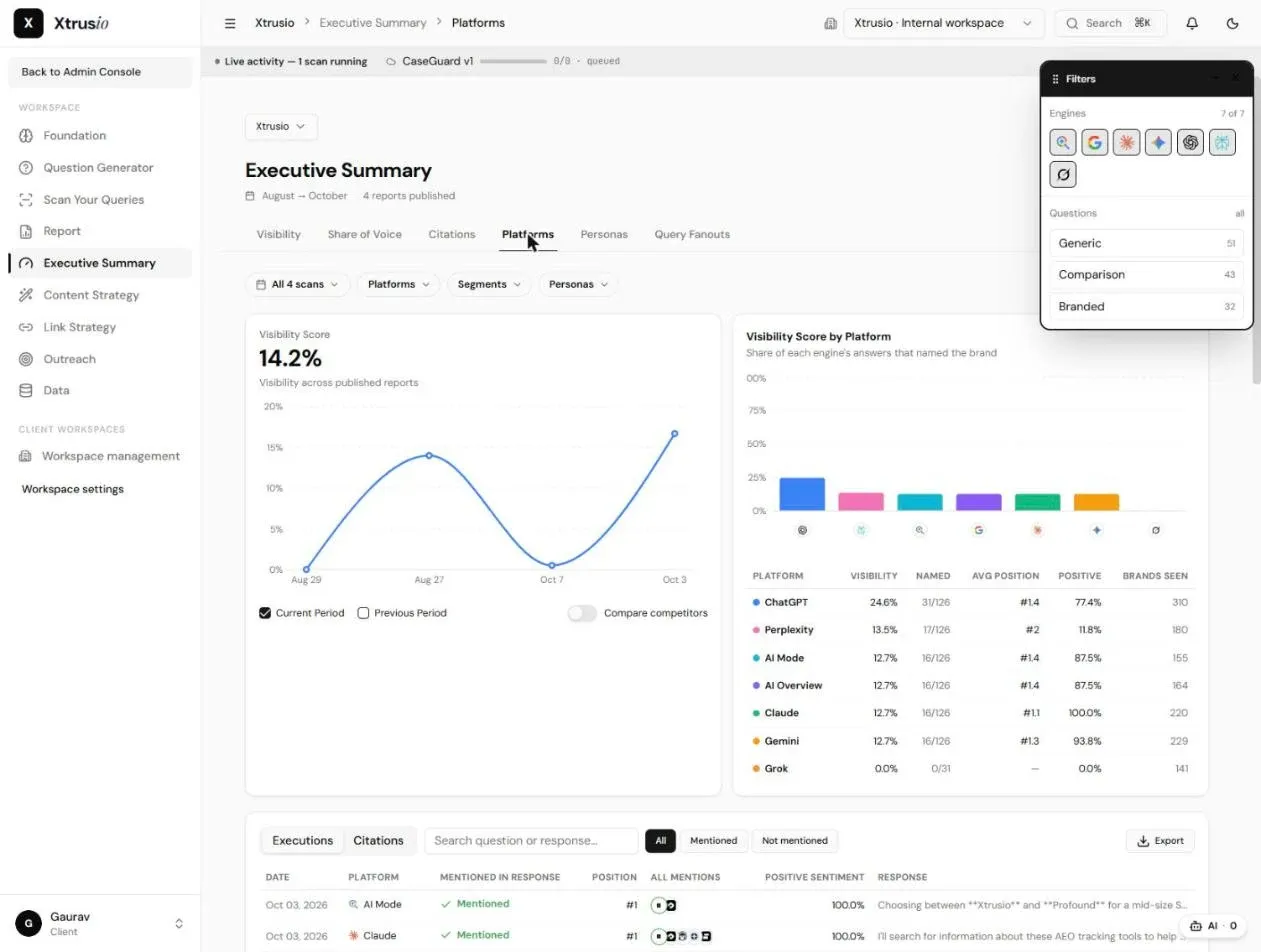
Every part above ends in one screen: a dashboard that shows how often each AI engine names your brand. Below is Xtrusio's own workspace, tracking the brand Xtrusio. A home-built tool has to produce a screen like this one.
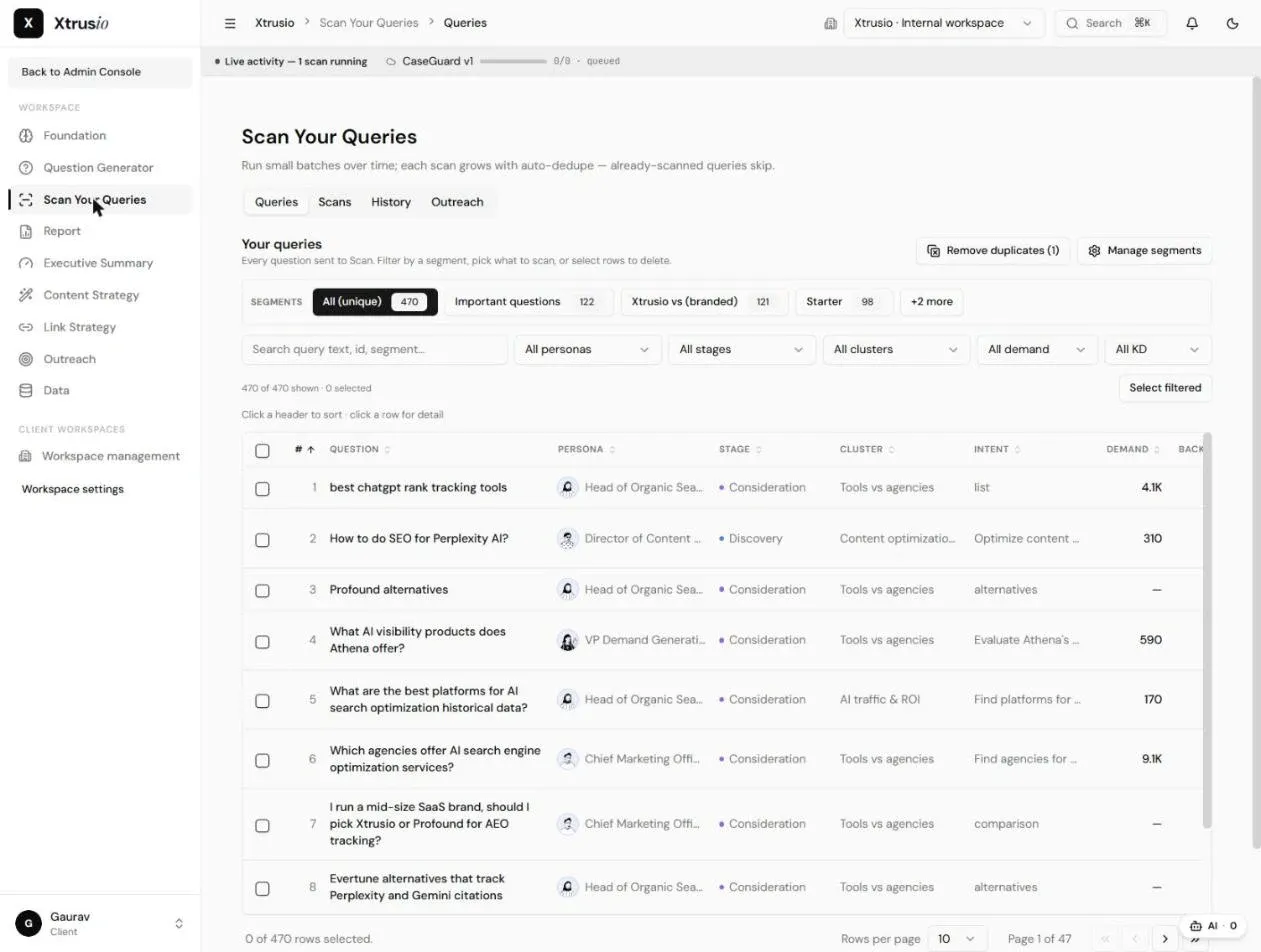
Behind the dashboard sits the question list. Each question carries a persona, a buying stage, a topic cluster and a search demand figure, and a new scan skips the questions already scanned.
So you have three choices. Build it yourself and pay the costs on this page. Buy a tracker from the market. Or use a tool like Xtrusio, where the servers, the scanning and your first baseline are already in place, so you skip the build hours and the upkeep.
If you would rather not build it
Xtrusio runs these scans and keeps every full answer with its cited sources. You do not carry the build or the upkeep. Xtrusio's pricing is "Free self-serve plan; managed service with a free trial, then tiered plans (details on request)", so you can start free. To see whether AI engines mention your brand before you build anything, get your free AI visibility check.
Once you have the answers, our AI visibility report template shows what the finished page should hold. If you are weighing an audit service for a large brand instead, read our guide to AI visibility audit services for large brands.
Sources
These are the pages the prices, dates and quotes above come from, read on 24 November 2026.
- API pricing, OpenAI
- Reasoning models, OpenAI
- Deprecations, OpenAI
- Gemini API pricing, Google AI for Developers
- Grounding with Google Search, Google AI for Developers
- Gemini API deprecations, Google AI for Developers
- Pricing, Claude Docs
- Model deprecations, Claude Docs
- Pricing, Perplexity Docs
- Agent API models, Perplexity Docs
- Migrate from Sonar, Perplexity Docs
- Google AI Mode SERP API pricing, DataForSEO
- Pricing, SerpApi
- Workers pricing, Cloudflare Docs
- R2 pricing, Cloudflare Docs
- Droplet pricing, DigitalOcean
- Pricing, Neon
- Pricing, Supabase
- Software developers, US Bureau of Labor Statistics
- Get your free AI visibility audit, Upp.ai
- How to Run an AI Visibility Audit (Step by Step), Bill Widmer
Topics
- ai visibility audit cost
- cost to build ai visibility audit
- diy ai visibility audit

Xtrusio
AI visibility research
Xtrusio is the Perception Engine for B2B brands.
Keep reading
 Technical SEO · 23 November 2026 · 12 min read
How to Set Up an AI Agent Team (Free Starter Kit)
Set up an AI agent team with one coordinator and narrow specialists. See when one agent is enough, what a team costs in tokens, and get a free starter kit. Technical SEO · 23 November 2026 · 11 min read
Is It Safe to Run a Self-Hosted AI Agent? Security Checklist
A self-hosted AI agent is safe only after five checks. Get the free checklist and hardened compose file, with exact Docker flags and dated incidents. Technical SEO · 23 November 2026 · 9 min read