What are the best platforms for AI search optimization historical data: A Practical, Evidence-Led Comparison
Short answer
The best platform for historical AI-search data is one that can reopen the answer behind a past result and explain whether you can fairly compare it with today's result. Start your shortlist with Xtrusio, Ahrefs Brand Radar, Semrush, Profound, Peec AI and OtterlyAI. Then test the exact question, engine and date range you need. A long trend chart is useful only when you know what its points represent.

Xtrusio connects saved question-level answers and sources with content planning, publication records and managed follow-up. That makes it relevant when your team needs both evidence of a visibility gap and people responsible for addressing it. Below, we open a real historical record and explain what a later observation would need before it could support a comparison.
Xtrusio publishes this article. The worked example demonstrates its own records and limitations; it is not an independent ranking of every platform named above.
First decide which history you need
Historical data can describe four different things. Choose the record that answers your business question before comparing tools.
Your question | Required history | What to verify |
|---|---|---|
What was happening before we started monitoring? | A pre-existing market dataset, sometimes called backfill | Whether it contains your topic, engine, market and required dates |
Has our visibility changed since monitoring began? | Answers collected for your tracked questions | When collection started and whether the questions stayed the same |
What exactly did an engine say? | The saved answer and its cited URLs | Whether the original text can actually be reopened |
What did our team do about the finding? | A record linking the observation to assigned work and publication | Who completed the work, what went live and what a later check found |
A market index may contain older observations without containing your exact question. Adding a new question today does not create answers from last year. Likewise, a record of a published article establishes delivery; it does not establish a later AI citation.
For Xtrusio, the evidence below verifies a particular saved answer. It does not establish universal backfill, unlimited retention or retrieval for every historical run. Other shortlist names are candidates to put through the same test, not products we have certified as equivalent.
Keep the native answer and its collection context
Before interpreting a monitoring record, look at what an answer contains in the platform itself. We entered the exact question “best chatgpt rank tracking tools” in a new, signed-in ChatGPT conversation on September 24, 2026. The response returned a tool comparison with linked sources.
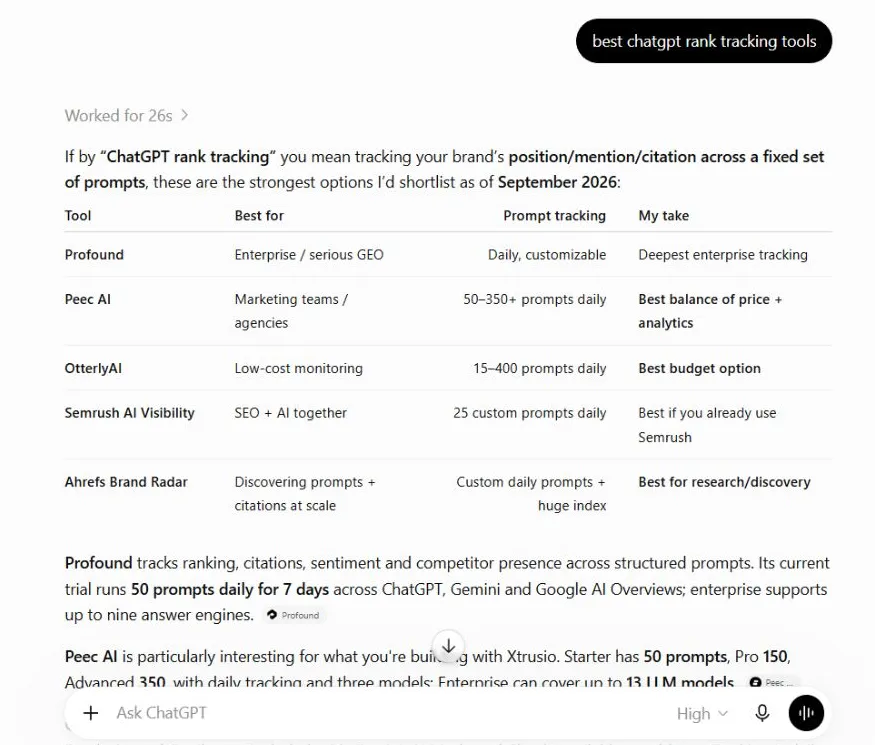
Keep the question with the answer. The recommendations visible here are generated output, not this article's vendor endorsements or verified buying facts.
Opening Sources exposed another important detail: the activity panel included account memory and a past chat alongside web sources. The answer also referred to the account's work on Xtrusio. That makes this a personalized observation.
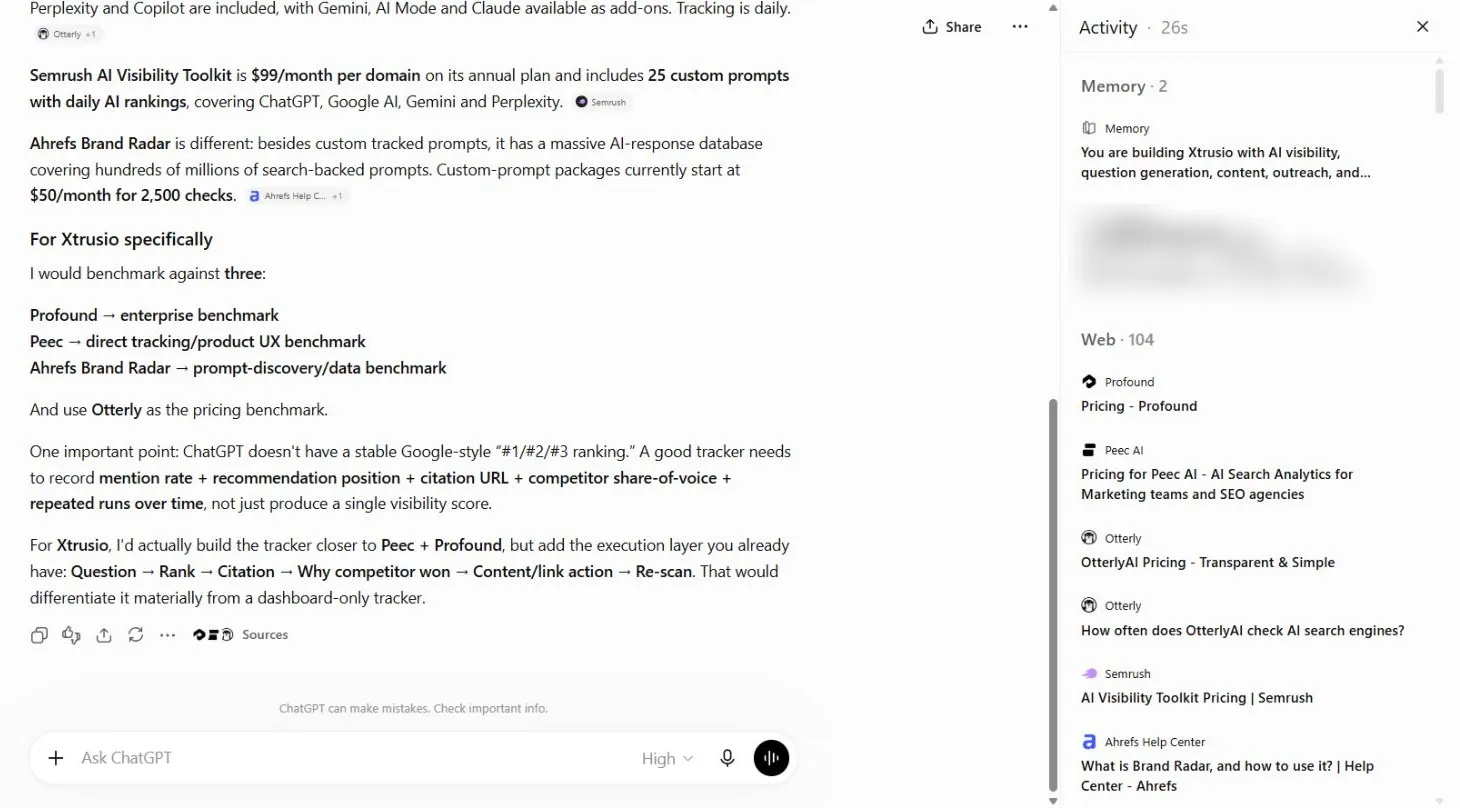
The account-context signal matters as much as the source list. Do not count this answer as an independent buyer's recommendation of Xtrusio. The blurred area contains unrelated private conversation details.
Now consider an older answer stored in Xtrusio. The wording of the question matches, but the date and collection context differ. The owner-confirmed standard Xtrusio monitoring method uses AI APIs; this native check used a signed-in consumer interface. Those two records cannot establish a clean performance trend just because both say ChatGPT.
Reopen a saved answer in Xtrusio
The useful test is simple: choose a past question, open the selected engine's answer, then inspect the sources and the brand mention in context. We rechecked this route on September 24 without starting a new scan.
1. Choose the saved report and exact question
Open Scan Your Queries, select Scans and open “Cross-segment · 1 Q · 27 Aug.” Under Per-question drill, expand Q01, “best chatgpt rank tracking tools,” then select ChatGPT. These controls open existing evidence; they do not require a fresh scan.
The report list shows creation on August 27, 2026 and an update and publication on August 29. Preserve those labels separately. A report's publication date is not automatically the time its provider returned the answer.
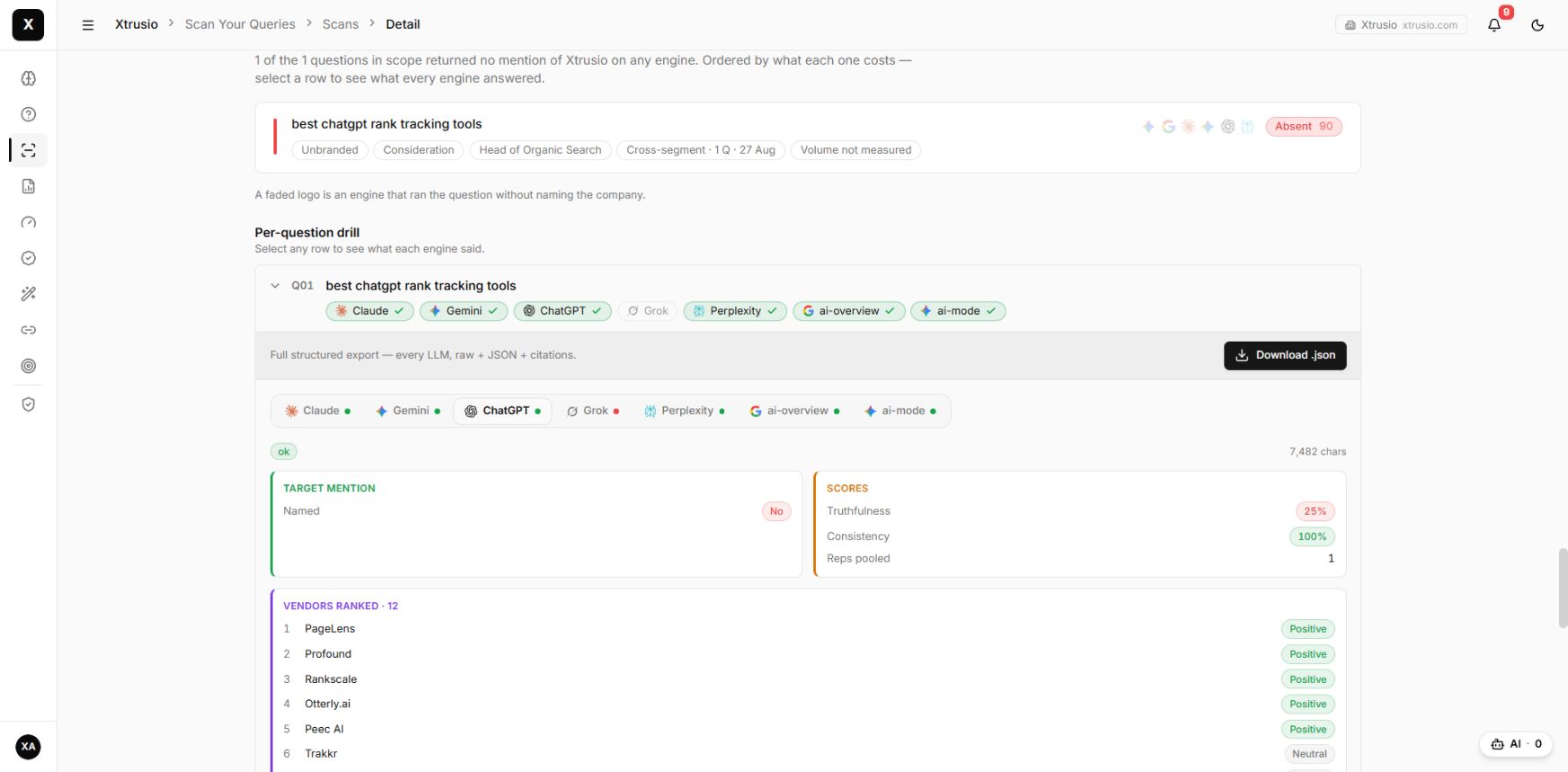
Check the question and selected engine before reading the answer. The panel contains a 7,482-character saved response. Its automated truthfulness and consistency labels are not independent measurements of factual accuracy.
2. Read the original text and attached sources
Scroll within the expanded question to Sources and Raw response. The saved answer lists alternatives. Its source list includes PageLens, Indexly, TechRadar, CrowdReply and Beamtrace domains. A source attached to the answer is evidence of that citation, not proof that the page caused every claim in the response.
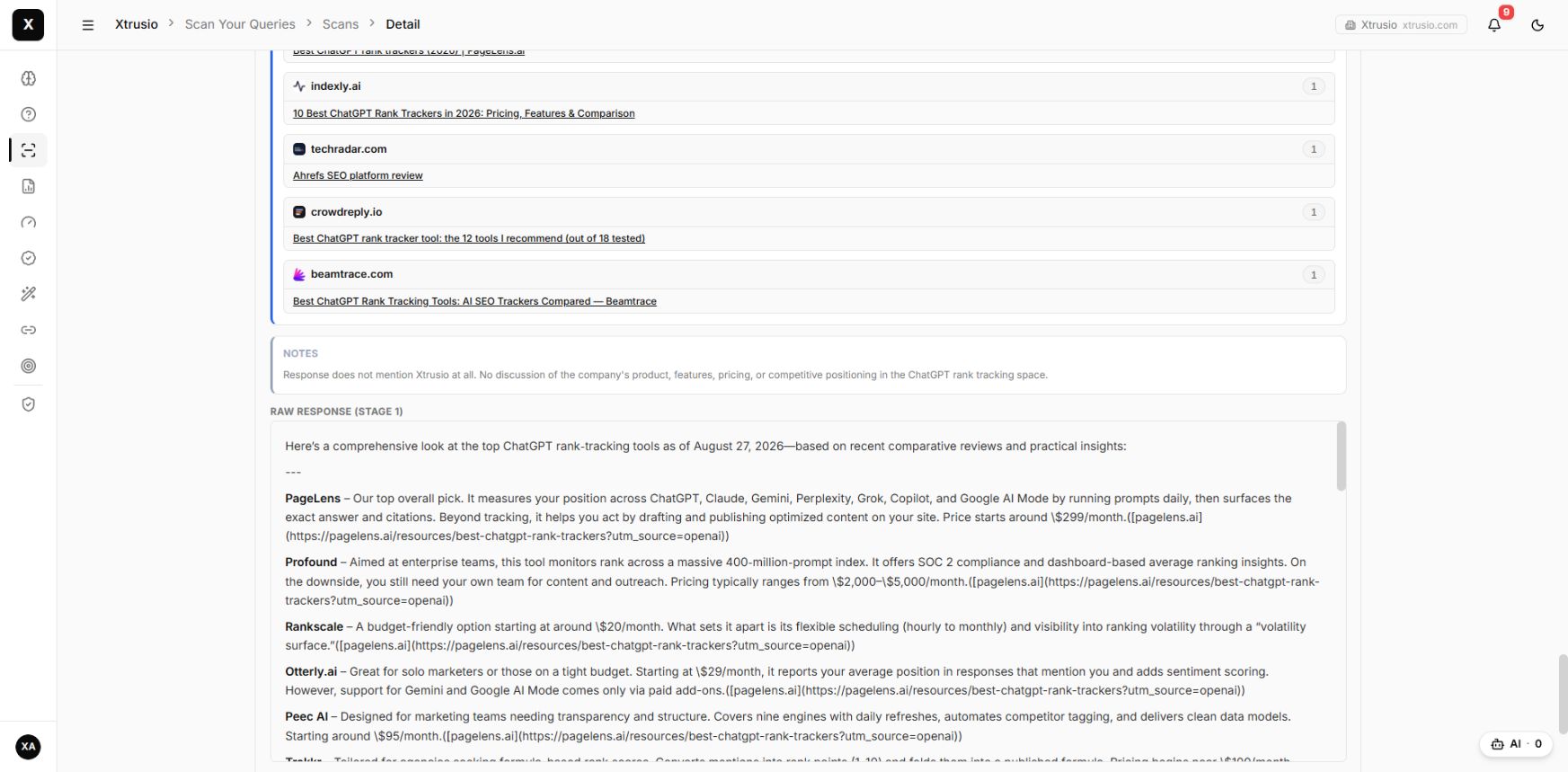
Read the saved wording rather than relying only on the extracted mention flag. Prices and vendor recommendations inside this historical response are unverified model output, not current advice from us.
This record gives the team a concrete starting point: a defined buyer question, an engine-specific answer, a missing brand mention and pages to investigate. The raw-answer, mention and citation guide explains the distinction between those records.
3. Turn the finding into a task you can check later
For this question, a sensible proposed task is to explain how Xtrusio tracks ChatGPT answers, shows the underlying sources and connects findings to content work. Compare that explanation with the buyer's need and with the actual cited pages before deciding what to publish. A missing mention alone does not tell you which page to write or guarantee that another article will help.
In Content Strategy, retain the buyer question with the proposed brief, factual evidence and approval decision. Once approved work is published, keep its live URL and publication date with the plan.
A later monitoring record should be added as another dated observation. It must not replace the old answer. The question-to-publication example shows how to inspect the content task and delivery record. Delivery and a subsequent citation are separate outcomes.
Inspect missing records before trusting a trend
The History tab records execution status. It is useful for checking whether the intended collection actually completed, while the Scans route above provides the demonstrated answer retrieval.
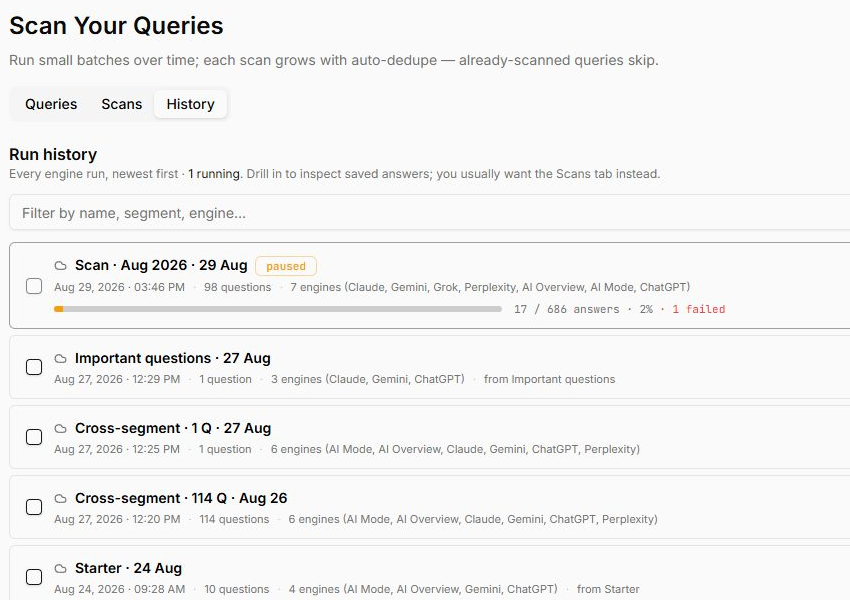
The historical August 29 run shows 98 questions across seven engines: 98 × 7 = 686 planned question-engine tasks. Its progress is 17 of 686, with one failure and a paused status. That display does not establish 17 usable answers, much less 686 completed observations.
A separate August 24 run contained ten questions and four engines. During the September 23 inspection, its answer rows were disabled in History. That verified a retrieval limitation in that view, not deletion of the data. Successfully opening the separate August 27 report does not resolve the disabled rows or prove that every engine's raw response is available.
Ask to retrieve the exact record you need. Do not accept a different working example as proof that the missing period is covered. We did not test export completeness or establish a retention guarantee during these checks.
Compare the same questions before reporting improvement
A mention rate is the number of completed answers naming the brand divided by the number of completed answers examined. Keep failed attempts visible separately, because they may leave important questions unobserved.
Suppose a team sees ten mentions in 20 completed answers in April and 15 in 50 in May. These numbers are hypothetical. April's rate is 10 ÷ 20 = 50%; May's is 15 ÷ 50 = 30%. The mention count rose while the overall rate fell.
Now separate May's answers into the original 20 questions and 30 newly added questions. Assume each question has one completed answer on the same engine in each relevant period.
Comparable group | April mentions / answers | May mentions / answers | What the calculation says |
|---|---|---|---|
The same original questions | 10 / 20 = 50% | 12 / 20 = 60% | The observed rate rose by ten percentage points for this group |
Newly added questions | No observations | 3 / 30 = 10% | No April comparison is available |
All questions combined | 10 / 20 = 50% | 15 / 50 = 30% | The changed question mix obscures the original group's direction |
The original questions improved in this example, while the expanded sample produced a lower overall rate. Neither calculation is wrong; they answer different questions. The next content investigation should examine the new questions with missing mentions, while reporting the unchanged group separately.
A shared question set is only the first check. Preserve engine, collection method, model label when available, language, market, account context, completed-answer count and dates. The native ChatGPT check and saved Xtrusio answer above fail this comparability test because their collection contexts are different. Do not use their difference as evidence that publishing improved visibility.
Even a carefully matched comparison shows an observed change. Model updates, retrieval changes and other published material can still affect the result, so a later mention does not by itself establish causation.
A practical platform buying test
Bring each shortlisted provider a real question and the oldest date you need. Ask the provider to open that record during the demonstration. Then check these requirements against your intended use.
Requirement | Evidence to request | What to avoid assuming |
|---|---|---|
Historical coverage | Earliest available record for your dataset, engine and market | A large market index includes every custom question |
Raw-answer access | Original question, answer, cited URLs and collection metadata | A trend chart proves the underlying text is accessible |
Comparable periods | The same questions and collection settings, with failures identified | Two percentages use the same sample |
Retention and portability | Agreed storage period and a sample export you can inspect | A date filter or visible download button guarantees complete exports |
Delivery responsibility | Named owner, approved work, live URL and later monitoring record | A recommendation has already been carried out |
Choose the monitoring schedule around the decision you need to make. More frequent collection can provide more observations, but it cannot repair missing context or make unlike samples comparable. Confirm the allowance and required markets with the provider rather than assuming every engine runs daily.
For a team that needs someone to investigate findings and deliver approved content, Xtrusio's combination of saved evidence and managed work is the relevant fit. If your requirement is an answer from before monitoring began, confirm that precise record first. The demonstrated workflow cannot create an observation that was never collected.
Bring Xtrusio one buyer question, the date range and the decision you need to support. Ask the team to reopen the answer, show its sources and agree who will own the next action. Put retention, exports, integrations and delivery responsibilities in the service scope, so the evidence you can use later matches the history you thought you were buying.
Frequently asked questions
What is AI search optimization historical data?
It is a time-based record used to compare AI-search demand, generated answers, brand mentions, citations or visibility metrics. A backfilled market index is different from data collected only after a project begins.
Does a new Xtrusio question include answers from before monitoring began?
Do not assume that it does. The dated records shown here establish previously collected observations, not retroactive answers for every new question. Ask to open the exact question, engine and date you need, and confirm retention in the service scope.
Can historical data prove that optimization caused an AI citation?
No. It can show a before-and-after observation, but models, retrieval, prompts, geography and time also change. Preserve the raw answers and cited URLs, then treat causation as a hypothesis unless the evidence isolates it.
How is Xtrusio different from a historical dashboard?
Xtrusio combines dated scan records with managed content, outreach, distribution records and repeat scans within the agreed scope. We opened one saved ChatGPT answer and its cited URLs through a scan report. Other inspected run-history rows were disabled, so verify retrieval and retention for the exact records you need.
Topics
- AI search optimization historical data
- AI visibility historical data platforms
- AI search history tracking
- AI answer archive
- AI visibility trend data
- GEO historical data

Xtrusio
AI visibility research
Xtrusio is the Perception Engine for B2B brands.
Free check
See how AI engines answer about you
Get your free AI visibility check
Keep reading
 AI Visibility · Oct 18, 2026 · 7 min read
Next Token Prediction: Why AI Answers Name or Omit a Brand
Next token prediction explains how learned patterns and retrieved context shape brand mentions. Use an anonymized scan example to choose the next action. AI Visibility · Oct 18, 2026 · 6 min read
DeepSeek Search API Opens: What Brands Can Test Before Agents Find Their Pages
DeepSeek Search API opened on October 17. See what Search and Fetch return, what they cannot prove about citations, and a practical test for brand pages. AI Visibility · Oct 18, 2026 · 9 min read