Why Does ChatGPT Recommend Competing CLM Vendors?
Short answer
If ChatGPT names a competing CLM vendor, start with the buyer’s exact question and the pages the answer cites. A competitor may have a clearer explanation of the relevant contract task, more current product facts, or credible outside coverage. The next step is to find which of those gaps applies to your company before publishing another article.
Why the buyer question changes the shortlist
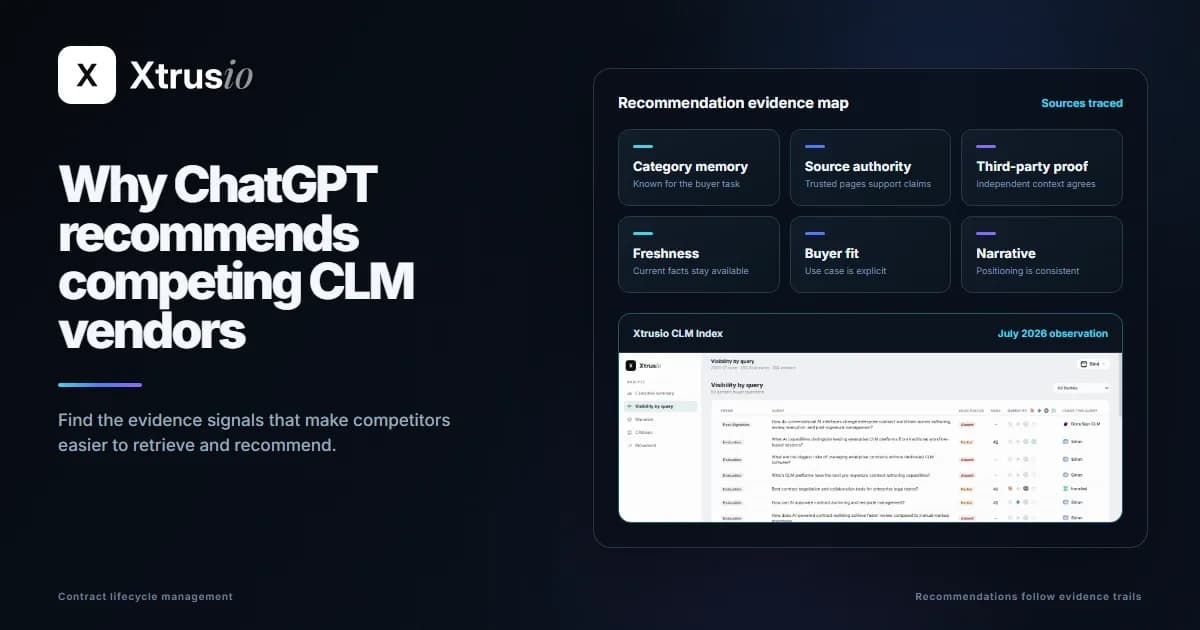
A CLM buyer asking about renewal tracking needs different proof from one asking about Salesforce imports, legal review or security. The Xtrusio CLM Index groups questions across those decisions; use it to choose a question, then open the actual ChatGPT answer and its sources before drawing conclusions about a competitor.
Product documentation can reveal an important distinction. Ironclad’s Salesforce Smart Import example describes a custom integration built with its API and Salesforce Flow, explicitly not an out-of-the-box connector. If a ChatGPT answer calls that example a ready-made connector, the vendor’s own documentation gives you a fact to check and a more precise comparison to publish.
Why a competitor may be named
OpenAI says ChatGPT search uses multiple factors to find relevant, reliable information. It does not publish a CLM vendor ranking formula. Compare the cited pages with the buyer’s requirement: which page answers it directly, which product claim is supported, and where your own explanation is missing or outdated?
Check five possible gaps before assigning work:
Evidence gap | What a CLM CMO should check |
|---|---|
Question fit | Does a public page answer the exact use case, buyer role and stage? |
Product proof | Are capabilities explained with specific, current evidence rather than broad claims? |
Independent corroboration | Do credible third parties connect the vendor with that problem? |
Accessibility | Can search crawlers reach, read and index the supporting pages? |
Consistency | Do the website, profiles, reviews and coverage describe the company in compatible language? |
For your own pages, OpenAI’s publisher guidance says OAI-SearchBot needs access for content to appear in ChatGPT search summaries and snippets. A crawler-access fix makes the page available; the product facts and sources still have to answer the question.
How should a CLM team check the recommendation?
Choose the buyer questions that affect real opportunities, such as rollout risk, Salesforce integration, renewal tracking and security. For each one, save the ChatGPT answer, the date, the named vendors and every cited page. Note whether it actually recommends a vendor or merely lists options.
Open the cited page behind each material claim. If an integration is custom, do not label it a standard connector. If your company is missing, compare the exact buyer task with your own public page and relevant independent sources. Xtrusio can keep those question, answer and source records together and link a correction to the page that changes.
What should the CMO fix first?
Assign one fix to each high-value gap. A missing capability explanation calls for a clear product page. An inaccurate third-party listing needs a factual correction request. A claim with no customer proof needs evidence from the product or customer team. A blocked page needs a technical fix before another content brief.
Keep each fix connected to the question that exposed it:
Buyer question → cited answer → missing or wrong fact → corrected public page → repeat check.
A later answer may still vary, so check whether the corrected fact appears and whether ChatGPT cites the exact page. Count a published page and a changed answer as separate results.
How do you tell whether the fix worked?
Repeat the same commercially important questions under comparable conditions. Save the answer and cited URLs each time. Look for an accurate description of your product, a recommendation that fits the requirement and a citation to the corrected page. Keep failed requests separate from completed answers with no mention.
Start with five revenue-relevant CLM questions and the pages ChatGPT cites for them. If you want help turning that evidence into corrections and repeat checks, ask Xtrusio for a free evaluation using your questions.
Frequently asked questions
Can a CLM company guarantee that ChatGPT will recommend it?
No. OpenAI states that placement in ChatGPT search is not guaranteed. A CLM company can improve the clarity, accessibility and corroboration of its public evidence, then measure whether recommendations change.
Should a CLM CMO publish more articles immediately?
Not before diagnosis. First identify the commercially important questions where competitors lead and check the evidence available for each vendor. New content is useful only when it closes a specific gap.
How should CLM AI visibility be measured?
Use a stable set of unbranded buyer questions, save the complete answers and visible sources, separate results by AI engine and compare the same questions over time.
Topics
- ChatGPT recommendations for CLM vendors
- CLM AI visibility
- contract lifecycle management marketing
- CLM answer engine optimization
- CLM organic visibility

Xtrusio
AI visibility research
Xtrusio is the Perception Engine for B2B brands.
Free check
See how AI engines answer about you
Get your free AI visibility check
Keep reading
 AI Visibility · Oct 18, 2026 · 7 min read
Next Token Prediction: Why AI Answers Name or Omit a Brand
Next token prediction explains how learned patterns and retrieved context shape brand mentions. Use an anonymized scan example to choose the next action. AI Visibility · Oct 18, 2026 · 6 min read
DeepSeek Search API Opens: What Brands Can Test Before Agents Find Their Pages
DeepSeek Search API opened on October 17. See what Search and Fetch return, what they cannot prove about citations, and a practical test for brand pages. AI Visibility · Oct 18, 2026 · 9 min read