What Is Profound AI? And Why Teams That Want to Get Cited Choose Xtrusio
Short answer
Profound is an AI search analytics platform with a self-serve agency option and custom Enterprise plans. It shows how AI engines such as ChatGPT, Gemini and Google AI Overviews describe and cite your brand (Answer Engine Insights), estimates what people ask AI about a topic (Prompt Volumes), and runs reusable Agents that can draft content and publish it to WordPress. A free 7-day trial runs 50 preset prompts on ChatGPT, Gemini and Google AI Overviews. Its self-serve Agency Growth plan includes 400 AI Marketer credits per month per client workspace; Enterprise plans are custom priced and cover up to nine answer engines. Profound suits large companies with analysts to read the reports and a content team to act on them. If you would rather have the work done for you and see proof when an engine cites your page, Xtrusio is built for that job.
Tool | Best for | Starting price | AI engines covered |
|---|---|---|---|
Xtrusio | Getting cited, with the work done and the citation proven | Free self-serve plan; managed service with a free trial | ChatGPT, Claude, Gemini, Perplexity, Grok, Google AI Overviews, Google AI Mode |
Profound | Large enterprises with analysts and a content team | Free 7-day trial; self-serve Agency Growth; Enterprise custom priced | Trial: ChatGPT, Gemini, AI Overviews; Enterprise: up to 9 engines |
Peec AI | Daily tracking on a budget | $95/month | 3 models you choose |
Otterly.AI | The lowest paid entry price | $29/month | ChatGPT, AI Overviews, Perplexity, Copilot |
Semrush AI Visibility | Teams already using Semrush | $99/month per domain, billed annually | ChatGPT, Google AI, Gemini, Perplexity |
Ahrefs Brand Radar | Teams already using Ahrefs | Included checks on paid Ahrefs plans | Varies by plan |
Profound's pricing page was checked October 18, 2026 for the Agency Growth plan and credits; other competitor prices were checked on October 7, 2026.
What does Profound include?
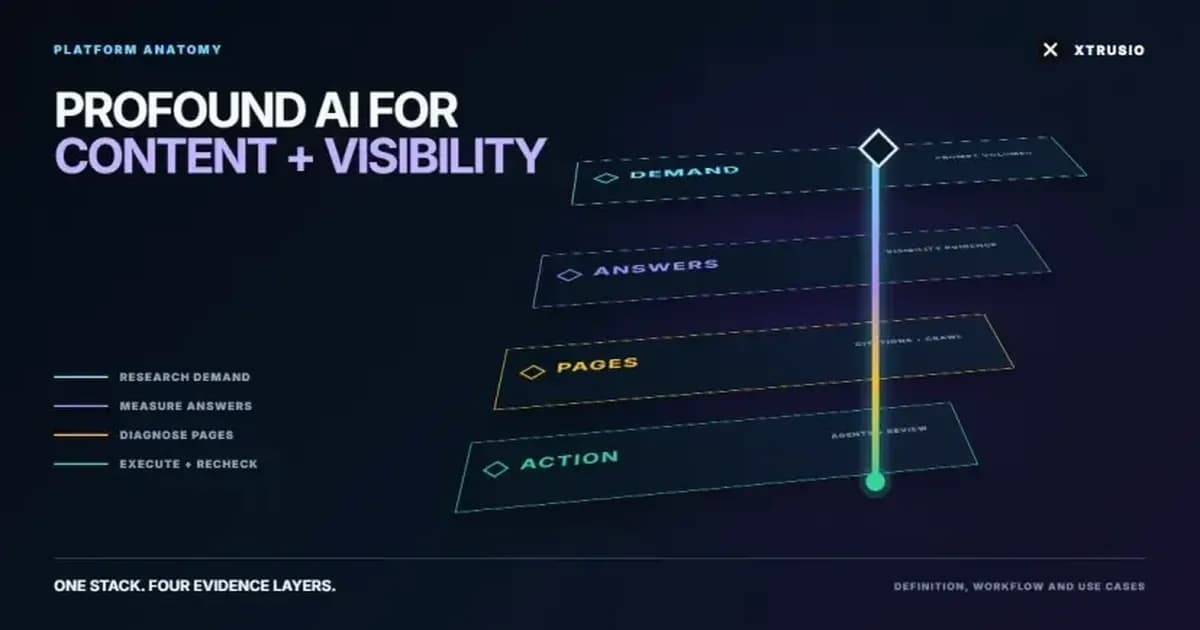
Profound groups its product into a few parts. Each does a different job.
Answer Engine Insights. This is the reporting core. It saves the answers AI engines give to the prompts you track and measures how often your brand appears, how it is described and which pages are cited. Profound defines its Visibility Score as the answers that mention your brand divided by the answers that mention at least one brand. Share of voice uses a different base: your mentions against all brand mentions in the same answers. Neither number is market share or revenue.
Prompt Volumes. A research tool for estimating what people ask AI about a topic. Profound says it draws on more than a billion AI conversations. Treat it as the vendor's sample, not a count of every conversation.
Agent Analytics and Pages. With server logs connected, Profound shows which AI crawlers visit your site and which visits AI answers send you. Pages brings citation and page health data together for the pages you own.
Agents. Reusable workflows that can read Profound data, write briefs and drafts, send them for review and publish through connected tools. Profound's WordPress integration supports creating, updating and publishing posts. Agents use AI Marketer credits.
Who is Profound built for?
Profound's custom Enterprise plan suits large companies that already have the people to run it. Someone has to choose the prompts, read the reports, decide what to change, set up and maintain the Agents, check every product fact in a draft and approve what goes live.
If your company has an analytics team and an in-house content team with that time, Profound gives them a wide set of reports to work from.
Many teams do not. They have one marketer, or a small team already stretched across channels. For them the hard part is not seeing the gap in AI answers. It is writing the right page, getting it placed where AI engines look and knowing whether it worked.
Xtrusio: the work done and the citation proven
Xtrusio is our product. It is built for teams that want AI engines to cite them, not only a report that says they are missing.
It asks your buyers' real questions. Xtrusio asks ChatGPT, Claude, Gemini, Perplexity, Grok, Google AI Overviews and Google AI Mode the questions your buyers ask before they buy. It keeps every full answer, every brand each answer names and every page it cites. Reports show visibility, share of voice, sentiment, average position and citations, broken down by engine, topic and buyer persona.
It plans from what AI actually searches. In Xtrusio's checks, ChatGPT and Claude search the web on every answer; Gemini and Grok decide when to search. Xtrusio records the searches ChatGPT, Claude, Gemini and Grok run, then drafts a content plan for each buyer question from those searches and the sites the engines cite. You approve the plan before anything is written.
It covers the places AI quotes. AI answers rarely cite only your website. They quote blogs, LinkedIn, Medium, Reddit, YouTube, guest posts and press coverage. Each plan picks the right channel for each piece. Xtrusio writes and scores the articles, checks every link before approval and publishes to your blog where it is connected. From each article it drafts LinkedIn posts, YouTube scripts, Medium essays and press releases.
It tracks every placement to a live URL. Link Strategy follows each guest post, PR placement and published piece through to its live address and shows whether an engine cites the live URL for the question it targets.
It counts a win only when you are cited. A page counts as a win only when an engine's answer to the question it targets cites that exact URL in a later scan. You see the before and after on the same question.
It protects what you already rank for. Xtrusio connects to Google Search Console and flags pages that are losing position, demand or freshness, with the reason in plain words.
You can start on the free self-serve plan, or have our team run the work as a managed service with a free trial, then tiered plans (details on request).
For a side-by-side view, read Xtrusio vs Profound.
The other tools in the table
Peec AI suits an in-house team that wants daily tracking at a fair price and will act on the data itself. Plans start at $95 a month for 50 prompts on three models you pick.
Otterly.AI is the lowest-priced paid option to see where you stand, from $29 a month for 15 prompts. Claude, Gemini and Google AI Mode are paid add-ons.
Semrush AI Visibility suits teams that already work in Semrush and want AI mentions next to their SEO data. The base plan is $99 a month per domain, billed annually, for 25 prompts.
Ahrefs Brand Radar suits teams that already pay for Ahrefs. Paid plans include a monthly allowance of custom prompt checks, starting at 150 on Lite, so the extra cost to begin can be zero.
For the full list, including Scrunch, AthenaHQ and SE Ranking, see our Profound alternatives guide.
How will you know it worked?
A visibility score going up is not the same as being cited. Before you sign with any tool, run this test on your own buyer questions:
- Pick 10 questions your buyers really ask an AI engine.
- Save the full answers and the pages each engine cites today.
- Agree who writes or fixes the page that should have been cited, and where it will be published.
- After it goes live, ask the same questions again and check whether the engine now cites that exact URL.
If a tool only covers the first two steps, you are buying a report and your team does the rest. Xtrusio is built around all four.
See how Xtrusio works and start with your own buyer questions.
Frequently asked questions
What is Profound AI used for?
Profound is used by enterprise marketing teams to see how AI engines mention and cite their brand, to research what people ask AI about a topic, and to run Agents that draft and publish content through connected tools such as WordPress.
Can Profound create and publish content?
Yes. Profound's Agents can write briefs and drafts, route them for review and publish through connected tools, including WordPress. Your team sets up the Agents, checks the facts and approves what goes live.
How much does Profound cost?
Profound offers a free 7-day trial with 50 preset prompts on ChatGPT, Gemini and Google AI Overviews. The self-serve Agency Growth plan includes 400 AI Marketer credits per month per client workspace. Enterprise plans are custom priced and cover up to nine answer engines; the public pricing page lists no Enterprise dollar price.
What is the difference between Profound and Xtrusio?
Profound gives enterprise teams analytics and automation to run themselves. Xtrusio plans the content from the questions buyers ask and the searches AI runs, gets it published on the channels AI quotes, and counts a win only when an engine cites that exact page.
Can any tool guarantee a citation in ChatGPT?
No. The engine decides what to cite. What you can do is publish the pages and win the placements the engine trusts, then check whether it cites them on the same question.
Topics
- what is Profound AI
- Profound AI visibility
- Profound content creation
- Profound Answer Engine Insights
- Profound Agents

Xtrusio
AI visibility research
Xtrusio is the Perception Engine for B2B brands.
Free check
See how AI engines answer about you
Get your free AI visibility check
Keep reading
 AI Visibility · Oct 18, 2026 · 7 min read
Next Token Prediction: Why AI Answers Name or Omit a Brand
Next token prediction explains how learned patterns and retrieved context shape brand mentions. Use an anonymized scan example to choose the next action. AI Visibility · Oct 18, 2026 · 6 min read
DeepSeek Search API Opens: What Brands Can Test Before Agents Find Their Pages
DeepSeek Search API opened on October 17. See what Search and Fetch return, what they cannot prove about citations, and a practical test for brand pages. AI Visibility · Oct 18, 2026 · 9 min read