How to Rank on ChatGPT: What Actually Helps Brands Get Mentioned
Short answer
Use a buyer-question worksheet to turn “how do we rank in ChatGPT?” into a specific correction. Start with one requirement your product meets, save the answer and cited sources, and record the fact to verify, page to update and person responsible. The worksheet below shows that process for a small CRM vendor; it is a hypothetical example, not a customer result.
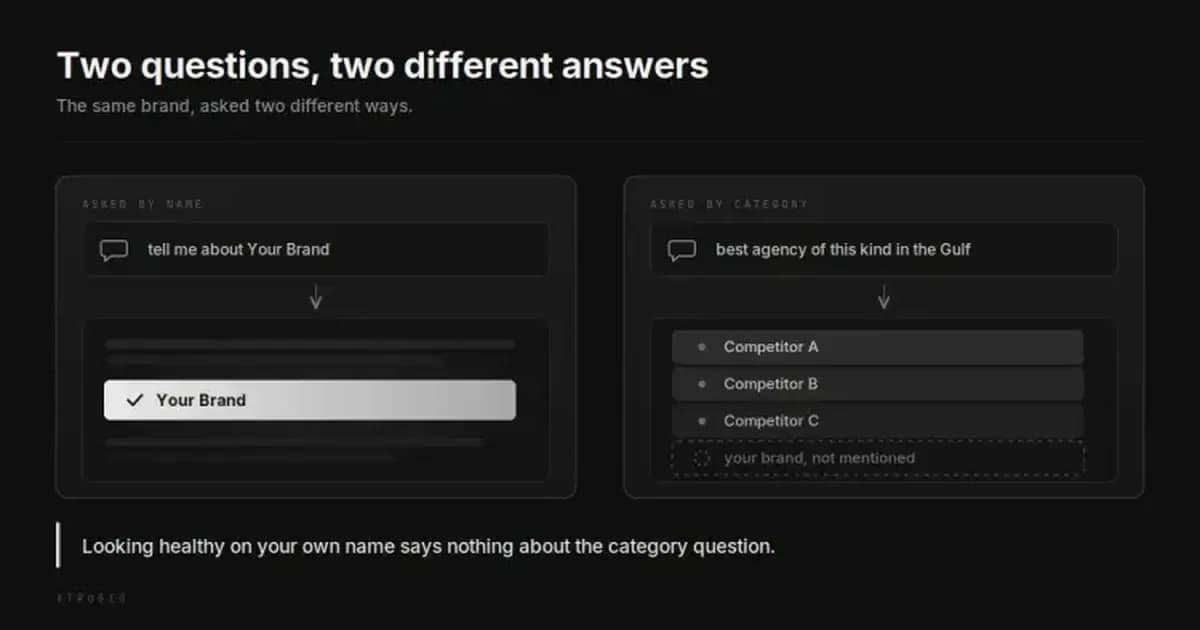
Start with a question your product genuinely answers. If someone asks for a feature you do not offer, more content will not make your product the right recommendation. If you do offer it but the evidence is missing or unclear, you have a specific problem to investigate.
Step | What to do | Useful output |
|---|---|---|
Choose the buyer question | Use a real requirement from sales or support, not only your brand name | Exact question and product-fit decision |
Read the current answer | Inspect the description and the particular sources supporting it | Saved answer, date and cited URLs |
Check access | Have your web team review access to the relevant public page | A verified access result or a specific issue to fix |
Improve the evidence | Add missing facts, authentic proof and clear limitations | A useful revised page with a named owner |
Check again | Repeat comparable questions and read what changed | A dated observation, not a ranking promise |
What does it mean to rank in ChatGPT?
A brand can be named, recommended for a particular need, or linked as a source. Those are different outcomes. An answer might cite your article while recommending another company. It might mention your product only to explain why it does not meet the buyer's requirement.
The order in a generated shortlist can be recorded, but it belongs to that answer under those conditions. Treat it as an observation, not a permanent search position. The more useful question is whether ChatGPT describes your product accurately and considers it for buyers it can actually serve.
OpenAI's search guidance explains that Search can use current web information and may rewrite a prompt into targeted searches. The illustration below shows a possible rewrite, not the hidden searches from an actual customer conversation.
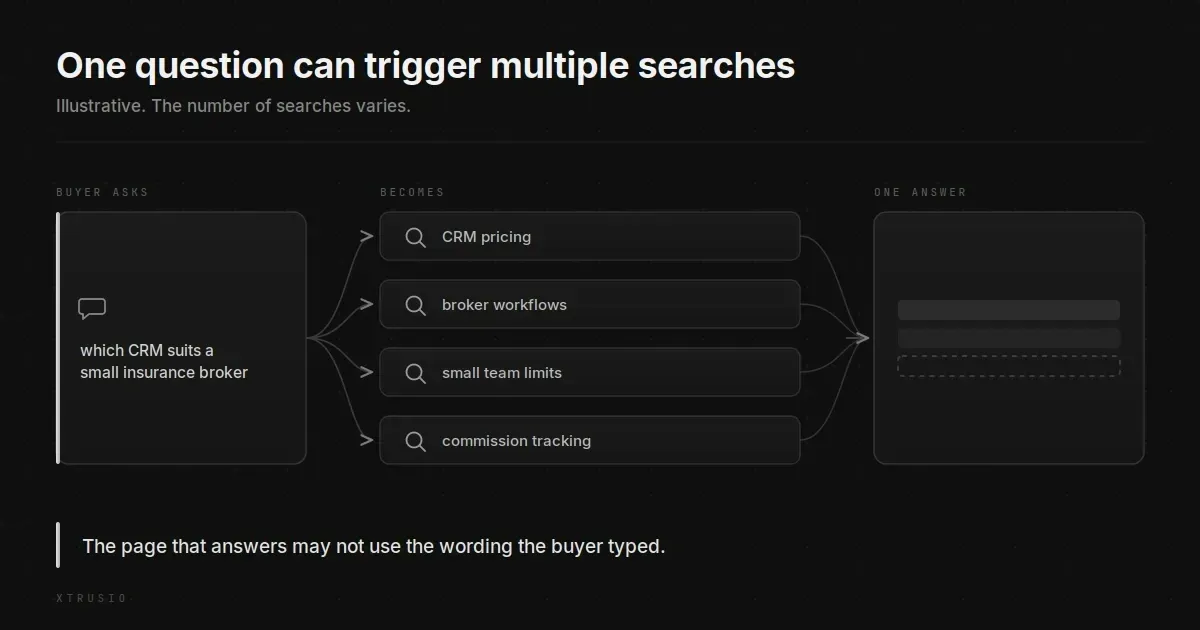
For a CRM buyer, team size, supported integrations and setup requirements can each need an explanation. That is a reason to make your product facts easy to find. It does not establish that every question follows the illustrated path or that matching those phrases guarantees selection.
Inspect the question, answer and source before changing a page
Keep the question precise enough to represent a buying decision. “What is a CRM?” and “Which CRM supports a small service team using Microsoft 365?” test different needs. A strong answer to your own brand-name question does not tell you how often you enter an unbranded shortlist.
These native ChatGPT captures show a September 24, 2026 question about rank-tracking tools, evidence access and content work. The question explicitly excludes prices. They are an example of the evidence to retain, not a test of the CRM scenario above.
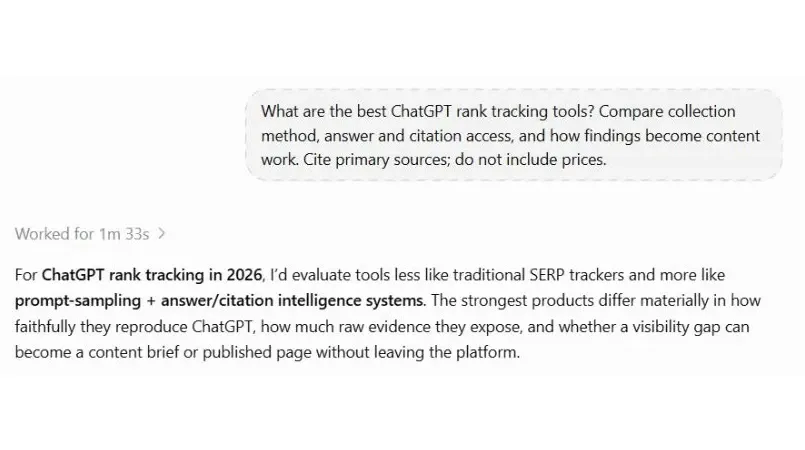
The answer can now be judged against what was actually asked. A tool omitted from this comparison is not necessarily absent from every related question. Preserve the full response as well as the input when recording your own test.
The second capture preserves an answer excerpt and its Ahrefs citation chip. Follow the source attached to the relevant claim and check its wording and date. The generated product statements are historical output, not a current feature endorsement. The model and geography were not recorded for this example.
Xtrusio's saved question and engine records help retain this kind of evidence for later review. The example below is from a different historical question and report. It shows why the exact cited URL matters when assessing source coverage.
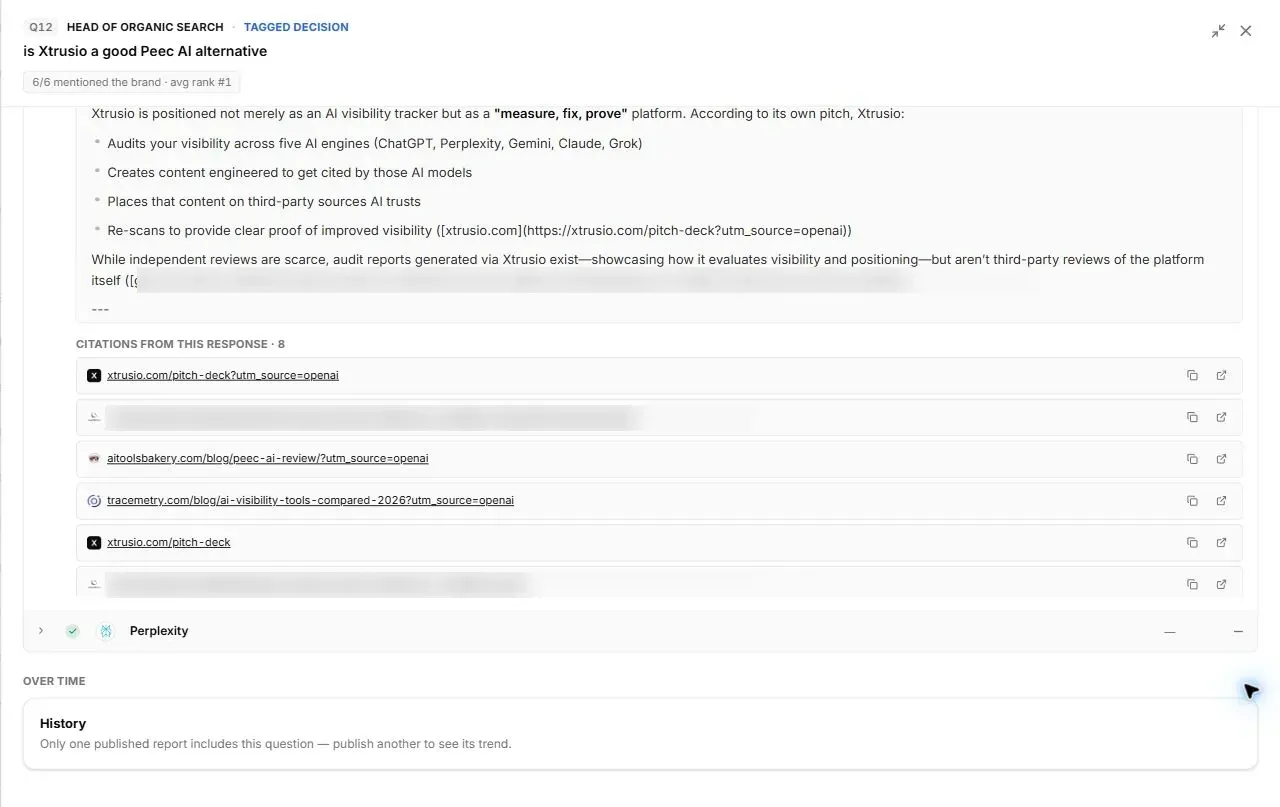
Two entries refer to variants of the public Xtrusio pitch-deck URL. Count distinct pages carefully rather than treating every URL entry as independent corroboration. The history area shows one published report, so this capture does not demonstrate a trend or an improvement. Private client paths are blurred.
Check search access without confusing it with training permission
OpenAI's crawler documentation separates three roles:
Agent | Role | Decision for your web team |
|---|---|---|
OAI-SearchBot | Surfaces pages in ChatGPT Search | Review robots.txt and access from OpenAI's published IP ranges |
GPTBot | Collects material that may be used for model training | Set training preferences separately from search access |
ChatGPT-User | Makes certain user-initiated visits | Do not use it as the control for Search inclusion |
OpenAI says sites opted out of OAI-SearchBot are excluded from search answers, although navigational links can still appear. Its approximate 24-hour adjustment period for robots.txt changes is not a promise of a brand mention within a day.
Ask your web team to inspect the particular public page you want available. A login wall, failed request or missing visible product information needs a specific diagnosis. Do not weaken site-wide security or expose private documents in pursuit of visibility. The useful result is evidence that the intended public content can be reached.
Access is a prerequisite to investigate, not proof that the page deserves to be selected. Once it is reachable, move to the buyer's actual information need.
What should you change in the content?
Improve the page that should answer the requirement before commissioning another broad blog. Explain what the product does, who can use the feature, what setup involves and where the limits are. Use a genuine screen, documented example or reproducible test when it makes the explanation easier to verify.
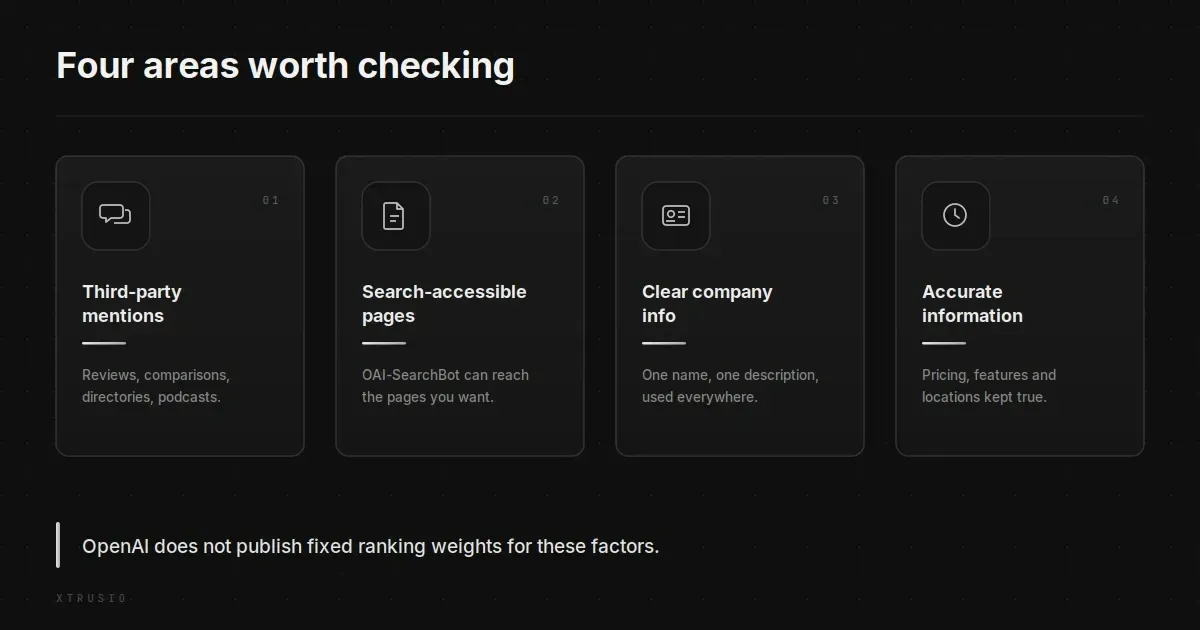
The four areas in this illustration are a practical review list. They are not a published set of ChatGPT ranking factors with known weights.
Here is a hypothetical claim-to-source worksheet for a small CRM vendor. It shows how an unclear buying answer becomes an editing assignment. It is not an Xtrusio customer result.
- Buyer question: Which CRM supports a five-person service team using Microsoft 365?
- Observed uncertainty: The answer names other products. Our page says “email integration” without naming the supported service or plan.
- Fact to verify: Does Microsoft 365 support exist? Which plan includes it, what permissions are needed, and what does not sync?
- Evidence to publish if confirmed: Setup steps, an authentic product screen, supported data and explicit limitations, checked by the product specialist.
- Page and owner: Update the relevant integration page. Product marketing owns the explanation; the product specialist verifies it.
- Later acceptance check: Read a comparable answer for an accurate account of support. Record whether the revised page is cited, separately from whether the brand is recommended.
There are three possible outcomes before you write. If the feature exists but the page omits it, improve the explanation. If the feature does not exist, state the limitation and choose a better-fit question. If an external page contains an outdated claim, document the correction and ask its publisher to review it. These are different jobs with different owners.
Put the direct answer near the relevant heading. Keep qualifications close to the claim they limit. A sentence saying “Microsoft 365 is supported” is less useful than an explanation of what is supported, for whom and under what conditions. Avoid padding the page with unrelated questions just to increase its length.
Do third-party mentions and authority matter?
Outside sources can provide information about your company that your own website does not. Inspect the sources appearing in relevant answers: what specific claim do they support, and is that claim accurate? A well-known publisher's name alone does not tell you whether its page addresses your buyer's question.
Ahrefs' research on ChatGPT mentions examines associations between brand visibility and signals across the web. Treat those findings as evidence for investigation, not a recipe that proves one extra mention or backlink will cause a recommendation.
Useful work can include correcting an inaccurate directory entry, making a documented customer implementation available with permission, or offering an original finding to an appropriate publication. Keep controlled company profiles consistent where the facts should agree. Do not try to manufacture consensus through fake reviews or undisclosed self-promotion.
If you pay for distribution or placement, record that fact. A paid page is not automatically independent editorial validation, and publication does not prove that ChatGPT has used it. Follow the delivered URL into later evidence before calling the work successful.
This distinction also applies to advertising. OpenAI's February 2026 release note separates sponsored material from organic answers and says answers are generated independently of ads. Buying an ad is a different activity from earning a recommendation in the answer.
How can you tell whether your work helped?
Keep a manageable set of real buyer questions. Record wording, date, interface, available model and mode, market, relevant settings, full answer and cited URLs. A missing response is an unknown, not evidence that the brand was excluded.
Memory and location can influence Search, according to OpenAI's guidance above. Record those conditions and keep them comparable. A fresh conversation is useful for limiting conversation history, but it does not make a sample representative of every buyer.
The following illustration shows the idea of repeated sampling across assistants. Its counts are illustrative, not measured customer results. For this article's ChatGPT question, keep the ChatGPT series separate rather than averaging different assistants into one apparent rank.
For a simple hypothetical example, 12 buyer questions checked twice create 24 planned observations. If two collections fail, there are 22 completed answers. A brand named in seven has an observed mention rate of 7/22, or 31.8%. If only three recommend it for the requirement, the recommendation rate is 3/22, or 13.6%. Keep both denominators visible.
When comparing the next check, use the same completed question-and-check pairs where possible. Do not celebrate a higher percentage if difficult questions failed or the question set changed. Read the changed answers: did they become accurate, cite your revised page, recommend a suitable product, or merely repeat its name?
Retain the page edit and date alongside the observation. A later improvement is consistent with progress, but it does not isolate your edit as the cause. Other sources, product changes and the answering system may also have changed. Relevant visits and inquiries are another measure; a mention alone is not revenue attribution.
There is no universal time-to-mention promise. Set a review cadence appropriate to how quickly your product facts and buying questions change. Judge the work by completed corrections and comparable evidence, not by a guaranteed number of days or articles.
Start with one buyer question and one verifiable correction
Choose a requirement your product meets, preserve the current answer, and inspect the exact source behind any questionable claim. Confirm the fact with the product owner. Improve the appropriate page or request the relevant external correction, then retain a later comparable observation.
That gives your team a concrete decision: continue the work, revise the explanation, investigate another source or acknowledge a genuine product limitation. For help applying it to your own questions, ask Xtrusio for a scoped free evaluation. Agree on the questions and evidence to review before deciding whether broader monitoring or delivery work is worthwhile.
Frequently asked questions
Can I pay to rank on ChatGPT?
Not for placement in organic answers, as things stand. OpenAI has been building out shopping and advertising surfaces, so paid formats exist and are growing. They sit apart from the answer itself. If someone promises you a guaranteed slot in ChatGPT's organic answers, they can't deliver it. Verify the current advertising options directly with OpenAI, since this area is moving fast.
How long does it take to show up?
There is no reliable universal timeline. Technical changes that affect whether ChatGPT Search can reach a page may be picked up sooner. Broader brand visibility takes longer, because new content and third-party coverage first have to exist and then be found. Instead of waiting for a fixed number of weeks, repeat the same buyer questions over time and watch whether your visibility is improving.
Does traditional SEO still help me rank on ChatGPT?
Yes. Crawlability, useful content, clear site structure and authoritative links can still help because ChatGPT Search needs useful web pages to retrieve. The difference is that AI visibility is not measured only by where one page ranks. You also need to watch whether your brand is mentioned, cited and described accurately in relevant answers.
Why does ChatGPT name my competitor and not me?
There can be several reasons. Your pages may be difficult to access. Your content may not answer the buyer's question clearly. Or your competitor may simply have stronger and more consistent coverage across third-party sources. Check each one before assuming a single ranking factor is responsible.
Do I need different content for ChatGPT, Gemini, and Claude?
Usually, you do not need three separate versions of the same page. Clear, useful and accessible content can work across multiple AI systems. But each platform retrieves and uses information differently, which is why the same brand can appear in one assistant and be missing from another.
Topics
- rank on ChatGPT
- ChatGPT ranking
- AI visibility
- answer engine optimisation
- generative engine optimisation

Xtrusio
AI visibility research
Xtrusio is the Perception Engine for B2B brands.
Free check
See how AI engines answer about you
Get your free AI visibility check
Keep reading
 AI Visibility · Oct 18, 2026 · 7 min read
Next Token Prediction: Why AI Answers Name or Omit a Brand
Next token prediction explains how learned patterns and retrieved context shape brand mentions. Use an anonymized scan example to choose the next action. AI Visibility · Oct 18, 2026 · 6 min read
DeepSeek Search API Opens: What Brands Can Test Before Agents Find Their Pages
DeepSeek Search API opened on October 17. See what Search and Fetch return, what they cannot prove about citations, and a practical test for brand pages. AI Visibility · Oct 18, 2026 · 9 min read