Bing Copilot and Microsoft AI in 2026: 30M Copilot Seats, a $37B AI Business, and What It Means for Brand Visibility
Short answer
Microsoft closed its 2026 fiscal year with some of the strongest AI numbers in its history. Most reports read those numbers for investors. I read them for marketers. The real question is simpler: what changes for your brand when AI stops being one app and starts shaping how buyers search and decide?
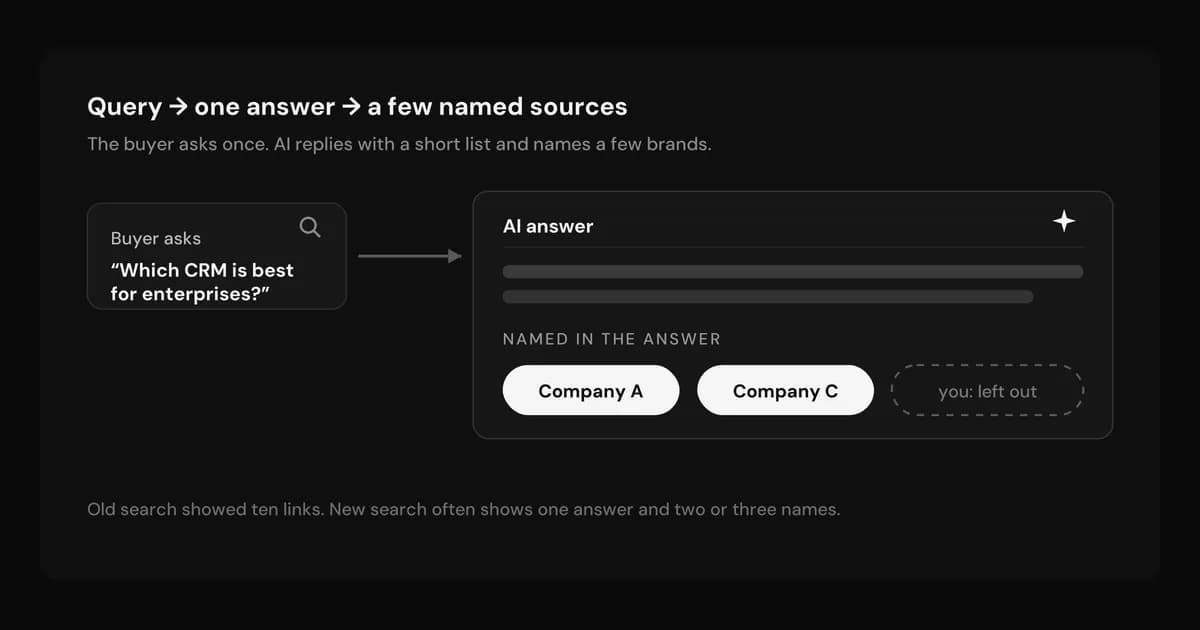
AI now sits inside Microsoft's cloud, its apps, and its search. For brands, the shift is simple. Bing and Copilot answer buyers directly, so you need to be seen inside those answers, not just ranked in a list of links.
Microsoft AI in 2026: Scale and Why It Matters
Microsoft's 2026 results are not a rounding error. AI is now growing fast and reaching enough of its customers to count as a core business, not an experiment. For marketers, that scale is what matters: it shapes how many buyers will meet your brand through an AI answer rather than a page of search links.
Here are the headline figures from Microsoft's own results, so you can see the scale in one place.
Microsoft 2026 metric | Reported figure |
|---|---|
Full-year FY26 revenue | $331.8 billion, up 18% |
FY26 Q4 revenue | $90.0 billion, up 18% |
Microsoft Cloud (Q4) | $59.3 billion, up 27% |
Azure annual revenue | More than $100 billion (first time) |
AI business run-rate | More than $37 billion (FY26 Q3) |
Microsoft 365 Copilot seats | More than 30 million paid |
Microsoft Foundry customers | 100,000 |
Agents on Agent 365 | Nearly 40 million |
Sources: Microsoft FY26 Q4 results and FY26 Q3 results. Run-rate means the yearly pace at the current level, not money already booked.
The AI run-rate is the number to sit with. Microsoft said its AI business passed a $37 billion yearly pace, up 123%, in its third quarter. A business that doubles at that size is not a trial. It is a platform.
Microsoft is not just adding a chatbot. It is wiring AI into its cloud, its Office apps, its developer tools, and its search. When a vendor this large makes AI the default way people work and search, the way buyers find brands changes too. That reaches marketing, not only IT budgets.
Think of it as one connected loop. Azure gives the compute. Foundry gives the models and data. Copilot brings AI into daily work. Agents handle multi-step tasks. And Web IQ and Copilot Search in Bing connect all of that to public and company information.
Microsoft says more than 90% of Fortune 500 companies use Microsoft 365 Copilot. That does not mean every worker has a paid seat. But it does mean AI is now inside the tools where big buyers read, write, and decide. The question is no longer whether firms want AI. It is where AI earns its place.
How is Bing search changing?
Microsoft now calls Bing an AI-powered answer engine. Copilot Search in Bing gives a written answer with cited sources on top, instead of only a list of links. So buyers can get one summary rather than ten pages. Your brand either shows up inside that summary or it does not.
The old path was simple: type a keyword, scan ten links, click a few. The new path folds those steps into one. The engine reads many sources, writes a short answer, and shows a few links that back it up. For brands, this adds a new question on top of ranking: does Microsoft's AI understand my content well enough to use it, or cite it, when it writes an answer?
That is a different job from climbing to position one. You are trying to be one of the trusted sources the model pulls from, not just a blue link waiting for a click.
What is Web IQ, and why should brands care?
Web IQ is a search system Microsoft built for AI assistants, shown at Build 2026. It feeds them fresh web facts and hands back short passages, or small chunks of text, instead of whole pages. Microsoft says it already helps power assistants including Copilot and ChatGPT. So it links plain search to how AI answers get built.
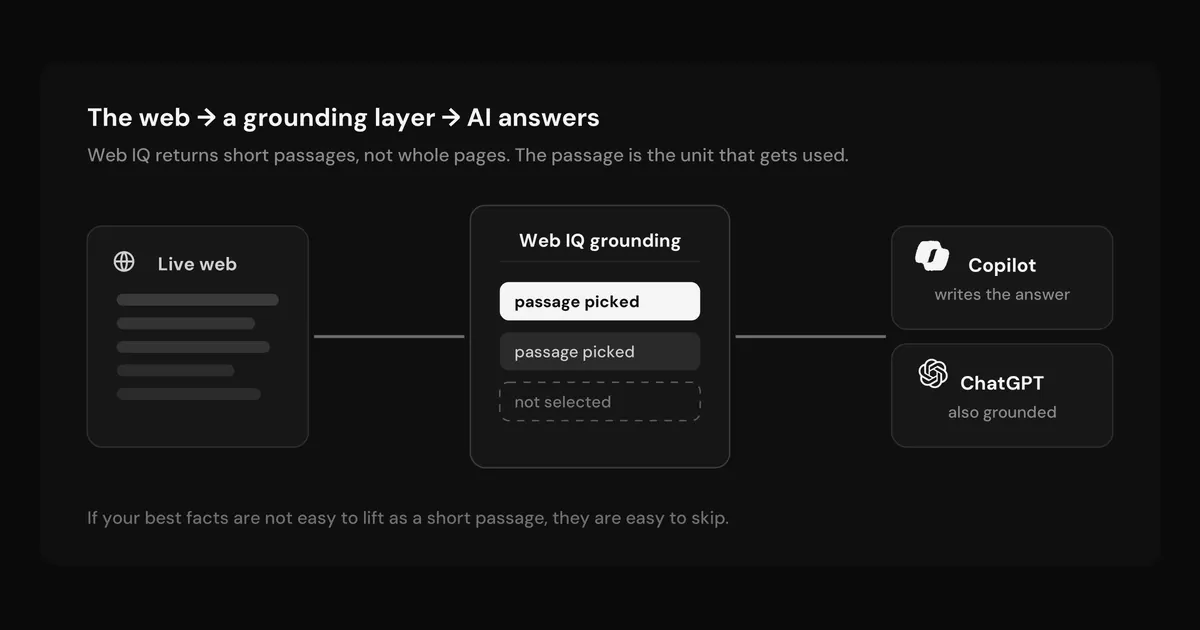
Two details matter for content teams. First, a single grounding layer can shape answers in more than one assistant at once, so one clear passage can help you in several places. Second, Web IQ returns passages, not whole pages. That rewards content where each section answers its own point in a few clean lines.
How to Measure AI Visibility and Citations
Microsoft made this measurable in 2026. It put citation reporting free inside Microsoft Clarity, which shows when AI finds and cites your pages, plus a share-of-authority score. Microsoft says this data comes from its grounding infrastructure across supported Microsoft and partner AI experiences, so it is a strong signal, not a universal log of every citation on every AI platform.
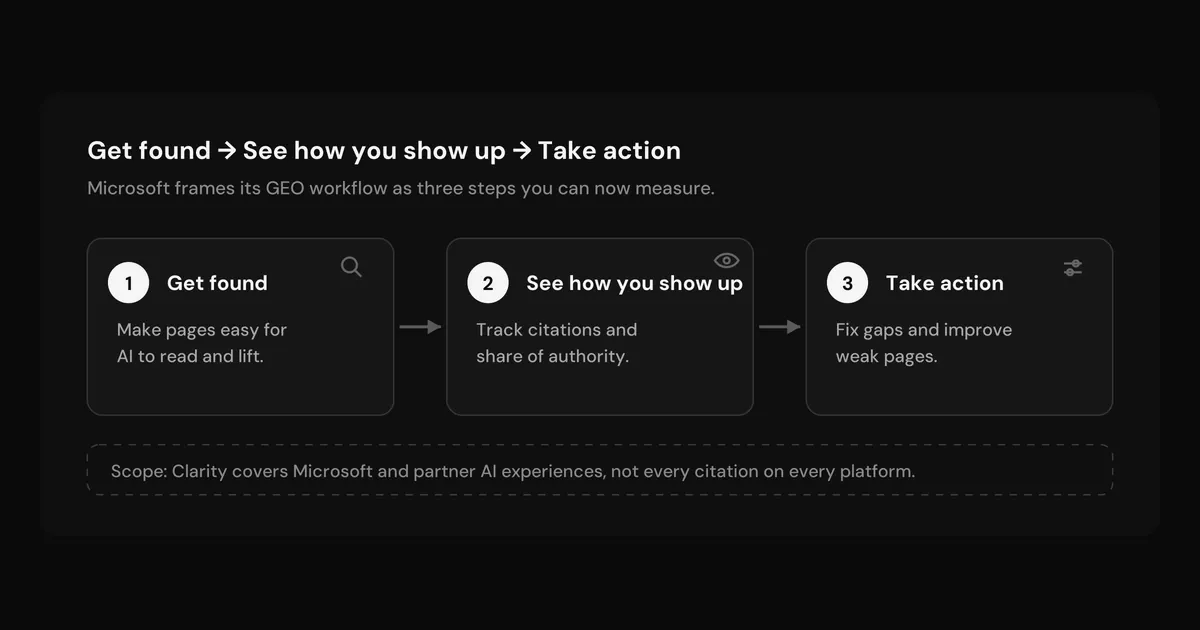
This is a real shift. GEO, or generative engine optimization, means getting your brand named and cited in AI answers. It is moving from a fringe idea into mainstream tools you can measure. Just read the numbers with care. Because no platform offers a single cross-engine citation standard, Clarity is a useful signal rather than a full map of where you appear, so cross-engine testing still fills the gap.
Old SEO metrics still help, but AI answers need a few more. Track how often you are named, how often your pages are cited, how you compare with rivals, and which buyer questions include or skip you. The goal is not a vanity score. It is knowing whether you are part of the answer buyers see.
Metric | What it tells you |
|---|---|
AI mention rate | How often you appear in relevant AI answers |
Citation rate | How often your own pages are cited as sources |
Share of authority | Your slice of citations versus rivals on the same questions |
Query-level gaps | Which buyer questions include or skip your brand |
AI referral traffic | Visits and leads that AI answers actually send you |
A short, practical set. Start with mention rate and query-level gaps; they point straight to the pages worth fixing.
How do you show up in Microsoft's AI answers?
There is no secret tag that forces AI to name you. What works is plainer. Make key pages easy to reach and read. Answer the real question in the first lines. Back claims with proof. Make your brand and category clear. And keep facts fresh. Do those five well and you give AI a reason to use you.
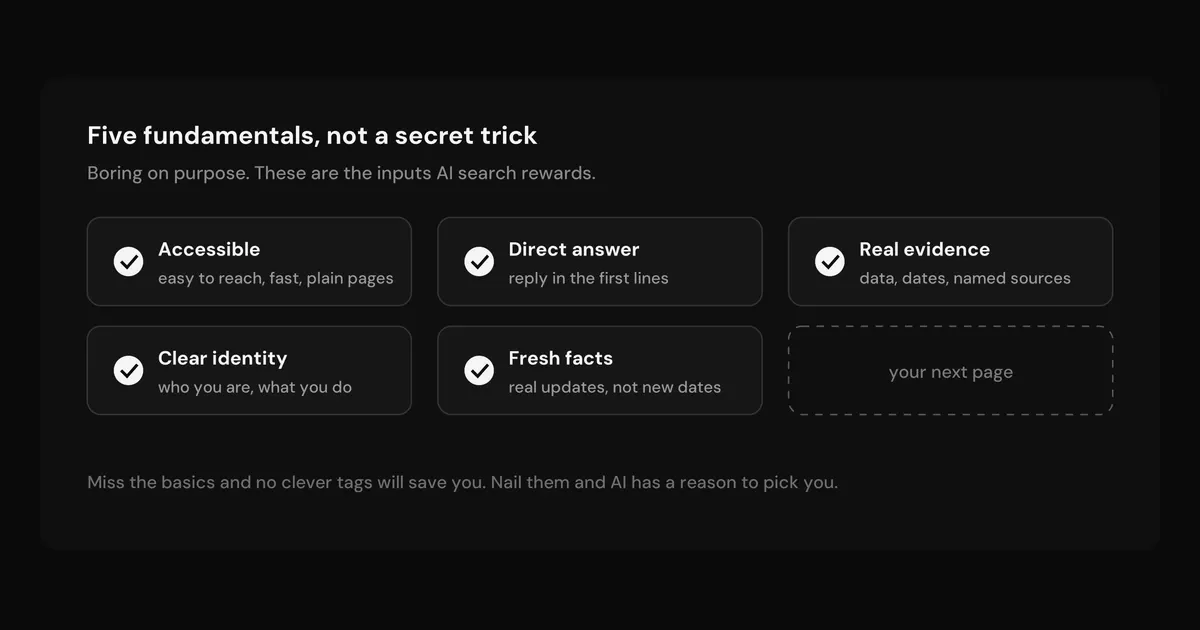
One idea sits above the rest: bring something new. AI adds little value by repeating what a hundred sites already say. A page earns its place when it brings something new. That could be your own data, a real client result, a clear cost model, or a framework built from real work. If you build content at scale, fold this into your programmatic SEO plan rather than bolting it on later.
Your own site is not the only place AI meets your brand. It also reads reviews, industry write-ups, and independent comparisons. This is where GEO, digital PR, and B2B lead generation meet. The aim is not to fake a wall of mentions. It is to build enough real, checkable proof around you that your standing holds up away from your own site.
Does traditional SEO still matter?
Yes. It would be wrong to call SEO dead. Microsoft's own search advertising revenue, excluding traffic costs, still grew 10% in its fourth quarter. The interface is changing, but AI answers still pull from accessible, relevant, trusted web pages. GEO extends that foundation. It does not throw it away.
Worth remembering. AI answers do not appear from nowhere. They are built from web pages the engine can reach and trust. So the classic work is still the base: clean structure, good internal links, and fast pages. GEO adds a layer on top; it does not replace the floor.
Microsoft even now defines GEO as its own discipline, separate from SEO but built on the same web foundation. Treat them as one stack, not rivals.
What should C-level leaders do next?
Four moves. Judge AI by workflow value, not seat count. Prepare your data so agents can use it safely. Treat AI search as a real discovery channel and measure it. And tie AI visibility to business outcomes, because a citation is not revenue on its own. Presence is the start of the funnel, not the end.
The last point is the one teams get wrong. It is easy to celebrate a rising mention rate and stop there. But the chain that matters runs further: AI visibility leads to brand consideration, then a qualified visit, then a lead, then an opportunity, then revenue.
The honest caveat. A citation is not a sale. If your mention rate doubles but leads stay flat, you have visibility without value. That is a signal to fix your pages and offers, not just your rankings. Measure presence and outcomes together, or the presence number will quietly mislead you.
For Gulf leaders, this is a fair time to act rather than wait. Adoption is early and buyer habits are still forming. The cost of being the clear, well-proven source in your category is lower now than it will be once every rival catches up. I have not seen this measured for the region yet, so treat it as a view to test, not a promise.
See where you stand in AI answers
Microsoft's tools give a useful signal, but not a complete view across every AI engine. To see how you show up across the major AI answer engines, including ChatGPT, Gemini, Claude, Perplexity and Grok, and where rivals are named instead of you, Xtrusio tracks your AI visibility and flags the gaps worth fixing first. Check your AI visibility with Xtrusio.
Frequently asked questions
Does Microsoft Clarity measure my visibility in ChatGPT and Gemini?
Not fully. Clarity shows citation data from Microsoft's grounding infrastructure across supported Microsoft and partner AI experiences. It is a useful signal, not a universal direct log of every citation across every AI platform. Because there is no single cross-platform citation standard, prompt testing across engines is still useful for the fuller picture.
What is Microsoft Web IQ?
Web IQ is Microsoft's AI-native search infrastructure for agents, announced at Build 2026. It grounds AI assistants in fresh web information and returns short passages rather than whole pages. Microsoft says it already helps power assistants including Copilot and ChatGPT, which links traditional search infrastructure to how AI answers get built.
Is traditional SEO dead now that Bing answers with AI?
No. Microsoft's search ad revenue still grew 10% year over year in its fourth quarter of fiscal 2026, so the older channel has not collapsed. AI answers are assembled from web pages an engine can crawl and trust, which means solid SEO is the base that GEO builds on, not something it replaces.
How many people use Microsoft 365 Copilot?
Microsoft reported more than 30 million paid Microsoft 365 Copilot seats at the end of fiscal 2026, up from about 20 million in April and roughly 15 million in January. Microsoft also states that more than 90% of Fortune 500 companies use Microsoft 365 Copilot, though that does not mean every employee has a paid seat.
Topics
- Bing Copilot
- Microsoft AI 2026
- AI visibility
- Web IQ
- generative engine optimization

Xtrusio
AI visibility research
Xtrusio is the Perception Engine for B2B brands.
Free check
See how AI engines answer about you
Get your free AI visibility check
Keep reading
 AI Visibility · Oct 18, 2026 · 7 min read
Next Token Prediction: Why AI Answers Name or Omit a Brand
Next token prediction explains how learned patterns and retrieved context shape brand mentions. Use an anonymized scan example to choose the next action. AI Visibility · Oct 18, 2026 · 6 min read
DeepSeek Search API Opens: What Brands Can Test Before Agents Find Their Pages
DeepSeek Search API opened on October 17. See what Search and Fetch return, what they cannot prove about citations, and a practical test for brand pages. AI Visibility · Oct 18, 2026 · 9 min read