Meta Muse Wonder: What the New Agent Models Mean for Business Teams
Short answer
Meta Muse Wonder is a new model family for long-running agent tasks, coding and computer use. Meta introduced Muse Wonder and Muse Wonder Full on October 12, 2026. Muse Wonder is available through the Meta Model API and Muse Code; Full is available through Muse Code subscriptions. Both list a one-million-token context window. For a business team, the practical question is not whether Meta has won an AI race. It is what an agent with memory, tools and permission to act can do inside a real workflow, and which controls a buyer should check before adopting it.
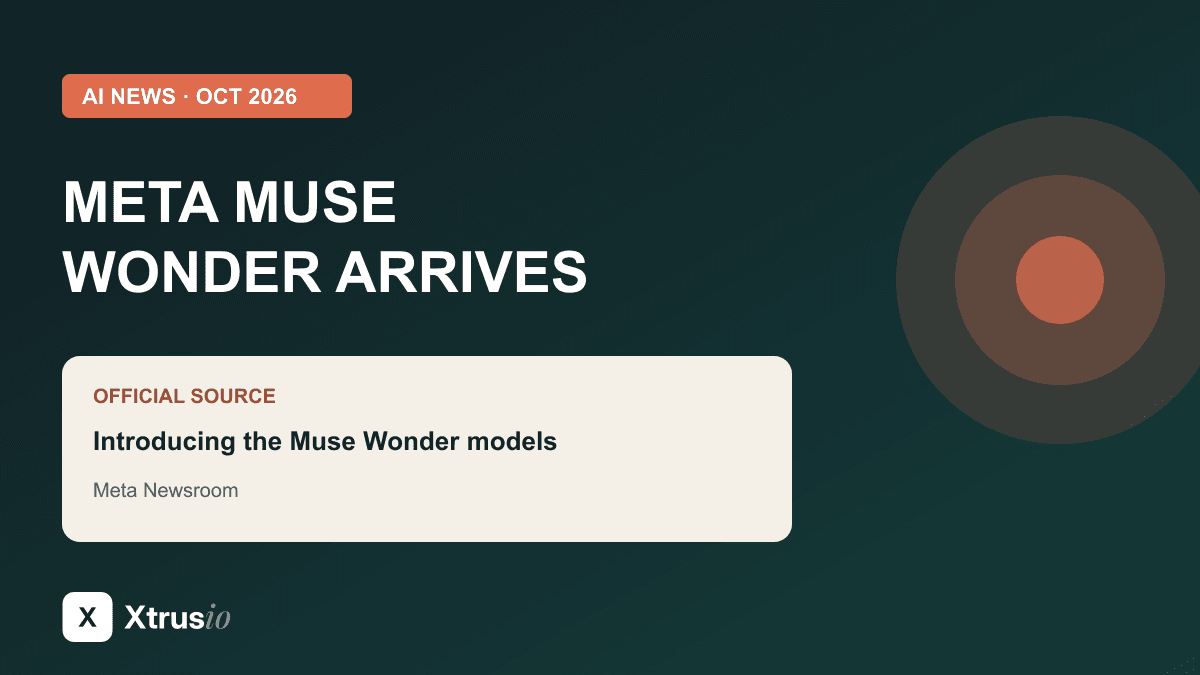
Meta's announcement says the models can work through tasks such as understanding a lease, navigating an insurance claim or building an app. Its developer page describes planning long tasks, delegating parts to agents, parallel tool use, error recovery and operation of browsers and apps. These are Meta's product descriptions, not independent proof that every task succeeds.
What is Muse Wonder, and who can use it?
Muse Wonder is the model offered through the Meta Model API and Muse Code. The developer page lists a one-million-token context window and, as of October 14, 2026, API rates of $4 per million input tokens, $0.20 per million cached-input tokens and $20 per million output tokens. Muse Wonder Full is available through Muse Code on its Power Usage and Maximum Usage subscription tiers; Meta does not list Full as a Model API option on that page.
Model | Access described by Meta | Context window |
|---|---|---|
Muse Wonder | Meta Model API and Muse Code | One million tokens |
Muse Wonder Full | Muse Code subscribers on Power Usage or Maximum Usage | One million tokens |
Meta says Muse Wonder will later power experiences in the Muse app, initially for subscribers. That future rollout is distinct from the developer access available now.
What do Active Memory and Active Focus do?
Meta describes Active Memory as carrying relevant details across conversations. Active Focus is its name for continuing a difficult task, trying another route after an error, asking for clarification and checking before an important action. The announcement uses insurance claims, leases and financial tasks as examples of work that unfolds over time.
That does not mean an organization should hand an agent broad access to messages, calendars, files and production systems at once. Meta itself notes that personal agents may work across private material, and says it trained the models to avoid sharing private information without permission. It says a fuller safety evaluation report is still forthcoming. A buyer should review that report when available rather than treating the launch post as a complete safety assessment.
What should a B2B team test first?
Start with one bounded job that has a clear result and a human owner. A team evaluating an agent for research could ask it to assemble a draft comparison from public vendor pages, then check every cited fact and link. A team evaluating computer use could give it a non-production environment and check which actions it proposes, executes or pauses for approval.
The useful questions are practical:
- Which files, apps and websites can the agent access?
- Which actions require human confirmation, and what happens after an error?
- Can a reviewer see the source and action history before relying on the answer?
- What happens to information carried across conversations?
- Does the full safety report support the particular workflow being proposed?
Meta's documentation says agents can use browsers, desktop and mobile apps. The scope of that access depends on how a developer or organization sets up the tools. A model capability alone is not an access policy.
What this means for AI search and brand visibility (our analysis)
More models that can research and act across sources give a brand another reason to keep its public product facts clear, dated and easy to verify. The launch does not prove that Muse Wonder is already a meaningful source of buyer referrals or that it will cite a particular company. Those are outcomes a business would need to measure, not infer from a model announcement.
The immediate content task is narrower: maintain pages that answer real buyer questions, name the product and its limits plainly, and make evidence reachable at stable URLs. If a team later finds those pages cited in an AI answer, it can connect the answer back to the exact page. Xtrusio shows how AI answers cite and describe a brand; it cannot promise that a new model will select it.
What is still unknown?
Meta has not yet published the additional safety evaluation report promised in its announcement. Muse app availability is a future rollout. The company shares benchmark claims on its developer page, but they should not be treated as a prediction for a buyer's own workflows. Before a paid deployment, test the intended task and the review process against the current access terms.
Sources: Meta's October 12 announcement and Muse Wonder developer page, read October 14, 2026.
Check how AI answers describe and cite your brand with Xtrusio.
Frequently asked questions
What is Meta Muse Wonder?
Muse Wonder is Meta's new model for long-running agent tasks, coding and computer use, available through the Meta Model API and Muse Code.
Is Muse Wonder Full available through the API?
Meta's developer page lists Wonder Full through Muse Code subscriptions, not the Model API.
How large is the context window?
Meta lists one million tokens for both Muse Wonder and Muse Wonder Full.
Can teams use it in the Muse app?
Meta says Muse Wonder will later power Muse app experiences, initially for subscribers.
Topics
- Meta Muse Wonder
- Muse Wonder AI model
- Muse Wonder Full

Xtrusio
AI visibility research
Xtrusio is the Perception Engine for B2B brands.
Free check
See how AI engines answer about you
Get your free AI visibility check
Keep reading
 AI Search · Oct 14, 2026 · 5 min read
OpenAI Recording Device Case: What the DOJ Alleges and What Buyers Should Ask
DOJ says an OpenAI recording device was found in a conference room. Read the allegation, timeline and security questions business buyers should ask. AI Search · Oct 14, 2026 · 5 min read
Anthropic: Claude Exploited a Server Flaw and Sent a Fake Police Tip in Tests
Anthropic's Claude used a server flaw and submitted a fake police tip in tests. What happened, how much harm occurred, and what changed. AI Search · Sep 3, 2026 · 8 min read