What Is the Best AI Search Engine? A Practical, Evidence-Led Comparison
Short answer
Pick the service by the fact you need to verify. For a restaurant, that may be total cost and availability; for a product, it may be one feature and the plan that includes it. The table gives you a starting point, and the source-check method below shows how to test the answer.
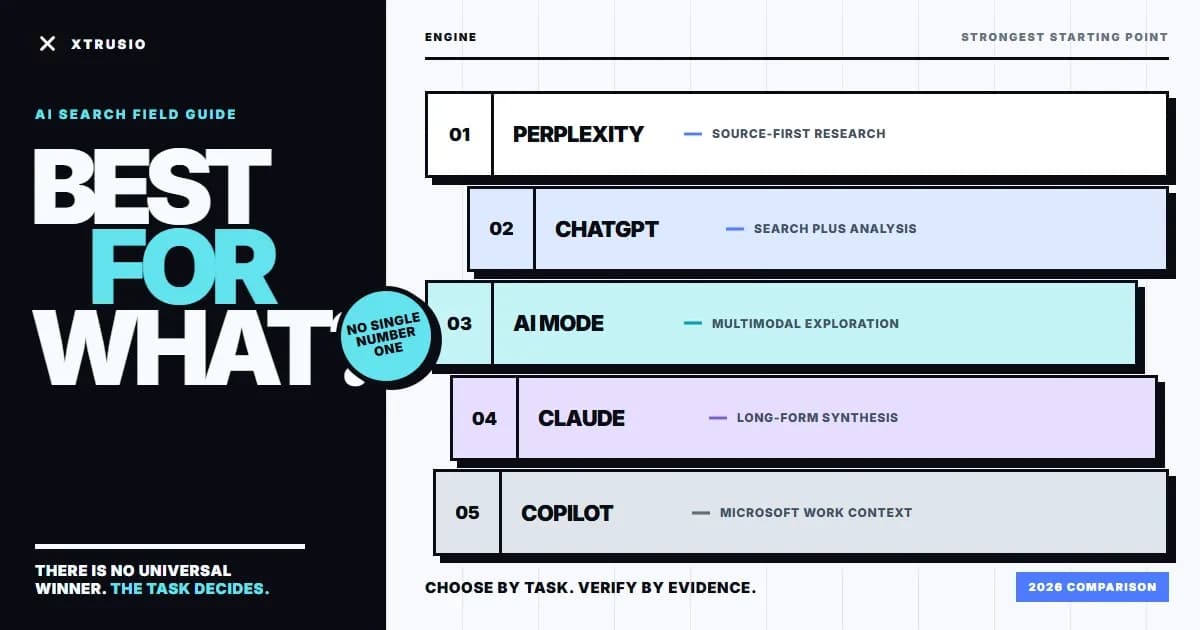
Company | Best for | Covers | Starting price | Ask before buying |
|---|---|---|---|---|
Perplexity | Source-first discovery | Web answers, source links and follow-ups; higher research scope by plan | Do the decisive citations support our claim, and which search limits apply? | |
OpenAI | Research continued in conversation | ChatGPT web search beside conversational work | Is search available in our account, and can we check the original source? | |
Mixed-input Search | AI Mode text, voice, images, files and follow-ups; availability varies | Are our market, input type and chosen mode supported? | ||
Anthropic | Cited conversational synthesis | Claude web search and source links; separate research features by plan | Is web search enabled, and will our task fit current usage limits? | |
Microsoft | Bing-grounded exploration | Copilot public-web answers; work-data access is separate | Are we evaluating public web search or a licensed work-data experience? | |
Xtrusio | Managed brand-answer evaluation | Buyer-question evidence, page corrections and later checks; not a personal search engine | Free self-serve plan; managed service with a free trial, then tiered plans (details on request) | Do we need personal search or someone to review and act on brand answers? |
Prices were checked October 1, 2026. Free plans have usage limits, and work-data access requires a separate Microsoft license. Xtrusio is a managed brand-answer service, not a personal search engine.
Which kind of search do you need?
An AI search experience retrieves web information and generates an answer with supporting links. A broader assistant can also answer from model knowledge. Check that it searched before treating a fluent reply as evidence about today's page.
Perplexity puts source links up front. ChatGPT and Claude let you continue the conversation; Google AI Mode accepts text, image, voice and file inputs. Copilot offers web answers grounded in Bing. Choose the workflow that fits the decision you need to make.
Perplexity Pro and Claude Pro each list $200 yearly; monthly terms are in the table. More paid access does not make every citation correct. Free public-web Copilot is separate from licensed Microsoft 365 work-data access.
What would make an answer useful enough to choose?
Before choosing, name the decision the answer must support and the source that could confirm it. Count the important facts you still need to check, rather than choosing the longest answer or the largest source list.
For personal research, open the decisive source. Check its date and surrounding passage. A page about the right topic is weaker than a passage that supports the exact claim you need.
What can you learn from a real source panel?
The dated search below shows what to check in an answer and its source list.
Perplexity: a source list is a starting point
This September 24, 2026 Perplexity search answers “What are the best SEO tools for Perplexity AI?” The exact input, short category-level answer and source pane are visible together. The interface shows a 10 sources control, with agency/vendor comparison titles in the open pane.
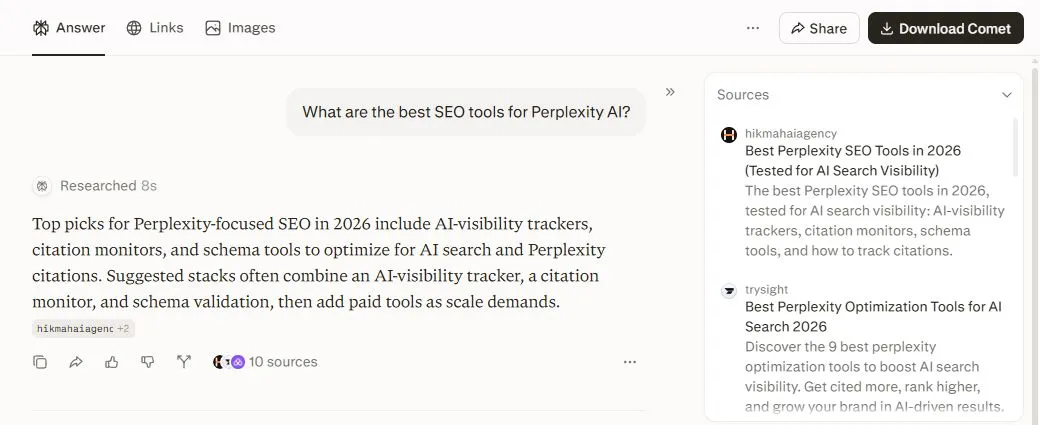
The screenshot shows the answer and source titles together. Open the cited pages before relying on a recommendation; a count of ten sources cannot tell you whether they support the decisive claim.
A source-repair test for your actual decision
Imagine booking dinner for eight people at 7 p.m. on October 2, 2026, with a $300 total budget including mandatory fees. The answer needs sources for capacity, the full charge and availability. These sample answers are made up to show how one missing fact changes the decision.
Sample answer | What its sources support | Repair needed before deciding |
|---|---|---|
“Yes, the menu is $30 per person.” | Menu price only; eight meals cost $240 | Check capacity, required fees and that exact booking time; the total budget is still unconfirmed |
“This venue is popular for groups.” | Several reviews discuss groups | Find current venue policy and booking evidence; more review links do not confirm eight seats on that date |
“The documented total exceeds your budget; availability needs confirmation.” | $240 meals plus $40 room fee plus $28 mandatory service charge totals $308 | Reject on budget; booking availability remains unconfirmed |
The third answer is the most useful even though it recommends no venue: the documented $308 cost rules it out on budget. Availability still needs a separate check. More source links would not change the budget decision.
For your own task, write down what the answer must confirm before asking. A product question may need a current feature and plan entitlement; a travel question may need the right date and total charge. Then check the exact passage that supports the decision.
How should you compare engines fairly?
Submit the same exact wording and required output, using comparable market, account state and time window. Record the mode, model label if shown, source dates, failed requests and any follow-up needed. Compare the work required to reach a supported decision. A source click is not the same kind of repair as replacing a false decisive fact.
If you plan ten questions across five engines, you have 50 answer checks. Say 45 complete and 36 have source support. Completion is 45/50, or 90%; source support is 36/45, or 80% of completed answers. The 36/50 figure is 72% of everything you planned. Use the denominator that matches the question you are answering.
Keep missed runs separate from answers with weak support. Repeat an important question when account, market or timing could change the result, and note any change in wording before comparing later answers.
What changes when the question is about your brand?
If you are checking how engines describe your company, ask each one the same buyer question. Save the full answer and cited pages. Mark whether you are named, whether the description is accurate and which source supplied the key fact. Then fix the specific missing or wrong fact.
Xtrusio can keep those buyer questions, answers, cited pages and changed URLs together, then recheck the same question after a correction is live. That connects a brand-answer problem to the page your team can improve.
If you need that brand-level review, request a free Xtrusio evaluation. Bring one buyer question and the public claim you need to check. Xtrusio pricing: Free self-serve plan; managed service with a free trial, then tiered plans (details on request).
For personal search, choose the interface that fits the job and leaves the fewest unsupported decisive facts. Features, prices, availability and generated answers can change. A subscription, a source count and a polished paragraph are useful context, but none substitutes for opening the source that supports your decision.
Frequently asked questions
Which AI search engine is best for cited research?
Perplexity is a strong first candidate because its official product design emphasizes citations, source links, model choice and dedicated research modes. Compare it with ChatGPT and Claude using the same questions before choosing.
Is ChatGPT Search better than Google AI Mode?
They fit different workflows. ChatGPT Search keeps web research inside a broader conversation, while Google AI Mode integrates multimodal questions, follow-ups and web links into Google Search.
Can AI search engines be trusted without checking sources?
No. Official guidance from multiple providers warns that generated answers can be incomplete or wrong. Open the cited source, check its date and verify that it supports the claim.
How should a company compare AI search engines?
Use the same question set, market, account state and time window. Preserve full answers, citations, failures and source quality, then score task completion rather than stylistic preference.
Topics
- best AI search engine
- AI search engine comparison
- ChatGPT vs Perplexity vs Google AI Mode
- best AI search for research
- AI search with citations

Xtrusio
AI visibility research
Xtrusio is the Perception Engine for B2B brands.
Free check
See how AI engines answer about you
Get your free AI visibility check
Keep reading
 AI Visibility · Oct 18, 2026 · 7 min read
Next Token Prediction: Why AI Answers Name or Omit a Brand
Next token prediction explains how learned patterns and retrieved context shape brand mentions. Use an anonymized scan example to choose the next action. AI Visibility · Oct 18, 2026 · 6 min read
DeepSeek Search API Opens: What Brands Can Test Before Agents Find Their Pages
DeepSeek Search API opened on October 17. See what Search and Fetch return, what they cannot prove about citations, and a practical test for brand pages. AI Visibility · Oct 18, 2026 · 9 min read